Can I Claim Lunch as a Business Expense? The Rules
The Short Answer: Usually No
If you are self-employed and hoping to write off your daily lunch as a business expense, the answer is almost always no. HMRC's general position is clear: everyone needs to eat, regardless of whether they run a business. Your normal, everyday meals are a personal expense, not a business one.
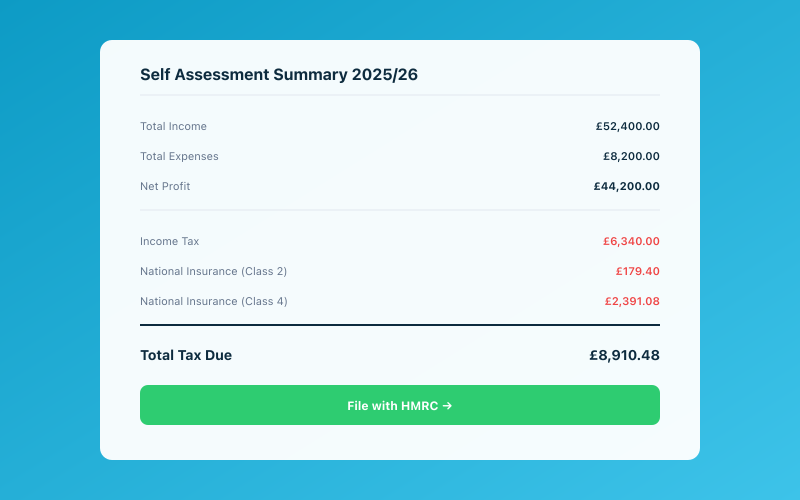 Your Accounted dashboard shows your real-time tax position
This disappoints a lot of people, but the logic is straightforward. You would eat lunch whether or not you were self-employed, so the cost of feeding yourself is not incurred "wholly and exclusively" for business purposes — which is the test every business expense must pass.
The "Wholly and Exclusively" Rule
To claim any expense against your self-employed income, it must be incurred wholly and exclusively for the purposes of your trade. This is the fundamental test set out in tax legislation, and HMRC applies it rigorously to food and drink.
Your regular lunch fails this test because it has a dual purpose — it keeps you alive and functioning as a human being, and it also happens to sustain you while you work. The personal element (needing to eat to survive) means it is not exclusively for business.
This is sometimes called the "duality of purpose" rule. If an expense serves both a personal and a business purpose, it is not allowable — even if the business purpose is significant.
When CAN You Claim Food and Drink?
Despite the general rule, there are specific circumstances where food and drink expenses are allowable. The key concept is subsistence while travelling to a temporary workplace.
Travelling to a Temporary Workplace
If you travel to a temporary place of work (somewhere that is not your normal, permanent workplace) and you buy food or drink that you would not have bought otherwise, you can claim the cost as a business expense.
The conditions are:
- You are travelling away from your normal workplace — This could be your home office, your regular business premises, or wherever you usually work.
- The destination is temporary — A client's office you visit occasionally, a one-off job site, a conference, a meeting at a different location.
- You buy food you would not normally buy — The expense must be additional to your normal lunch. If you would have packed a sandwich from home but instead bought a meal out because you were travelling, that additional cost is claimable.
Example: A Self-Employed Consultant
Priya normally works from her home office. Once a month, she travels to a client's office in another city for a day of meetings. She buys a sandwich and coffee at the train station on the way.
This is claimable. She is travelling to a temporary workplace and buying food she would not normally purchase. The cost is genuinely additional to her normal eating pattern.
Example: A Self-Employed Plumber
Dave is a self-employed plumber who travels to different customers' homes every day. He has no fixed workplace — he goes wherever the work is. He buys a meal deal from a supermarket every lunchtime.
This is more nuanced. If Dave has a "base" (his home, for example) and travels to different temporary locations each day, his lunch costs on those days could be claimable. However, HMRC might argue that buying lunch every single day is his normal pattern, not an additional expense caused by travelling.
The safest approach for people like Dave is to claim only when travelling further than usual or to locations that are clearly temporary and outside the normal pattern.
Example: A Sole Trader Who Works from a Rented Office
Tom rents a small office and goes there every day. He buys lunch from a cafe near the office every day.
This is not claimable. The office is his permanent workplace, and his daily lunch is a routine personal expense. It does not matter that he is self-employed — the cost fails the wholly and exclusively test.
Overnight Stays and Subsistence
The rules become more generous when you are travelling overnight for business. If you are away from home on business and need to stay overnight, you can claim reasonable costs for:
- Evening meals
- Breakfast (if not included in hotel accommodation)
- Lunch during the trip
- Non-alcoholic drinks
The key word is reasonable. HMRC does not publish specific limits for self-employed people (unlike the benchmark rates for employees), but they expect claims to be proportionate. A standard restaurant meal is fine. A tasting menu at a Michelin-starred restaurant would likely be challenged.
What About Alcohol?
The cost of alcoholic drinks is generally not allowable as a business expense, even during business travel. While there is no explicit rule banning it, HMRC takes the view that alcohol is a personal choice, not a business necessity.
Client Entertainment and Business Meals
Another common question: can you claim the cost of taking a client out for lunch?
No. Client entertainment — meals, drinks, events, hospitality — is specifically disallowed as a business expense for tax purposes. This applies even if the meal has a genuine business purpose, such as discussing a contract or building a client relationship.
You can pay for it from your business account, but you cannot deduct it from your profits when calculating your tax bill. It is one of the most commonly misunderstood areas of self-employed expenses.
The same rule applies to entertaining suppliers, potential clients, or business contacts. If you are buying someone else a meal or drink to build or maintain a business relationship, it is entertainment and it is not deductible.
Subsistence for Employees Who Are Self-Employed
Some people are confused by the different rules for employees and the self-employed. Employees have specific HMRC benchmark subsistence rates (for example, £5 for a one-meal allowance of 5+ hours, £10 for a two-meal allowance of 10+ hours, and £25 for a 24-hour rate with an overnight stay). These are tax-free amounts an employer can pay without needing receipts.
These benchmark rates do not apply to self-employed people. As a sole trader, you claim your actual costs (with receipts) and they must meet the wholly and exclusively test.
Keeping Records
If you do have claimable food expenses — because you are travelling to temporary workplaces — make sure you keep the receipts. You should also note:
- Where you travelled to
- The business purpose of the trip
- That the expense was additional to your normal eating costs
This level of record-keeping protects you if HMRC ever queries your expenses. A receipt alone, without context, may not be enough to demonstrate that the cost was wholly and exclusively for business.
When you use Accounted, Penny — our AI bookkeeper — flags food and drink transactions and asks whether they relate to business travel. This prompts you to record the context at the time, rather than trying to remember months later why you spent £8.50 at a cafe in Birmingham.
Common Mistakes to Avoid
- Claiming every lunch — This is the most common mistake. Your daily lunch is not a business expense.
- Claiming coffee on the way to your normal workplace — Your regular commute and associated costs are personal.
- Confusing client entertainment with travel subsistence — Buying lunch for a client is entertainment (not deductible). Buying lunch for yourself while travelling to a client is subsistence (potentially deductible).
- Not keeping receipts — Even for legitimate claims, you need receipts. Credit card statements alone are usually not sufficient.
- Claiming extravagant meals — Even when travelling, keep it reasonable. HMRC can challenge excessive claims.
The Bottom Line on Lunch Expenses
The rules on food and drink expenses are not complicated — they are just stricter than most people hope. Your regular lunch is not a business expense. Food bought while genuinely travelling to a temporary workplace, or during overnight business trips, usually is.
If you are ever unsure whether a particular meal is claimable, ask yourself: "Would I have bought this food if I were not travelling for business today?" If the answer is yes, it is probably personal. If the answer is no, you likely have a valid claim.
Accounted takes the guesswork out of expense categorisation. Start your free trial today and let Penny help you identify which expenses are claimable and which are not — so you claim everything you are entitled to, without overstepping the line.
Related Reading
Start your free trial and let Penny handle your bookkeeping automatically.
Penny, your AI bookkeeper, tracks your tax position in real time and flags opportunities to reduce your bill. Meet Penny →
Tax & Compliance Specialists
Our tax specialists have decades of combined experience in UK sole trader and small business taxation, MTD compliance, and HMRC submissions. All content is reviewed against current HMRC guidance before publication and updated quarterly to reflect legislative changes.
Ready to try Accounted?
Join UK sole traders who are simplifying their bookkeeping and tax.
Start your 14-day free trial