When Should You Register for VAT? A Sole Trader's Guide
VAT: The Tax That Creeps Up on You
Most sole traders don't think about VAT when they're starting out. But if your business is growing, you'll hit the VAT threshold sooner than you think. And HMRC doesn't accept "I didn't know" as a reason for late registration.
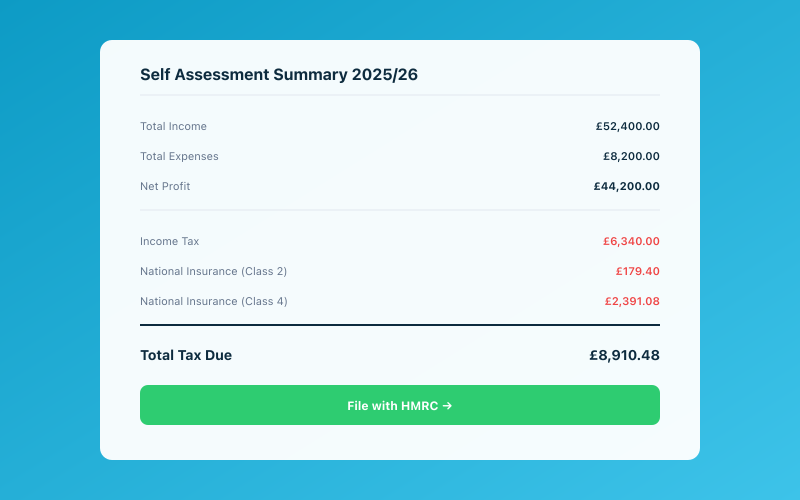 Your Accounted dashboard shows your real-time tax position
Here's when you need to register, when you might want to voluntarily, and how to choose the right VAT scheme.
The Mandatory Registration Threshold
You must register for VAT if your VAT-taxable turnover exceeds £90,000 in any rolling 12-month period. Not your profit — your turnover (total sales before expenses).
HMRC looks at this in two ways:
The Historical Test
At the end of any month, look back over the previous 12 months. If your total VAT-taxable turnover exceeds £90,000, you must register. You have 30 days from the end of that month to notify HMRC, and your registration takes effect from the first day of the second month after you crossed the threshold.
Example: Your turnover for the 12 months to February 2026 hits £91,000. You have until 31 March to notify HMRC, and registration starts from 1 April.
The Future Test
If you expect your turnover to exceed £90,000 in the next 30 days alone, you must register immediately — for instance, if you've landed a single large contract worth more than the threshold.
What Counts as VAT-Taxable Turnover?
Most goods and services are VAT-taxable, but some are exempt (financial services, education, health) or zero-rated (most food, children's clothing, books). Only taxable turnover counts towards the threshold.
Voluntary Registration
Here's something many sole traders don't realise: you can register for VAT even if your turnover is well below £90,000. And sometimes, it actually makes sense.
Pros of Voluntary Registration
- Reclaim VAT on purchases: If you buy goods and services from VAT-registered suppliers (which you almost certainly do), you're already paying VAT. Once registered, you can reclaim that input VAT. If your business has high costs — equipment, materials, software subscriptions — the reclaims can be substantial.
- Professional credibility: Some clients (especially larger businesses) prefer or require working with VAT-registered suppliers. It signals that you're an established, serious business.
- No retrospective headache: If you register voluntarily before hitting the threshold, there's no risk of accidentally going over and having to register retrospectively (with potential penalties).
Cons of Voluntary Registration
- Admin burden: You'll need to file VAT returns (usually quarterly), keep detailed VAT records, and issue VAT invoices. It's more work than not being registered.
- Cash flow impact: If you sell to consumers (B2C), you'll need to add 20% VAT to your prices. Absorbing it reduces your margin; passing it on makes you more expensive. For price-sensitive markets, this matters.
- Complexity: VAT rules are notoriously fiddly. Partial exemption, the capital goods scheme, place of supply rules — it can get complicated fast.
As a general rule: if you sell mainly to VAT-registered businesses (B2B), voluntary registration is usually beneficial. If you sell mainly to consumers (B2C), it's usually not.
VAT Schemes: Choosing the Right One
Once you're registered, you need to decide how to account for VAT. There are several schemes available:
Standard VAT Accounting
The default. You charge VAT on sales, reclaim VAT on purchases, and pay the difference to HMRC (or reclaim it if your input VAT exceeds your output VAT). Returns are filed quarterly.
This is straightforward if your bookkeeping is in order, and it gives you the most accurate picture.
Flat Rate Scheme
Designed for small businesses with turnover under £150,000. Instead of tracking VAT on every purchase, you pay HMRC a fixed percentage of your gross turnover. The percentage varies by industry — it ranges from 4% for food retailing to 14.5% for computer and IT services.
The advantage is simplicity: less bookkeeping, fewer records. The disadvantage is you can't reclaim VAT on most purchases (except capital goods over £2,000). For businesses with low costs, the Flat Rate Scheme can mean you keep more than you charge. For high-cost businesses, Standard Accounting is usually better.
Cash Accounting Scheme
Available for businesses with turnover under £1.35 million. Instead of accounting for VAT when you issue an invoice, you account for it when you actually receive (or make) payment.
This is a genuine lifesaver for businesses with slow-paying clients. Without Cash Accounting, you might have to pay VAT to HMRC on an invoice that your customer hasn't paid yet. With it, you only pay when the money actually comes in. If cash flow management is a concern — and for most sole traders, it is — this scheme is worth serious consideration.
Annual Accounting Scheme
Available for businesses with turnover under £1.35 million. Instead of quarterly returns, you file one annual return and make interim payments throughout the year. You can combine it with the Flat Rate or Cash Accounting schemes.
The Impact on Your Pricing
This is the practical question every sole trader asks: "Does this make me more expensive?"
If you sell to VAT-registered businesses, effectively no — your customers reclaim the VAT you charge. If you sell to consumers, you have three choices:
- Add VAT on top: Your £100 service becomes £120. Transparent, but you're now 20% more expensive.
- Absorb the VAT: Your £100 service stays at £100, but £16.67 of that is now VAT. Your actual revenue drops.
- Split the difference: Raise prices by less than 20% and absorb some of the VAT.
Most B2C businesses end up somewhere between options 2 and 3. It's a commercial decision, not a tax one.
Deregistering if Turnover Drops
If your turnover drops below £88,000 (the deregistration threshold), you can apply to deregister. You're not obligated to — you can stay registered if you want — but if the admin burden outweighs the benefits, it's an option.
You can also deregister if you stop trading or stop making taxable supplies.
How Accounted Handles VAT
VAT alongside income tax is a lot to manage. In Accounted, we've built it so that:
- Penny automatically identifies and codes the VAT element on your expenses
- Your VAT return is prepared from the same transaction data as your income tax records — no double entry
- We support the MTD for VAT digital filing requirements, so you can submit returns directly to HMRC
- Cash Accounting and Flat Rate schemes are fully supported
The aim is to make VAT one more thing that's handled, not one more thing to worry about. For more on what you can deduct from your taxable income, see our complete list of sole trader expenses. And if you're wondering whether you need an accountant for all this, we've written about whether sole traders need an accountant too.
Ready to simplify your bookkeeping? Try Accounted free for 14 days →
Related Reading
Start your free trial and let Penny handle your bookkeeping automatically.
Penny, your AI bookkeeper, tracks your tax position in real time and flags opportunities to reduce your bill. Meet Penny →
Tax & Compliance Specialists
Our tax specialists have decades of combined experience in UK sole trader and small business taxation, MTD compliance, and HMRC submissions. All content is reviewed against current HMRC guidance before publication and updated quarterly to reflect legislative changes.
Ready to try Accounted?
Join UK sole traders who are simplifying their bookkeeping and tax.
Start your 14-day free trial