VAT and MTD: Do You Need to Register for Both?
Two Systems, One Taxpayer
If you're a VAT-registered sole trader, you might already be doing some form of Making Tax Digital — you've been filing VAT returns through compatible software since MTD for VAT became mandatory. But now MTD for Income Tax Self Assessment (ITSA) is arriving too, and that means a second set of digital obligations landing on your desk.
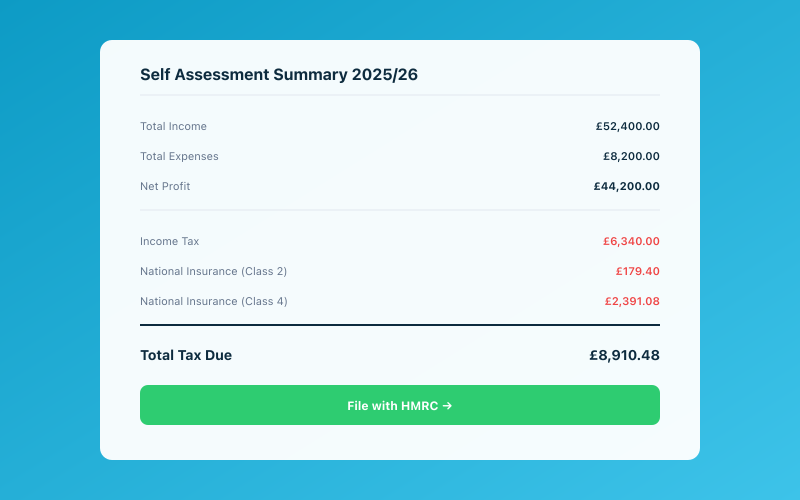 Your Accounted dashboard shows your real-time tax position
The question a lot of people are asking is: do I really need to deal with both? And if so, how do the two systems interact?
Let's untangle it.
MTD for VAT: A Quick Recap
MTD for VAT has been live since April 2019. If you're VAT-registered — mandatory once your taxable turnover exceeds £90,000 — you're already keeping digital records and submitting VAT returns through compatible software.
If you've been doing this for years, you've got a head start. But MTD for Income Tax is a separate system with its own requirements, submissions, and deadlines. Being VAT-compliant doesn't automatically make you compliant with MTD for ITSA.
MTD for Income Tax: What's New
MTD for Income Tax Self Assessment launches in April 2026 for sole traders and landlords with gross income above £50,000, with the threshold dropping to £30,000 from April 2027.
Under MTD for ITSA, you'll need to:
- Keep digital records of all your self-employment income and expenses
- Submit quarterly updates to HMRC summarising your business figures
- File a final declaration replacing your traditional Self Assessment tax return
This is separate from your VAT returns. The quarterly updates for MTD ITSA cover your income and expenses for income tax purposes, while your VAT returns cover your output tax and input tax for VAT purposes.
If You're VAT-Registered AND a Sole Trader
If you're both VAT-registered and above the income threshold, you'll have two sets of MTD obligations:
- VAT: Quarterly returns, digital VAT records, payment each quarter (already live)
- Income Tax: Quarterly income/expense updates, digital records, final declaration by 31 January, plus payments on account
That's potentially eight quarterly submissions a year plus your annual final declaration. Since VAT quarters follow your registration date and ITSA quarters follow the tax year, you could be submitting to HMRC almost every month.
The good news? The underlying record-keeping is the same. If your software handles both systems from a single set of records, you won't need two sets of books. This is why choosing the right software matters so much.
VAT Threshold vs MTD ITSA Threshold
The thresholds for VAT registration and MTD for Income Tax are completely different, and it's important not to confuse them:
| | VAT Registration | MTD for Income Tax | |---|---|---| | Current threshold | £90,000 taxable turnover | £50,000 gross income (from April 2026) | | Calculated on | Rolling 12-month taxable turnover | Previous tax year's gross income | | Dropping to | No change announced | £30,000 from April 2027 |
This means you could be in scope for MTD ITSA without being anywhere near the VAT threshold. A sole trader earning £55,000 would need to comply with MTD for Income Tax but wouldn't need to be VAT-registered.
Conversely, if your turnover is above £90,000, you'll almost certainly be in scope for both, since the MTD ITSA threshold is much lower.
Voluntary VAT Registration
Some sole traders voluntarily register for VAT even when below the £90,000 threshold — for instance, if most of their clients are VAT-registered businesses and can reclaim the VAT anyway. If you've done this, you're already dealing with MTD for VAT, and adding MTD for ITSA is one more layer to manage.
How the Two Systems Interact
Despite both being "Making Tax Digital," the VAT and Income Tax systems are largely separate within HMRC:
- They use different APIs (MTD VAT API and MTD ITSA API)
- They have different submission schedules (your VAT quarters and your income tax quarters may not align)
- They require separate sign-ups — being registered for MTD VAT doesn't register you for MTD ITSA
- They have different penalty regimes (though both now use the new points-based penalty system)
Your software needs to support both APIs if you want to manage everything in one place. Not all MTD software does — some tools that were built for MTD VAT haven't yet added MTD ITSA support, so check before assuming your current setup will cover both.
The Flat Rate Scheme Under MTD
If you're on the VAT Flat Rate Scheme, you pay a fixed percentage of your gross turnover as VAT instead of calculating the difference between output and input VAT. Under MTD for VAT, this still works as before — you submit via compatible software, but the calculation is simpler.
The important thing to understand is that the Flat Rate Scheme only affects your VAT. Your MTD for Income Tax obligations are entirely separate. You still need detailed records of all income and expenses for income tax purposes, quarterly updates, and your final declaration.
Some people assume the Flat Rate Scheme means they don't need to track individual expenses. That's broadly true for VAT purposes, but for income tax you absolutely still need those expense records to calculate your profit and claim allowable deductions.
Managing Both VAT and ITSA Submissions in Accounted
Accounted handles both MTD for VAT and MTD for ITSA from a single set of records:
One set of books. Every transaction — bank feed, WhatsApp receipt, or manual entry — is stored once. Accounted handles VAT treatment and income tax categorisation from the same data.
Separate submissions, same source. When your VAT quarter ends, Accounted produces your VAT return. When your ITSA quarter ends, it prepares your income tax update. Both draw from the same transactions — you never enter anything twice.
One dashboard. All upcoming deadlines — VAT and income tax — in one place.
Smart categorisation. Penny, our AI bookkeeper, categorises transactions for both purposes simultaneously. A purchase categorised as "office supplies" gets the correct VAT treatment and income tax treatment automatically.
If you're a VAT-registered sole trader, managing both MTD obligations doesn't have to mean double the work. With the right software, it's one set of records, one workflow, and one place to see everything that's due. The complexity is in the rules — not in your daily routine.
For a broader overview of the MTD landscape, see our complete guide to Making Tax Digital. And if you're not yet signed up for MTD ITSA, now's the time to get that sorted.
Ready to simplify your bookkeeping? Try Accounted free for 14 days →
Further Reading
- Learn more about Making Tax Digital for Income Tax on GOV.UK.
- HMRC maintains a list of compatible MTD software.
Related Reading
Related reading: MTD for Landlords: Property Income Reporting.
For step-by-step guidance, see our article on How to Set Up Making Tax Digital for Business.
Related reading: What Happens If You Miss the MTD Deadline.
See how Accounted handles MTD and start your free trial.
Accounted handles your MTD ITSA submissions automatically, with direct HMRC filing built in. See how MTD works in Accounted →
Tax & Compliance Specialists
Our tax specialists have decades of combined experience in UK sole trader and small business taxation, MTD compliance, and HMRC submissions. All content is reviewed against current HMRC guidance before publication and updated quarterly to reflect legislative changes.
Ready to try Accounted?
Join UK sole traders who are simplifying their bookkeeping and tax.
Start your 14-day free trial