MTD for Sole Traders Earning Under £50,000: When Is Your Deadline?
The Big Question: Does MTD Apply to Me?
Making Tax Digital for Income Tax is rolling out in phases, and the threshold that determines whether you're included is causing a lot of confusion. If you're a sole trader earning under £50,000, you might think you're off the hook entirely. You're not — you're just not in the first wave.
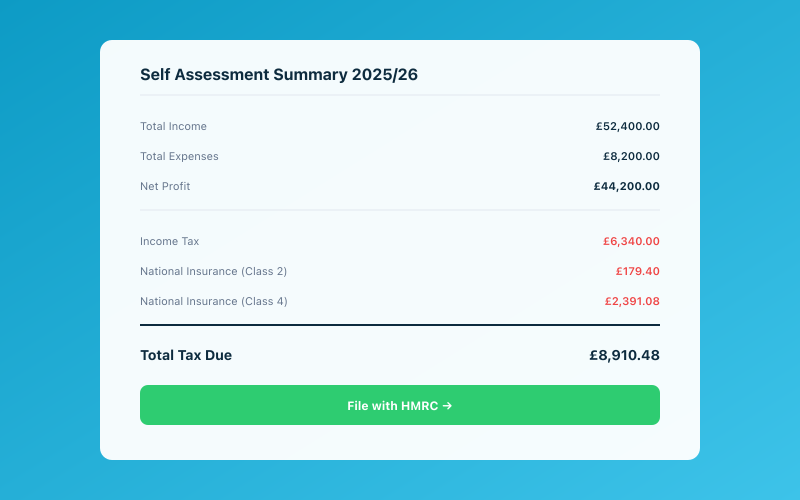 Your Accounted dashboard shows your real-time tax position
Let's break down exactly when each threshold kicks in, how it's calculated, and why you might want to get ahead of the curve even if you're not legally required to yet.
The Current Threshold: £50,000+ from April 2026
The first group of sole traders and landlords to be brought into MTD for Income Tax are those with gross income above £50,000. This phase starts on 6 April 2026, which means the first quarterly submissions for this group will be due from July 2026 onwards.
If your self-employment or property income exceeds £50,000, you need to be using HMRC-compatible software and keeping digital records from April 2026. That deadline is now very close.
The Next Threshold: £30,000+ from April 2027
Here's where it gets relevant for a much larger group. From 6 April 2027, the threshold drops to £30,000. If your gross income from self-employment or property exceeds thirty thousand pounds, you'll be required to comply with MTD from that date.
This brings hundreds of thousands more sole traders into scope. If you're a freelance designer earning £35,000, a plumber turning over £40,000, or a landlord with rental income above £30,000, April 2027 is your deadline.
That might sound like it's ages away, but consider this: by April 2027, you'll need to have chosen your software, set up your digital records, signed up for MTD with HMRC, and ideally had a few months of practice. The clock is already ticking.
What About Below £30,000?
HMRC has indicated that a further threshold — likely £20,000 — will follow, though the exact date hasn't been confirmed. The direction of travel is clear: MTD will eventually cover the vast majority of people who currently file Self Assessment.
If you're earning under £30,000 right now, you're not required to use MTD yet. But "not required" doesn't mean "shouldn't."
How the Threshold Is Calculated
This catches people out constantly, so let's be absolutely clear: the threshold is based on gross income, not profit.
Your gross income is your total turnover — everything that comes in before you deduct any expenses. So if you're a sole trader who invoices £55,000 a year but spends £20,000 on materials, tools, and travel, your taxable profit might be £35,000, but your gross income is £55,000. You'd be in the first phase from April 2026.
The same applies to landlords. If your total rental income across all properties is above the threshold, you're in scope — even if mortgage interest payments, repairs, and other allowable costs bring your profit well below the threshold.
Multiple Income Sources
If you have both self-employment income and property income, HMRC looks at each source separately against the threshold. If either one exceeds £50,000 (or £30,000 from April 2027), you're in scope. They are not combined for the purposes of determining the threshold — it's whichever single source is highest.
What If You're Close to the Threshold?
This is a genuinely tricky spot. If your gross income hovers around the threshold — say, £48,000 to £52,000 — you might be in scope one year and out the next.
HMRC has said that the threshold will be assessed based on the previous tax year's data. So your 2024/25 tax return determines whether you're in scope from April 2026, and your 2025/26 return determines April 2027.
If you're close to the boundary, our honest advice is to prepare as if you're in scope. The cost of being ready but not required is minimal — you'll have better records and a clearer picture of your finances. The cost of being required but not ready is penalties and stress.
Why You Might Want to Start Early
Even if you're not legally required to use MTD yet, there are genuine reasons to consider voluntary sign-up:
Better Financial Visibility
Quarterly reporting means you see where your money is going four times a year instead of once. That's not just a compliance exercise — it's genuinely useful information. You'll spot trends, catch problems early, and have a much clearer picture of your tax position throughout the year.
No More January Panic
Under the traditional Self Assessment system, most sole traders spend January scrambling to find receipts, figure out their expenses, and file before the 31 January deadline. With MTD, the work is spread across the year. Each quarterly update takes a fraction of the time a full annual return does.
If the annual Self Assessment crunch is something you dread, switching to quarterly updates might actually feel like a relief.
Practice Before It's Mandatory
Using MTD-compatible software before you're required to means you can learn the system, work out your processes, and iron out any problems at your own pace. When it becomes mandatory, you'll already be comfortable. That's much less stressful than trying to learn everything in a rush.
Claim Expenses You're Missing
One of the underrated benefits of proper digital bookkeeping is that it helps you catch allowable expenses you might be overlooking. When every transaction is categorised and every receipt is captured, it's much harder for legitimate deductions to slip through the cracks. Many sole traders find that better record-keeping actually reduces their tax bill.
You're Going to Have to Do It Eventually
HMRC's plan is clear: the threshold will keep dropping. If you're a sole trader earning any meaningful amount, MTD is coming for you sooner or later. Getting set up now, while there's no pressure, is simply easier.
Getting Ahead of the Curve with Accounted
Accounted is designed to make MTD compliance painless whether you're in the first wave or preparing early. Here's what that looks like in practice:
Connect your bank account and your transactions flow in automatically — no manual data entry. Send receipt photos via WhatsApp, and Penny, our AI bookkeeper, extracts the details, categorises the expense, and matches it to the right transaction. Your digital records are created and maintained without you having to think about file formats or HMRC requirements.
When it's time to submit a quarterly update, Accounted pulls together your income and expenses, lets you review everything, and submits directly to HMRC via their API. No bridging software, no manual uploads, no stress.
And because Accounted tracks your income in real time, you'll always know where you stand relative to the MTD threshold. If you're approaching it, you'll know — and you'll already be ready.
Whether you're above £50,000 and need to comply by April 2026, approaching the £30,000 threshold for April 2027, or simply want to get your bookkeeping sorted before it's mandatory, the best time to start is now. Not because HMRC says so, but because it genuinely makes your life easier.
Ready to simplify your bookkeeping? Try Accounted free for 14 days →
Related Reading
See how Accounted handles MTD and start your free trial.
Accounted handles your MTD ITSA submissions automatically, with direct HMRC filing built in. See how MTD works in Accounted →
Tax & Compliance Specialists
Our tax specialists have decades of combined experience in UK sole trader and small business taxation, MTD compliance, and HMRC submissions. All content is reviewed against current HMRC guidance before publication and updated quarterly to reflect legislative changes.
Ready to try Accounted?
Join UK sole traders who are simplifying their bookkeeping and tax.
Start your 14-day free trial