Will MTD Affect My Tax Bill? (Spoiler: It Shouldn't, But...)
It's one of the most common questions sole traders and landlords ask about Making Tax Digital: "Will I end up paying more tax?" It's a fair concern. Whenever the government introduces a new system, there's always a suspicion that it's really about squeezing more money out of people.
So let's address it head-on. In theory, MTD should not change the amount of tax you owe. The tax rates, allowances, and thresholds remain exactly the same. MTD is about how you report your income, not how much tax you pay.
But in practice? Things are a bit more nuanced. Let's dig into why.
Why MTD Shouldn't Change Your Tax Bill
The fundamental point is this: Making Tax Digital changes the process of reporting your finances to HMRC. It doesn't change the rules about how your tax is calculated.
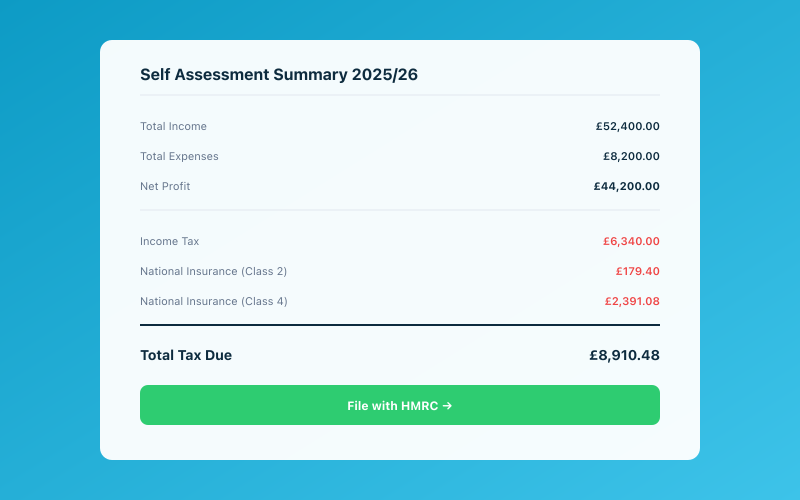 Your Accounted dashboard shows your real-time tax position
Under MTD, you'll still pay:
- Income tax at the same rates: 20% basic rate (on taxable income from £12,571 to £50,270), 40% higher rate, and 45% additional rate for 2025/26 onwards.
- National Insurance at the same rates: Class 2 and Class 4 for self-employed individuals.
- Your personal allowance remains £12,570.
- Allowable expenses are deducted from your income in exactly the same way.
The quarterly updates you submit under MTD are summaries of your income and expenses — they don't trigger additional tax charges. Your actual tax liability is calculated at year-end through the Final Declaration, just as it is now through Self Assessment.
So if you were accurately reporting your income and expenses before MTD, and you continue to do so under MTD, your tax bill should be exactly the same.
The key phrase there is "accurately reporting."
Why Some People Might Pay More
Here's where the "but" comes in. HMRC's own research suggests that the tax gap — the difference between the tax that should be collected and the tax that actually is collected — amounts to billions of pounds each year. A significant chunk of that gap comes from errors and carelessness in Self Assessment returns.
MTD is designed, in part, to close that gap. And if you've been — even unintentionally — underreporting your income or overclaiming expenses, MTD's more structured approach may result in a higher tax bill.
Better Record Keeping Catches Errors
When you keep digital records throughout the year and review them quarterly, you're much less likely to miss income. Under the old system, it was easy to forget about a cash payment received in May when you're filing your return the following January. With quarterly reporting, that payment gets captured in real time.
Similarly, if you've been estimating expenses rather than recording them accurately, digital records will give you the real numbers — which may be lower (or higher) than your estimates.
Income from Digital Platforms Is Increasingly Visible
From 2024, online platforms like eBay, Etsy, Airbnb, and others are required to report UK sellers' earnings directly to HMRC. This means HMRC already knows about income that might previously have gone undeclared. MTD's digital record keeping makes it harder for this kind of income to fall through the cracks.
If you've been earning money through platforms and not declaring it — even inadvertently — switching to MTD and proper digital records will mean this income shows up on your return.
Fewer "Creative" Expense Claims
Let's be diplomatic about this: some Self Assessment returns include expense claims that don't quite stand up to scrutiny. Perhaps personal costs have been claimed as business expenses, or the split between business and personal use of a vehicle is more generous than it should be.
When your records are digital and systematic, it's harder to include expenses that aren't genuinely allowable. This is ultimately a good thing — it keeps you on the right side of HMRC's rules — but it may mean your expense total comes out lower than before, leading to a higher taxable profit.
Why Some People Might Pay Less
It's not all one-directional. MTD can actually reduce your tax bill in some cases.
Claiming Expenses You'd Otherwise Forget
The flip side of better record keeping is that you might actually claim expenses you'd previously overlooked. Many sole traders underclimate their allowable expenses because they don't have the records to back them up.
When you're tracking expenses digitally throughout the year — scanning receipts, categorising bank transactions — you're more likely to capture everything you're entitled to claim. That £15 parking fee, the ink cartridges for your printer, the reference books you bought for work — small expenses add up, and digital records make sure none of them go missing.
More Accurate Mileage Claims
If you use the simplified mileage rate (45p per mile for the first 10,000 miles, 25p thereafter), keeping a digital log of your business journeys is much easier than trying to reconstruct a year's worth of travel in January. Better mileage records often mean higher — and more defensible — mileage claims.
Capital Allowances and Other Reliefs
With quarterly reviews of your finances, you (or your software) are more likely to spot opportunities for tax-efficient decisions. For instance, if you realise in October that you need a new laptop, purchasing it before the end of the tax year lets you claim capital allowances sooner. The annual investment allowance lets you claim the full cost of qualifying equipment against your profits.
This kind of proactive tax planning is easier when you have a real-time view of your finances rather than a once-a-year reckoning.
The Real Cost of MTD: Software and Time
While MTD shouldn't change your tax liability directly, it does introduce costs that affect your bottom line.
Software Costs
You'll need MTD-compatible software, and most options come with a monthly subscription. Prices range from around £10 to £30 per month for sole trader packages. The good news is that this subscription is an allowable business expense, so you can deduct it from your profits.
For help choosing the right tool, see our guide on what to look for in MTD software.
Time Investment
There's no getting around the fact that quarterly reporting takes time — at least initially. You'll need to set up your software, connect your bank account, and get into the habit of regular bookkeeping.
However, most people find that after the first quarter or two, the ongoing time commitment is modest — perhaps 15 to 30 minutes per week. And if you choose software with good automation (like Accounted's Penny, which categorises transactions using AI), even that can be reduced.
The time you invest during the year also pays off at year-end. If your records are up to date, preparing your Final Declaration should be far quicker and easier than the old approach of scrambling to compile a year's worth of information in one go.
Accountant Fees
If you use an accountant, their fees may change. Some accountants are adjusting their pricing to reflect the new quarterly reporting requirements. Others see MTD as an opportunity to provide more value — reviewing your figures each quarter rather than just at year-end.
Talk to your accountant about how MTD affects their fees and services. In many cases, more frequent touchpoints lead to better tax planning advice, which can save you money overall.
What About Payments on Account?
One concern that comes up frequently is whether MTD will change the timing of tax payments. Currently, if your Self Assessment bill is over £1,000, you make payments on account — advance payments towards next year's tax, due on 31 January and 31 July.
MTD doesn't change this system. Your tax payment dates remain the same. Quarterly updates are about reporting income and expenses, not making tax payments. You don't pay tax with each quarterly submission.
That said, having a clearer picture of your finances throughout the year should help you plan for tax payments more effectively. No more January surprises — you'll know roughly what your bill will be well before it's due.
For more on how payment timing works, see our guide on payments on account explained.
The Soft Landing Period
HMRC has acknowledged that the transition to MTD won't be seamless for everyone. For the first year of mandatory MTD for Income Tax (2026/27 for those with income over £50,000), there's a soft landing period during which HMRC will take a more lenient approach to penalties.
Specifically:
- The points-based penalty system for late submissions will apply, but HMRC has indicated it will focus on helping businesses comply rather than punishing early missteps.
- Penalties for inaccurate quarterly updates won't apply to cumulative updates — you can correct errors in subsequent quarters or at year-end.
- HMRC will provide additional support and guidance during the first year.
This doesn't mean you can ignore the deadlines, but it does mean that genuine efforts to comply won't be met with heavy-handed enforcement from day one.
So, Will Your Tax Bill Change?
For the vast majority of sole traders and landlords who are already reporting their income honestly and claiming legitimate expenses, MTD will not change your tax bill. The same income taxed at the same rates with the same allowances produces the same result, regardless of whether it's reported annually or quarterly.
Where MTD might change things is at the margins:
- If you were underreporting income (even accidentally), your bill may go up.
- If you were underclimate expenses (because you lacked records), your bill may go down.
- If you were estimating rather than recording accurately, the real figures could go either way.
The net effect for the country is expected to be positive for the Exchequer — HMRC anticipates collecting more tax overall because MTD reduces errors. But at the individual level, the change could go in either direction.
The best approach? Embrace the process, keep accurate records, and use the quarterly rhythm to your advantage. Better information means better decisions — and that's good for your finances whether it changes your tax bill or not.
Related reading:
- MTD Software — What to Look For and What to Avoid
- Making Tax Digital — The Complete Guide
- How to Pay Your Self Assessment Bill
Accounted helps UK sole traders stay on top of their bookkeeping and tax. Start your free 30-day trial at getaccounted.co.uk
Related Reading
See how Accounted handles MTD and start your free trial.
Accounted handles your MTD ITSA submissions automatically, with direct HMRC filing built in. See how MTD works in Accounted →
Tax & Compliance Specialists
Our tax specialists have decades of combined experience in UK sole trader and small business taxation, MTD compliance, and HMRC submissions. All content is reviewed against current HMRC guidance before publication and updated quarterly to reflect legislative changes.
Ready to try Accounted?
Join UK sole traders who are simplifying their bookkeeping and tax.
Start your 14-day free trial