MTD Penalties in Detail: Points, Amounts, and How to Appeal
Making Tax Digital (MTD) introduced a new points-based penalty system for late submissions and a reformed late payment penalty regime. These changes moved away from the old system of immediate fixed penalties and introduced a more gradual approach designed to be fairer to taxpayers who occasionally miss a deadline while being tougher on those who persistently fail to comply. This guide explains how the new system works in detail, including when penalty points convert to financial penalties, how late payment penalties are calculated, what constitutes a reasonable excuse, and how to appeal.
The Points-Based System for Late Submissions
Under the new system, each time you submit a VAT return or MTD quarterly update late, you receive one penalty point. Points accumulate over time, and once you reach a specific threshold, a financial penalty is triggered.
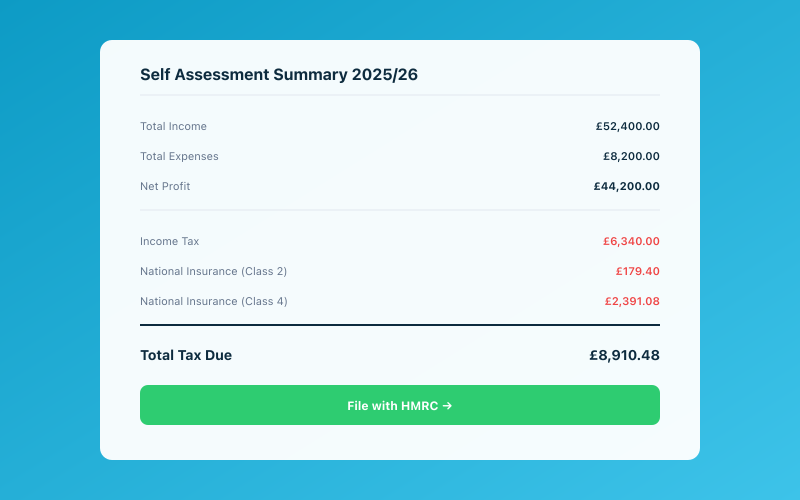 Your Accounted dashboard shows your real-time tax position
How Points Accumulate
Every late submission adds one point to your total, regardless of how late the submission is. Whether you submit one day late or three months late, the result is the same: one penalty point. Points are recorded against the specific obligation (VAT, Income Tax Self Assessment, and so on) and do not transfer between different taxes.
The Penalty Threshold
The threshold at which points convert into a financial penalty depends on your submission frequency.
For annual submissions (such as Self Assessment tax returns), the threshold is two points. For quarterly submissions (such as VAT returns and MTD quarterly updates), the threshold is four points. For monthly submissions (such as monthly VAT returns), the threshold is five points.
Once you reach the threshold, a £200 fixed penalty is charged. After that, every further late submission also triggers a £200 penalty, until you bring your compliance up to date and the points are reset.
Worked Example: Quarterly VAT Returns
Suppose you submit quarterly VAT returns. If you submit your Q1 return late, you receive one point but no financial penalty. Q2 late: two points, no penalty. Q3 late: three points, no penalty. Q4 late: four points, and now you have hit the threshold. A £200 penalty is charged. If Q1 of the following year is also late, another £200 penalty is charged, because you are above the threshold.
Resetting Your Points
To get your points reset to zero, you must meet two conditions. First, you must have submitted all outstanding returns or updates for the previous 24 months (for quarterly and monthly obligations) or the previous 24 months (for annual obligations). Second, you must submit on time for a period of compliance. The period of compliance depends on your submission frequency: 24 months for annual submissions, 12 months for quarterly submissions, and 6 months for monthly submissions.
Once both conditions are met, your points total resets to zero and you start fresh. Points also expire automatically after 24 months if you have not reached the penalty threshold, provided you have filed all outstanding returns within that period.
The £200 Fixed Penalty
The fixed penalty of £200 per late submission (once the points threshold is reached) applies regardless of the amount of tax involved. Whether your VAT return shows £50 of VAT due or £50,000, the penalty is the same £200.
This is a significant change from the previous system, where the default surcharge for late VAT returns was a percentage of the VAT due, which could amount to thousands of pounds for large returns. The fixed-amount approach is designed to be proportionate and predictable.
Late Payment Penalties
Separate from the points system for late submissions, there is a two-stage penalty for late payment of tax.
Stage One: First 15 Days
If you pay your tax up to 15 days after the due date, no late payment penalty is charged. This provides a short grace period for taxpayers who pay slightly late.
Stage Two: 16 to 30 Days Late
If the tax is still unpaid after 15 days, a first late payment penalty is calculated at 2% of the tax outstanding at day 15.
Stage Three: Over 30 Days Late
If the tax remains unpaid after 30 days, an additional penalty is charged at 2% of the tax outstanding at day 15, plus a further 2% of the tax outstanding at day 30. This gives a total first penalty of up to 4% of the tax due.
Ongoing Daily Penalty
From day 31 onwards, a second late payment penalty accrues at a daily rate calculated as 4% per annum on the outstanding balance. This continues to accrue until the tax is paid in full.
Worked Example: Late VAT Payment
Suppose you owe £10,000 in VAT and the payment is due on 7 March. You do not pay until 20 April, which is 44 days late.
After 15 days (22 March), the first penalty calculation begins. At day 15, the full £10,000 is still outstanding, so the first element of the penalty is 2% of £10,000, which is £200.
After 30 days (6 April), the second element kicks in. The outstanding amount at day 30 is still £10,000 (assuming no partial payment), so an additional 2% is charged: another £200. The total first late payment penalty is £400.
From day 31 onwards, the second late payment penalty accrues at 4% per annum on the outstanding amount. For the 14 days from day 31 to day 44, this would be approximately £15.34 (£10,000 x 4% / 365 x 14).
The total penalties would be approximately £415.34, plus any interest charged by HMRC on the late payment.
Interest on Late Payments
In addition to penalties, HMRC charges interest on tax paid late. The interest rate is the Bank of England base rate plus 2.5%. This is a separate charge from the late payment penalties and accrues from the due date of the payment until the date the tax is actually paid.
HMRC also pays repayment interest on tax that it owes to you (for example, a VAT repayment), at the Bank of England base rate minus 1%, with a minimum of 0.5%.
Reasonable Excuse
If you have a reasonable excuse for a late submission or late payment, you can ask HMRC to remove the penalty. A reasonable excuse is something unexpected or outside your control that prevented you from meeting the deadline.
Examples of Reasonable Excuses
HMRC gives the following as examples of what may constitute a reasonable excuse: the death of a partner or close relative shortly before the deadline, an unexpected stay in hospital that prevented you from dealing with your tax affairs, a fire, flood, or theft that prevented you from completing your return, serious illness or mental health condition, and HMRC service issues such as an online filing system outage.
What Is NOT a Reasonable Excuse
The following are generally not accepted as reasonable excuses: reliance on a third party (such as an accountant) who let you down, lack of funds to pay (though this may be a reasonable excuse for late payment if there is a genuine and unexpected cash shortage), ignorance of the rules or deadlines, and pressure of work or being too busy.
If you relied on an accountant who failed to file on time, you may have a claim against the accountant, but HMRC will still hold you responsible for the late filing.
How to Claim Reasonable Excuse
You can claim a reasonable excuse when appealing a penalty (see below). You should provide a clear explanation of the circumstances and any supporting evidence, such as medical certificates, insurance claims, or correspondence with service providers.
How to Appeal
If you receive a penalty and believe it is incorrect or that you have a reasonable excuse, you can appeal. The process has several stages.
Stage One: Appeal to HMRC
You can appeal directly to HMRC within 30 days of the penalty notice. You can do this online through your HMRC account or by writing to HMRC. In your appeal, explain why you believe the penalty should be removed and provide any supporting evidence.
HMRC will review your case and either agree with your appeal (and cancel the penalty), offer a review, or reject the appeal.
Stage Two: HMRC Review
If HMRC rejects your appeal, you can ask for an independent review by a different HMRC officer. This must be requested within 30 days of HMRC's decision. The reviewing officer will look at your case afresh and may uphold, vary, or cancel the penalty.
Stage Three: Tribunal Appeal
If you are still not satisfied after the HMRC review (or if you choose to skip the review stage), you can appeal to the First-tier Tribunal (Tax Chamber). The tribunal appeal must be made within 30 days of HMRC's review decision, or within 30 days of HMRC's original decision if you did not request a review.
Tribunal hearings are relatively informal, and many taxpayers represent themselves. However, for complex cases or large penalties, professional representation is advisable. There is no fee for making a tribunal appeal.
Practical Tips for Avoiding Penalties
Set up calendar reminders for all submission and payment deadlines well in advance. For quarterly obligations, consider setting reminders two weeks before the deadline to give yourself time to gather information and prepare the submission.
If you know you will struggle to pay on time, consider setting up a Time to Pay arrangement with HMRC before the deadline. HMRC is generally more receptive to these arrangements if you approach them proactively rather than after the deadline has passed. A Time to Pay arrangement does not remove the obligation to pay, but it may help you avoid the escalating late payment penalties.
Use MTD-compatible software that submits directly to HMRC, reducing the risk of manual errors or delays. Many software packages can be set up to send automatic reminders and even submit returns automatically once you have approved them.
Let Accounted and Penny Help
Staying on top of MTD deadlines is essential to avoiding the accumulating penalty points that can quickly turn into financial penalties. Accounted is fully MTD-compatible and helps you prepare and submit your returns on time, every time. Penny, your AI bookkeeper, tracks your obligations, sends you reminders before deadlines, and ensures your records are complete and ready for submission. Start your free trial today and never worry about penalty points again.
Related Reading
-
MTD Penalties Explained: What Happens If You're Not Ready by April 2026
-
MTD for Income Tax — The Complete Timeline of What's Changing
See how Accounted handles MTD and start your free trial.
Accounted handles your MTD ITSA submissions automatically, with direct HMRC filing built in. See how MTD works in Accounted →
Tax & Compliance Specialists
Our tax specialists have decades of combined experience in UK sole trader and small business taxation, MTD compliance, and HMRC submissions. All content is reviewed against current HMRC guidance before publication and updated quarterly to reflect legislative changes.
Ready to try Accounted?
Join UK sole traders who are simplifying their bookkeeping and tax.
Start your 14-day free trial