MTD Penalties: What Changed in 2026 and How to Avoid Them
A New Penalty System for a New Era
The old system of penalties for late tax returns and late payments has been replaced. HMRC's new points-based penalty regime is now in effect, and it works very differently from what came before. If you're self-employed, a landlord, or run a small business, understanding the new system is essential — because getting caught out is easier than you might think.
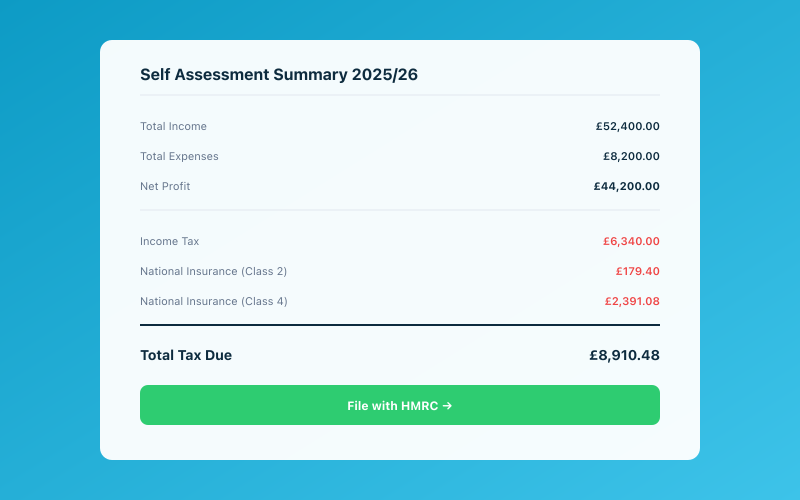 Your Accounted dashboard shows your real-time tax position
The new regime was introduced alongside Making Tax Digital and applies to VAT (already in place) and Income Tax Self Assessment (rolling out from April 2026). It's designed to be fairer to those who make occasional mistakes while coming down harder on those who are persistently late.
How the Points-Based System Works
The Basic Principle
Instead of receiving an immediate financial penalty for a single late submission, you now accumulate penalty points. Each late submission adds one point. Once you hit a certain threshold, you receive a financial penalty. After that, every subsequent late submission triggers another penalty until you bring your compliance up to date.
The Thresholds
The threshold depends on how frequently you're required to submit:
- Annual submissions (e.g., annual tax return) — penalty at 2 points
- Quarterly submissions (e.g., quarterly MTD updates) — penalty at 4 points
- Monthly submissions (e.g., monthly VAT returns) — penalty at 5 points
For most self-employed people and landlords filing quarterly under MTD for Income Tax, the threshold is 4 points. You can be late three times before a financial penalty is triggered. On the fourth late submission, you receive a £200 penalty — and another £200 for every late submission after that until your points are reset.
How Points Are Removed
To reset your points to zero, you need to achieve a period of compliance (12 months for quarterly submissions) and submit all outstanding returns. If you slip up during that period, the clock resets.
Late Payment Penalties
Late payments are handled separately. Up to 15 days late, there's no penalty but interest accrues from the due date. At 16 to 30 days late, a penalty of 2% of the tax owed applies. At 31 days or more, an additional 2% is charged plus a daily penalty at 4% per annum on the outstanding balance.
HMRC also charges interest on late payments at the Bank of England base rate plus 2.5% — around 7% per annum in early 2026. The message is clear: pay on time, or it will cost you.
Comparison With the Old System
Under the old regime, a tax return filed one day late attracted an immediate £100 penalty, with escalating penalties at three, six, and twelve months. The old system was harsh on occasional lateness but somewhat predictable.
The new system is more forgiving for occasional lateness (no financial penalty for a first late submission) but potentially more expensive for persistent lateness. The combination of escalating submission penalties and daily late payment charges means that someone who is regularly late will face significantly higher costs.
How to Appeal
If you receive a penalty and believe it's unfair, you can appeal within 30 days. The grounds include reasonable excuse (illness, bereavement, fire, flood, serious IT failure) and HMRC error. Being too busy or forgetting does not count as a reasonable excuse.
Practical Steps to Avoid Penalties
1. Know Your Deadlines
The shift to quarterly submissions means there are now more deadlines to track. Keep a calendar of all submission and payment deadlines and set reminders two to three weeks in advance.
2. Keep Your Records Up to Date
The most common reason for late submissions is that the records aren't ready. This is where keeping on top of your bookkeeping throughout the year pays off. Tools like Accounted, with AI bookkeeper Penny, keep your books up to date continuously. Transactions are categorised as they come in, receipts are matched automatically, and when a quarterly deadline approaches, the data is already there.
3. Set Up Direct Debits for Payments
Late payment penalties can be avoided entirely by setting up a direct debit with HMRC. For Income Tax, HMRC's Budget Payment Plan lets you spread payments throughout the year.
4. Use MTD-Compatible Software
Make sure your software is set up, connected to HMRC, and tested before the first deadline. Last-minute technical issues are not generally accepted as a reasonable excuse.
5. Talk to Your Accountant Early
If you're going to miss a deadline, tell your accountant as soon as you know. They may be able to help you get the submission done in time. Burying your head in the sand always makes things worse.
What This Means for Accountants
The new penalty system changes the conversation with your clients. The stakes for late filing are now cumulative and escalating, which means your role in keeping clients compliant is more valuable than ever.
If your clients' records are up to date throughout the year, filing quarterly is straightforward. If they're not, every quarter is a potential crisis. Recommending tools that keep the books current and handle MTD submissions directly is now a core part of the advisory relationship.
Accounted is built specifically for MTD compliance, with quarterly submission capability and real-time bookkeeping powered by Penny. If you're looking for a way to keep your clients compliant and penalty-free under the new regime, start a free trial and see how it works in practice.
Related Reading
-
MTD Penalties Explained: What Happens If You're Not Ready by April 2026
-
What is Making Tax Digital for Income Tax? A Simple Explanation
See how Accounted handles MTD and start your free trial.
Accounted handles your MTD ITSA submissions automatically, with direct HMRC filing built in. See how MTD works in Accounted →
Tax & Compliance Specialists
Our tax specialists have decades of combined experience in UK sole trader and small business taxation, MTD compliance, and HMRC submissions. All content is reviewed against current HMRC guidance before publication and updated quarterly to reflect legislative changes.
Ready to try Accounted?
Join UK sole traders who are simplifying their bookkeeping and tax.
Start your 14-day free trial