MTD for Income Tax — The Complete Timeline of What's Changing
Making Tax Digital for Income Tax Self Assessment (MTD for ITSA) has been a long time coming. After years of delays, consultations, and revised timelines, the rollout is now firmly underway. If you're a sole trader or landlord in the UK, these changes will affect how you keep records and report your income to HMRC — and the deadlines are approaching faster than you might think.
This guide lays out the complete timeline: what's already happened, what's happening now, and what's still to come. Consider it your definitive reference for staying on top of MTD.
A Brief History — How We Got Here
To understand where we are, it helps to know where MTD started.
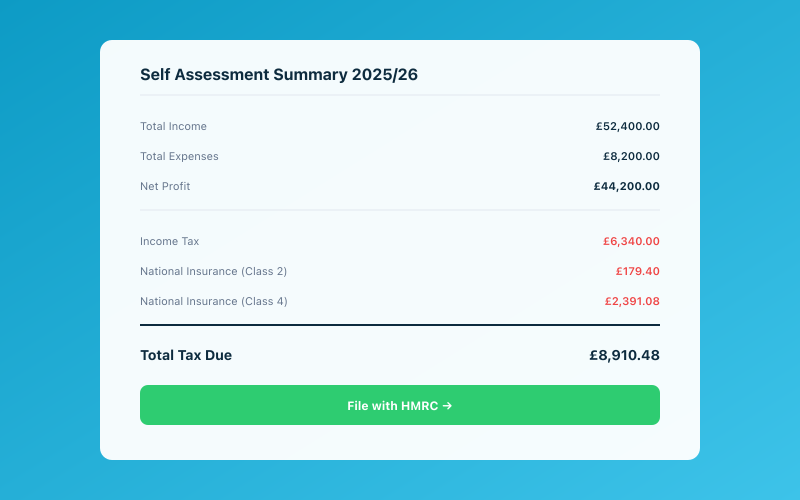 Your Accounted dashboard shows your real-time tax position
2015: The Announcement
The government first announced the Making Tax Digital initiative in 2015, with the ambitious goal of becoming "one of the most digitally advanced tax administrations in the world." The original plan was to require digital record keeping and quarterly reporting for most businesses by 2020.
2017–2019: MTD for VAT
MTD for VAT was the first phase to go live. From April 2019, VAT-registered businesses with taxable turnover above £85,000 were required to keep digital records and submit VAT returns through MTD-compatible software. This was extended to all VAT-registered businesses from April 2022.
2020–2023: Delays for Income Tax
The income tax phase was originally supposed to launch in April 2024, but was pushed back multiple times — first to April 2024, then to April 2026. The delays were partly due to the pandemic, partly due to concerns about business readiness, and partly due to the complexity of the systems involved.
2024: Confirmation of the April 2026 Start
In late 2023 and through 2024, HMRC confirmed the April 2026 launch date for the first phase of MTD for Income Tax. Pilot programmes were expanded, software providers finalised their products, and HMRC began its communications campaign to affected taxpayers.
The Current Timeline
Here's what the MTD for Income Tax rollout looks like right now, with the confirmed dates and thresholds.
April 2026: Phase 1 — Income Over £50,000
Who's affected: Self-employed individuals and landlords with gross income (before expenses) over £50,000 per year.
What it means: From 6 April 2026, these individuals must:
- Keep digital records of all business income and expenses using MTD-compatible software.
- Submit quarterly updates to HMRC (summaries of income and expenses for each quarter).
- Submit an End of Period Statement (EOPS) after the end of the tax year, confirming the figures.
- Submit a Final Declaration — which effectively replaces the traditional Self Assessment tax return.
The quarterly update deadlines for the 2026/27 tax year are:
| Quarter | Period | Submission Deadline | |---------|--------|-------------------| | Q1 | 6 April – 5 July 2026 | 5 August 2026 | | Q2 | 6 July – 5 October 2026 | 5 November 2026 | | Q3 | 6 October – 5 January 2027 | 5 February 2027 | | Q4 | 6 January – 5 April 2027 | 5 May 2027 |
The End of Period Statement and Final Declaration will be due by 31 January 2028 (for the 2026/27 tax year).
If you're in this group, you should already be getting set up. For practical steps, see our guide on getting ready for the MTD April 2026 deadline.
April 2027: Phase 2 — Income Over £30,000
Who's affected: Self-employed individuals and landlords with gross income over £30,000 per year.
What it means: The same requirements as Phase 1 — digital records, quarterly updates, EOPS, and Final Declaration — now apply to a wider group. If your income is between £30,000 and £50,000, this is when MTD becomes mandatory for you.
This expansion roughly doubles the number of people within MTD's scope. If you're close to the £30,000 threshold, it's worth preparing early rather than waiting until the last moment.
Future Phases: Income Under £30,000
HMRC has signalled its intention to bring businesses with income below £30,000 into MTD eventually, but no confirmed date has been set for this. A consultation on the approach for those with income between £20,000 and £30,000 was expected, but as of early 2026, the timeline for lower thresholds remains uncertain.
The government has stated that it wants to provide "adequate notice" before expanding the mandate further. Practically speaking, it's unlikely that those earning under £30,000 will be required to comply before April 2028 at the earliest — and possibly later.
If your income is below £30,000, you're not required to join MTD yet, but you can volunteer to do so. Some sole traders choose to opt in early because the quarterly reporting helps them stay on top of their finances.
What "Gross Income" Means for the Thresholds
An important clarification: the income thresholds (£50,000 and £30,000) refer to your gross income — that's your total turnover before deducting expenses. It's not your profit.
So if your business turns over £55,000 but your expenses are £20,000 (leaving £35,000 profit), you're in the £50,000+ group for Phase 1 purposes.
If you have multiple income sources that fall under MTD (for example, self-employment and rental income), you combine them to determine which threshold applies. So if you earn £35,000 from self-employment and £20,000 from rental income, your combined gross income is £55,000 — putting you in Phase 1.
The Quarterly Reporting Cycle in Detail
One of the biggest practical changes MTD brings is the shift from annual to quarterly reporting. Let's look at what this actually involves.
What Goes in a Quarterly Update?
Each quarterly update is a summary of your business income and expenses for that quarter. You're not submitting a tax return — it's more like a progress report. The update includes:
- Total income received during the quarter.
- Total expenses incurred during the quarter, broken down by category.
You don't need to include every individual transaction. The software summarises your records and submits the totals.
Can You Amend Quarterly Updates?
Yes. If you realise you've made a mistake or missed something, you can amend a quarterly update before submitting your End of Period Statement. This gives you flexibility to correct errors as the year progresses.
The End of Period Statement
After your fourth quarterly update, you'll submit an End of Period Statement. This is your opportunity to make any year-end adjustments — for example, accounting for accruals, prepayments, or capital allowances. Think of it as a review and confirmation of the year's figures.
The Final Declaration
The Final Declaration is the MTD equivalent of the Self Assessment tax return. It brings together all your income (not just business income) and calculates your tax liability for the year. It replaces the SA100 tax return and is due by 31 January following the end of the tax year.
For more detail on what's involved in quarterly submissions, check our guide on quarterly submissions preparation.
Penalties Under MTD
HMRC is introducing a new points-based penalty system for late submissions and late payments under MTD. Here's how it works.
Late Submission Penalties
Each time you miss a quarterly submission deadline, you receive a penalty point. Once you accumulate a certain number of points, you receive a £200 penalty — and another £200 for each subsequent late submission.
For quarterly submissions, the penalty threshold is four points. That means you could miss up to three deadlines before incurring a financial penalty — but the points accumulate, and the threshold is cumulative.
Points expire after a period of compliance (24 months for quarterly submissions), so you can work your way back to zero by submitting on time.
Late Payment Penalties
Late payment penalties are separate. If you don't pay your tax by the due date:
- After 15 days: A penalty of 2% of the outstanding tax.
- After 30 days: An additional 2% of the outstanding tax.
- After 30 days onwards: A daily penalty at 4% per annum on the remaining balance.
Interest also accrues on late payments from the original due date.
For a full breakdown, see our guide on MTD penalties explained.
What You Need to Do Now
Depending on your income level, here's your action plan.
If Your Income Is Over £50,000
You're in Phase 1. MTD is mandatory from April 2026 — which means it may already apply to you by the time you're reading this.
- Sign up for MTD with HMRC if you haven't already. See our sign-up guide.
- Choose compatible software and get it set up with your bank feeds.
- Start recording transactions digitally from the beginning of the tax year.
- Submit your first quarterly update by the Q1 deadline.
If Your Income Is Between £30,000 and £50,000
You have until April 2027, but don't wait. Use the extra year to:
- Choose your software and trial it during the 2025/26 tax year.
- Get comfortable with digital record keeping before it becomes mandatory.
- Consider volunteering for the MTD pilot to get ahead of the curve.
If Your Income Is Under £30,000
You're not currently required to join, but:
- Keep an eye on announcements — the threshold may come down eventually.
- Consider adopting digital record keeping anyway — the habits MTD encourages are genuinely useful.
- Don't ignore MTD entirely — understanding the system now means you won't be scrambling when it does become mandatory.
Looking Ahead
MTD for Income Tax is the biggest change to UK tax administration in a generation. The transition from annual Self Assessment to quarterly digital reporting will take some getting used to, but the underlying principle is sound: keeping on top of your finances in real time is better than scrambling once a year.
Accounted was built from the ground up to make MTD compliance simple and stress-free. If you're looking for software that handles the quarterly submissions, digital record keeping, and bank connections without unnecessary complexity, it's worth taking a look.
Related reading:
Accounted helps UK sole traders stay on top of their bookkeeping and tax. Start your free 30-day trial at getaccounted.co.uk
Related Reading
See how Accounted handles MTD and start your free trial.
Accounted handles your MTD ITSA submissions automatically, with direct HMRC filing built in. See how MTD works in Accounted →
Tax & Compliance Specialists
Our tax specialists have decades of combined experience in UK sole trader and small business taxation, MTD compliance, and HMRC submissions. All content is reviewed against current HMRC guidance before publication and updated quarterly to reflect legislative changes.
Ready to try Accounted?
Join UK sole traders who are simplifying their bookkeeping and tax.
Start your 14-day free trial