AI in Accounting: What's Real and What's Hype in 2026
Cutting Through the Noise
Every accounting software vendor is talking about AI. Every conference has panels about it. Every headline promises that artificial intelligence will transform the profession. Some of this is real. Some of it is marketing.
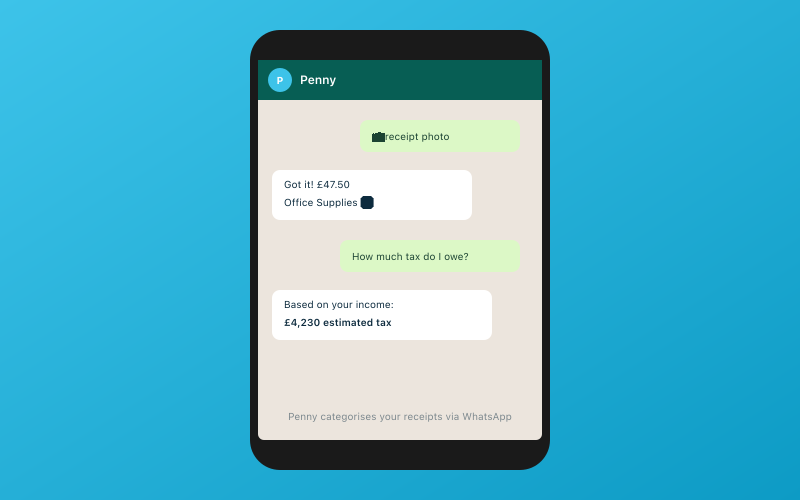 Chat with Penny on WhatsApp — your AI bookkeeper
If you're a small business owner or an accountant trying to figure out what AI can actually do for you right now, this article is for you. No breathless predictions about robots replacing accountants. Just an honest assessment of what works, what doesn't, and what you should care about.
What AI Can Actually Do in 2026
Transaction Categorisation
This is the most mature and impactful application of AI in day-to-day accounting. When a transaction comes through your bank feed, AI examines the description, amount, merchant, and your past patterns to automatically assign it to the right category.
Accuracy is typically 85% to 95% for businesses with established patterns, and the system learns over time. For a sole trader with a hundred transactions a month, this turns hours of manual work into minutes of reviewing exceptions.
Accounted's AI bookkeeper Penny does exactly this — categorising transactions as they arrive, learning from corrections, and improving over time.
Receipt and Invoice Processing
AI-powered OCR can extract data from photographs of receipts and invoices — date, amount, supplier name, VAT amount — and match it to the corresponding bank transaction. Modern OCR handles crumpled receipts and faded print far better than earlier versions. Instead of manually typing receipt data, you photograph it and the data is extracted and matched automatically.
Anomaly and Error Detection
AI is good at spotting things that don't look right — duplicate transactions, unusual amounts, potential miscodings. For business owners, this catches errors before they compound. For accountants reviewing client records, it highlights what needs attention rather than requiring line-by-line review.
Tax Calculation and Estimation
For straightforward situations, AI can calculate or estimate tax liabilities in real time based on the data in the system. This gives business owners visibility of their likely tax position throughout the year rather than waiting until year end.
Bank Reconciliation
Matching bank transactions to invoices and bills is another strong area. Partial payments, batch payments, and slight timing differences are handled intelligently.
What AI Cannot Do (Yet)
Complex Tax Planning
AI can calculate your tax liability. What it cannot do is advise you on restructuring your affairs to reduce it. Complex tax planning involves understanding a client's full financial picture, their future plans, their risk appetite, and the interplay between different taxes and reliefs.
A good accountant considers factors that aren't in the data — a planned property purchase, an intention to sell the business in three years. AI works with what's in the system. Humans work with the whole picture.
Relationship Management
Clients need to trust their accountant. They need someone who understands their business and communicates in a way that makes them feel supported. AI can support the accountant by automating routine work and freeing up time for conversations, but the relationship itself is fundamentally human.
Professional Judgement and Ethics
Is this expense allowable? Is this revenue recognition approach appropriate? Should we report a suspicion of money laundering? These decisions sit in grey areas requiring context, intent, and professional ethics that go beyond pattern recognition. AI can flag issues, but the judgement calls should remain human.
Handling the Unusual
AI handles common patterns well and unusual situations badly. A straightforward sole trader is well within AI's comfort zone. A business owner with rental income in three countries, share options, and a dispute with HMRC is not. AI handles the 80% that's routine. Humans handle the 20% that's interesting.
Where Penny Sits: Firmly in the "Real" Column
We built Penny to do the things AI is genuinely good at and hand off to humans for everything else.
Penny categorises transactions, processes receipts, reconciles bank feeds, flags anomalies, and estimates tax liabilities. She learns from corrections and improves over time. She keeps the books tidy so that when a human needs to make a decision, the data is accurate and ready.
Penny does not pretend to be an accountant. She doesn't offer tax advice, make judgement calls, or tell you how to structure your business. She does the groundwork so that you and your accountant can focus on the decisions that actually matter.
How to Evaluate AI Claims
When an accounting software vendor tells you their product uses AI, ask:
- What specifically does the AI do? Vague claims about "AI-powered insights" mean nothing.
- What's the accuracy rate? Any honest vendor can tell you.
- What happens when the AI gets it wrong? Good systems flag low-confidence decisions for human review.
- Does it learn from corrections? A system that improves over time is more valuable than one that repeats mistakes.
- What data is it trained on? This helps you assess whether it'll work for your situation.
The Honest Summary
AI in accounting in 2026 is genuinely useful for automating routine bookkeeping tasks. It saves time, reduces errors, and frees up humans for more valuable work. It is not a replacement for professional expertise, complex tax planning, or the human relationship at the heart of good accounting.
The winners are the businesses and practices that use AI for what it's good at and invest human time where it matters most.
If you want to see what AI can realistically do for your bookkeeping right now, try Accounted. Penny handles the routine so you can focus on the rest. Start your free trial and judge the results for yourself.
Further Reading
- Accounted is built to comply with Making Tax Digital requirements.
- Good bookkeeping software helps you meet HMRC record-keeping requirements.
Related Reading
- Best Accounting Software for Construction Workers and Builders
- How to Switch from Xero to Accounted (Step-by-Step)
Start your free trial and see how Accounted simplifies your bookkeeping.
Editorial & Research
The Accounted editorial team covers software comparisons, technology, and the tools UK sole traders need to run their businesses efficiently. All software comparisons are based on independent research and publicly available pricing.
Ready to try Accounted?
Join UK sole traders who are simplifying their bookkeeping and tax.
Start your 14-day free trial