National Insurance Changes in 2026 — What's Different
National Insurance is one of those taxes that everybody pays but few people truly understand. It's deducted automatically if you're employed, calculated on your Self Assessment if you're self-employed, and generally treated as an unavoidable fact of life — somewhere between death and the weather.
But the changes to National Insurance over the past couple of years have been far from routine. Rates have been cut for employees and the self-employed, thresholds have been shuffled, and employer contributions have gone up. If you're a sole trader, a company director, or someone who employs staff, you need to know where things stand in 2026.
A Quick Primer — What National Insurance Actually Is
National Insurance Contributions (NICs) fund the State Pension, certain benefits, and the NHS. The amount you pay depends on how you earn your money:
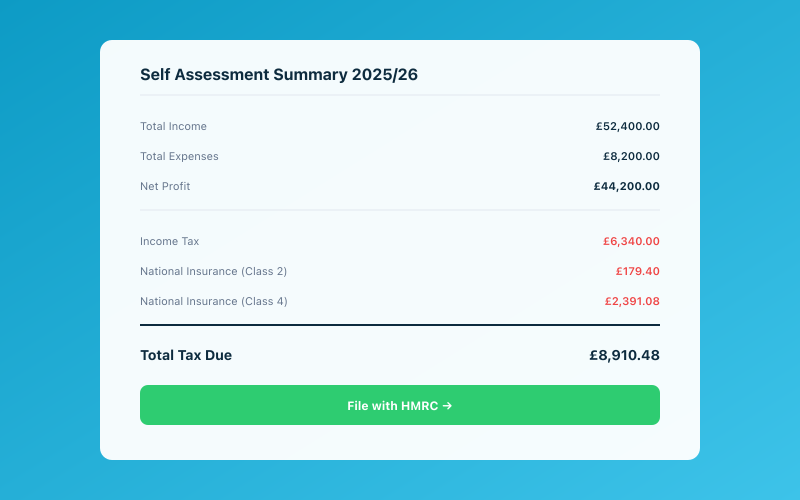 Your Accounted dashboard shows your real-time tax position
- Class 1: Paid by employees (and matched by employers) on earnings above certain thresholds
- Class 2: A flat weekly amount paid by self-employed people, protecting your State Pension entitlement
- Class 4: Paid by self-employed people on profits, calculated as part of your Self Assessment
There used to be a Class 3 (voluntary contributions to fill gaps in your NI record) and a Class 1A/1B (employer contributions on benefits in kind), which still exist but aren't the focus here.
The class you pay — and how much — has shifted meaningfully in recent years. Let's look at where things stand.
Class 4 NICs — Self-Employed Profits
Class 4 is the big one for sole traders. It's charged on your self-employment profits and calculated when you file your Self Assessment tax return.
For the 2026/27 tax year:
| Profit band | Rate | |-------------|------| | Up to £12,570 | 0% | | £12,570 to £50,270 | 6% | | Above £50,270 | 2% |
This 6% main rate is significantly lower than the 9% that applied before January 2024. The reduction happened in two stages — a cut from 9% to 8% in January 2024, followed by a further cut to 6% in April 2024. These were genuine, headline-making reductions that put money back in self-employed pockets.
To illustrate the impact: if your self-employment profit is £35,000, your Class 4 liability at 6% on the band from £12,570 to £35,000 would be approximately £1,346. Under the old 9% rate, the same calculation would have produced approximately £2,019 — a saving of around £673 per year.
If your profits are higher, the saving is proportionally larger. On profits of £50,270 (the top of the main band), the annual saving compared to the old 9% rate is around £1,131.
Class 2 NICs — Self-Employed Flat Rate
Class 2 contributions are a flat weekly payment that gives self-employed people access to certain contributory benefits, most importantly the State Pension.
The position with Class 2 has been somewhat confusing in recent years. There were plans to abolish it entirely, but those were reversed. As of 2026/27:
- If your profits are at or above the Small Profits Threshold (£6,725): You're liable for Class 2, but the contributions are treated as having been paid — meaning you get the NI credit for State Pension purposes without actually having to pay anything. This effective zero-rating has been in place since April 2024.
- If your profits are below the Small Profits Threshold: You can choose to pay Class 2 voluntarily to protect your State Pension record. The rate is modest — around £3.45 per week (subject to annual uprating).
In practical terms, most self-employed people no longer actually pay Class 2, but they still receive the benefit. It's one of the few recent changes that's unambiguously positive.
For more detail on how NICs work for the self-employed, see our guide on National Insurance for sole traders.
Class 1 NICs — Employees
If you're employed (or a company director paying yourself a salary), Class 1 employee NICs apply:
| Earnings band | Employee rate | |---------------|-------------| | Up to £12,570 (Primary Threshold) | 0% | | £12,570 to £50,270 (Upper Earnings Limit) | 8% | | Above £50,270 | 2% |
The employee rate was cut from 12% to 10% in January 2024, and then to 8% in April 2024 — mirroring the cuts to Class 4 for the self-employed.
For company directors who pay themselves a salary up to or around the Primary Threshold (£12,570), no employee NICs are due. This is one of the reasons the "small salary plus dividends" strategy remains popular — you keep your salary just below the NIC threshold and extract additional profits as dividends.
Employer NICs — The Big Increase
This is where things get less cheerful. From April 2025, employer NICs increased from 13.8% to 15%. At the same time, the Secondary Threshold (the point at which employer NICs kick in) was reduced from £9,100 to £5,000.
These changes remain in effect for 2026/27, and they've had a significant impact on the cost of employing staff:
| Element | Before April 2025 | From April 2025 | |---------|-------------------|-----------------| | Employer NIC rate | 13.8% | 15% | | Secondary Threshold | £9,100 | £5,000 | | Employment Allowance | £5,000 | £10,500 |
The increased Employment Allowance (from £5,000 to £10,500) was introduced to cushion the blow for smaller employers. If your annual employer NIC liability is less than £10,500, the Employment Allowance covers it entirely — meaning many small businesses with just one or two employees won't actually pay any more.
However, businesses with larger payrolls or those employing higher-paid staff will feel the increase. An employee earning £30,000 now costs the employer approximately £3,750 in NICs (15% on earnings above £5,000), compared to roughly £2,884 previously (13.8% on earnings above £9,100). That's an increase of around £866 per employee per year.
For sole traders considering hiring their first employee, these numbers are important to factor into the decision. The Employment Allowance helps, but you need to account for the full cost — salary plus employer NICs plus pension auto-enrolment contributions plus any other employment costs.
Directors and the Annual Earnings Period
Company directors are treated differently from regular employees when it comes to NICs. Instead of calculating NICs on each monthly payslip, directors' NICs are calculated on an annual basis — the "annual earnings period" method.
This means your total salary for the year is compared against the annual thresholds, and NICs are calculated on the total. In practice, this usually produces the same result as the monthly method, but it can differ if your salary payments are irregular.
If you pay yourself a regular monthly salary at or around the optimal NIC threshold, this won't cause any issues. But if your salary varies month to month — or if you take a lump sum at year-end — the annual calculation ensures you pay the correct amount overall.
How National Insurance Affects Your State Pension
One of the most important (and most overlooked) aspects of National Insurance is its link to your State Pension.
To qualify for the full new State Pension, you need 35 qualifying years of NI contributions. You need at least 10 qualifying years to get any State Pension at all.
For self-employed people, a qualifying year traditionally required paying Class 2 contributions. Since April 2024, if your profits are above the Small Profits Threshold, you're automatically credited with a qualifying year even though you're not actually paying Class 2.
But if your profits are below the threshold, or if you have gaps in your record from earlier years, you may want to make voluntary contributions to fill them. The cost of buying a missing year (through Class 3 voluntary contributions, currently around £17.45 per week) is often vastly outweighed by the additional State Pension you'll receive.
You can check your National Insurance record and State Pension forecast online at gov.uk. It's worth doing this at least once a year to make sure you're on track.
What This Means for Your Tax Planning
The National Insurance landscape in 2026 is a mixed bag. Self-employed people are genuinely better off thanks to the Class 4 cuts. Employees are similarly benefiting from lower Class 1 rates. But employers are paying more, and the frozen thresholds (for both Income Tax and NICs) continue to drag more income into the taxable bands.
Here's how to respond:
If you're a sole trader: Enjoy the lower Class 4 rate, but don't forget that fiscal drag on Income Tax thresholds means your overall tax burden may still be increasing. Use the NIC saving to boost your pension contributions or build your emergency fund.
If you're a company director: Review your salary-and-dividend split in light of the current NIC rates. The optimal salary level may have shifted slightly with the changes to employer NICs and the Employment Allowance. Our guides on dividend vs salary for director pay and salary vs dividends for directors work through the calculations.
If you employ staff: Factor the increased employer NICs into your cost projections. If you're a small employer, check whether the Employment Allowance covers your liability. If you're considering hiring, run the full numbers before committing.
Whatever your situation: Keep your records accurate and up to date. National Insurance calculations are based on your declared income, and errors or omissions can mean you pay too much, too little, or miss out on qualifying years for your State Pension.
Accounted makes this easier by keeping your income and expense records current throughout the year. Penny categorises transactions as they come in, so when it's time to file your Self Assessment or run payroll, the numbers are ready. No scrambling, no guesswork.
Related reading:
- National Insurance for Sole Traders
- Salary vs Dividends for Directors
- New Tax Year April 2026 — What's Changing
Accounted helps UK sole traders stay on top of their bookkeeping and tax. Start your free 30-day trial at getaccounted.co.uk
Related Reading
Start your free trial and let Penny handle your bookkeeping automatically.
Penny, your AI bookkeeper, tracks your tax position in real time and flags opportunities to reduce your bill. Meet Penny →
Tax & Compliance Specialists
Our tax specialists have decades of combined experience in UK sole trader and small business taxation, MTD compliance, and HMRC submissions. All content is reviewed against current HMRC guidance before publication and updated quarterly to reflect legislative changes.
Ready to try Accounted?
Join UK sole traders who are simplifying their bookkeeping and tax.
Start your 14-day free trial