The Tax Benefits of Working from a Garden Office
The Garden Office Dream
Garden offices have gone from a luxury to a genuine business tool. Since 2020, thousands of self-employed people across the UK have invested in purpose-built garden studios, shepherd's huts turned offices, and converted sheds where they run their businesses. And for good reason — a dedicated workspace away from the kitchen table makes you more productive, more professional, and quite possibly happier.
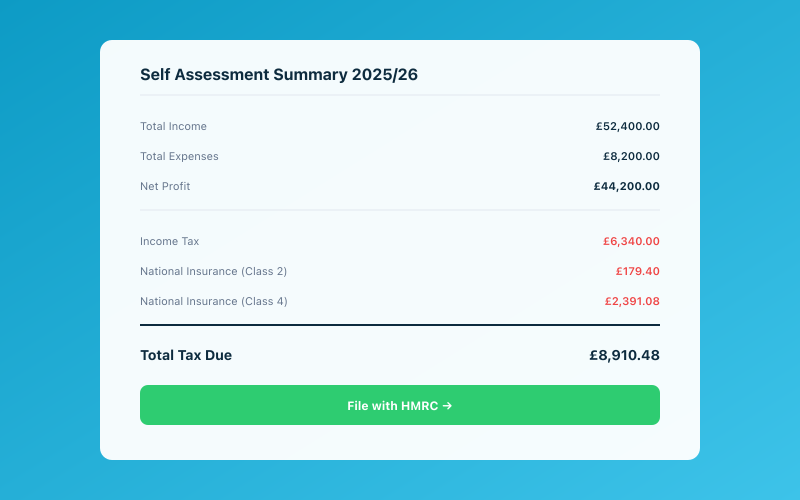 Your Accounted dashboard shows your real-time tax position
But there's a question that comes up constantly: what can you actually claim for tax purposes? The answer is more nuanced than most people expect. Some costs are fully deductible, some partially, some not at all — and there are a few traps that could cost you thousands if you get them wrong.
Let's go through everything.
Building Costs: The Bad News First
Here's the part nobody wants to hear: the cost of building or buying your garden office is almost certainly not an allowable revenue expense. You can't simply deduct the £15,000 you spent on your garden pod from your trading profits.
Why? Because building a garden office is capital expenditure — you're creating an asset, not paying a running cost. Revenue expenses (like office supplies, software subscriptions, and phone bills) are deducted from your trading income. Capital expenditure is treated differently.
However, all is not lost. There are still ways to get tax relief on the building itself.
Capital Allowances on Fixtures and Fittings
While the structure of the garden office itself doesn't qualify for capital allowances (it's considered a building, which falls outside the scope of plant and machinery allowances), the fixtures and fittings inside it do.
You can claim capital allowances on:
- Electrical systems — wiring, sockets, lighting fixtures
- Heating systems — radiators, underfloor heating, air conditioning
- Plumbing — if you've installed a sink or toilet
- Built-in furniture — desks, shelving, storage units that are fixed to the building
- IT equipment — computers, monitors, printers, routers
- Security systems — alarms, cameras, locks
Using the Annual Investment Allowance (AIA), you can deduct 100% of the cost of qualifying plant and machinery in the year you buy it, up to £1 million. For most garden offices, the qualifying items will be well within this limit.
The key is to get a proper breakdown of costs. If your garden office builder gives you one lump sum, ask them to itemise the fixtures and fittings separately from the structure. This makes it much easier to claim the capital allowances you're entitled to.
What About the Structure Itself?
The structure (walls, roof, floor, windows, doors) is classified as a building for tax purposes. For sole traders using Self Assessment, buildings don't qualify for capital allowances. However, if you're running your business through a limited company, there may be some relief available through the Structures and Buildings Allowance (SBA), which gives 3% per year over 33.33 years — though the conditions are strict and the relief is slow.
For most sole traders, the honest answer is: you won't get tax relief on the building cost itself. Focus on maximising the fixtures and fittings claims instead.
Running Costs: The Good News
Once your garden office is up and running, the day-to-day costs are generally deductible. These are revenue expenses and can be claimed against your trading income.
Heating and Electricity
If your garden office has its own electricity supply (a separate meter or sub-meter), you can claim 100% of the electricity used in the garden office as a business expense.
If it's connected to your household supply (which is more common), you'll need to estimate the business proportion. This is typically done by floor area or by metering usage. For example, if your garden office is 15 square metres and your whole property (including the office) is 150 square metres, you could claim 10% of your total electricity bill.
In 2025/26, with energy costs still significant, this can add up to a meaningful deduction.
Broadband and Internet
If you've run a dedicated internet line to your garden office, you can claim 100% of the cost. If you're using your home broadband, claim the business proportion — most people claim 25-50% depending on usage.
Insurance
Contents insurance for your garden office equipment and building insurance for the structure itself are both allowable business expenses if they cover the business use.
Maintenance and Repairs
Painting, fixing a leak, replacing a broken window — these are all deductible revenue expenses. Just make sure you keep the receipts. If you're using Accounted, Penny can help categorise these expenses automatically, so nothing slips through the cracks.
Cleaning
If you pay someone to clean your garden office, that's an allowable expense. If you clean it yourself... well, you can't claim for your own time, unfortunately.
Comparison with Claiming Home Office Costs
If you work from a room in your house rather than a garden office, HMRC offers two main options for claiming expenses:
Simplified Expenses (Flat Rate)
HMRC's simplified expenses method lets you claim a flat rate based on the hours you work from home each month:
| Hours worked per month | Flat rate per month | |----------------------|-------------------| | 25 to 50 | £10 | | 51 to 100 | £18 | | 101 or more | £26 |
This is straightforward but relatively modest — working full-time from home gives you just £312 per year.
Actual Costs (Proportion Method)
Alternatively, you can calculate the actual proportion of household costs attributable to your business use. This typically includes a proportion of:
- Mortgage interest or rent
- Council tax
- Electricity and gas
- Water rates
- Broadband
- Home insurance
The business proportion is usually calculated by dividing the number of rooms used for business by the total number of rooms, then adjusting for hours of use.
For more detail, see our guide on working from home expenses.
Which Is Better?
A garden office typically lets you claim more than either of the home office methods, because you can claim the running costs directly rather than apportioning household bills. Plus, you get capital allowances on the fixtures and fittings — something you don't get with a room in your house.
Business Rates: Do You Need to Pay Them?
This is a question that worries many garden office owners, and the answer depends on several factors.
If your garden office is a separate, self-contained building with its own facilities, your local council could technically assess it for business rates. However, in practice, most small garden offices used by sole traders fall under the Small Business Rate Relief threshold and would pay nothing.
Small Business Rate Relief means that if your garden office has a rateable value below £12,000, you pay no business rates at all. Between £12,000 and £15,000, you get partial relief. Most garden offices are valued well below £12,000.
You should be aware, though, that registering for business rates could affect your council tax bill on the main property (as the garden office would be assessed separately). It's worth speaking to your local council's business rates department to understand the implications.
Planning Permission
This isn't strictly a tax issue, but it's relevant because building without proper permission can cause problems down the line — including when you sell your property.
Most garden offices fall under "permitted development" if they meet certain criteria:
- Not more than 2.5 metres high if within 2 metres of a boundary
- Total outbuilding coverage doesn't exceed 50% of the garden area
- Not used as a self-contained dwelling
- Not in front of the house
If your garden office is larger or doesn't meet these criteria, you'll need planning permission. The cost of applying for planning permission is an allowable business expense if the building is used for business.
The CGT Trap: Main Residence Relief
This is the big one. Your main residence is normally exempt from Capital Gains Tax when you sell it, thanks to Private Residence Relief. But if part of your property is used exclusively for business, that part may lose its CGT exemption.
Here's the distinction:
- A room in your house used as an office but also used personally (even occasionally) generally retains its CGT exemption. As long as the room isn't used exclusively for business with no personal use at all, you're usually fine.
- A separate garden office used exclusively for business is more likely to be treated as a distinct business premises. If it is, the proportion of your property's value represented by the garden office could be subject to CGT when you sell.
In practice, this depends on the specifics. A small garden office in a large garden, used partly for personal hobbies as well as business, is unlikely to create a CGT issue. A large, purpose-built office with its own entrance, used solely for business, is more likely to attract HMRC's attention.
How to Protect Yourself
- Use your garden office for personal activities too (studying, reading, hobbies) — this weakens the "exclusively for business" argument
- Don't claim a proportion of your mortgage interest relating to the garden office (this strengthens the "exclusively for business" argument)
- Keep records showing mixed use
- Take advice if your property is very valuable or your garden office is substantial
Rent-a-Room Relief Interaction
If you're renting out a room under the Rent-a-Room scheme (up to £7,500 tax-free), having a garden office doesn't affect this relief. The two are completely separate. However, you can't use Rent-a-Room relief and the actual expenses method for home office costs simultaneously.
Insurance Considerations
Your standard home insurance probably doesn't cover a garden office. You'll likely need building insurance for the structure, contents insurance for equipment, and public liability insurance if clients visit. The premiums are all allowable business expenses.
Making Your Garden Office Tax-Efficient
To maximise the tax benefits of your garden office:
- Get itemised invoices from your builder, separating structure from fixtures and fittings
- Claim capital allowances on all qualifying fixtures and fittings
- Track running costs carefully — meter electricity if possible, or keep records for apportionment
- Don't over-claim — HMRC expects reasonable, justifiable claims
- Be mindful of CGT — consider mixed use to protect your main residence relief
- Keep receipts for everything — maintenance, repairs, insurance, utilities
Accounted and Penny can help you track and categorise all your garden office expenses, making sure you claim everything you're entitled to without crossing any lines. When Making Tax Digital requires quarterly submissions, having your expenses properly categorised from the start will make your life significantly easier.
Is a Garden Office Worth It?
From a pure tax perspective, a garden office isn't the most tax-efficient investment — the building cost itself isn't deductible for most sole traders. But when you factor in the productivity gains, the professional image, the improved work-life balance, and the ongoing running cost deductions, it's often one of the best investments a home-based business can make.
Just make sure you go in with your eyes open about the tax implications, claim everything you're entitled to, and avoid the CGT trap. Your accountant (or Penny) will thank you.
Related Reading
- Working from Home Expenses — What You Can Claim in 2025/26
- Tax Deductions Every Sole Trader Should Know About
- Making Tax Digital 2026 — What You Need to Know
- Employee Share Schemes — EMI, CSOP, SIP Explained
- Tax When a Spouse Dies — What Self-Employed People Need to Know
Penny, your AI bookkeeper, tracks your tax position in real time and flags opportunities to reduce your bill. Meet Penny →
Tax & Compliance Specialists
Our tax specialists have decades of combined experience in UK sole trader and small business taxation, MTD compliance, and HMRC submissions. All content is reviewed against current HMRC guidance before publication and updated quarterly to reflect legislative changes.
Ready to try Accounted?
Join UK sole traders who are simplifying their bookkeeping and tax.
Start your 14-day free trial