Tax When a Spouse Dies — What Self-Employed People Need to Know
Losing a spouse is one of the most devastating experiences anyone can go through. In the midst of grief, the last thing you want to think about is tax. But unfortunately, there are financial and tax matters that need attention, and dealing with them promptly can prevent complications further down the line.
This article is written with sensitivity, but also with practical clarity. If you're a self-employed person who has recently lost a spouse — or if you want to understand what would happen in that situation — this guide walks through the key tax implications and the steps you need to take.
The Immediate Priorities
In the first days and weeks after a bereavement, tax should not be your priority. Focus on the practical necessities — registering the death, arranging the funeral, and looking after yourself and your family.
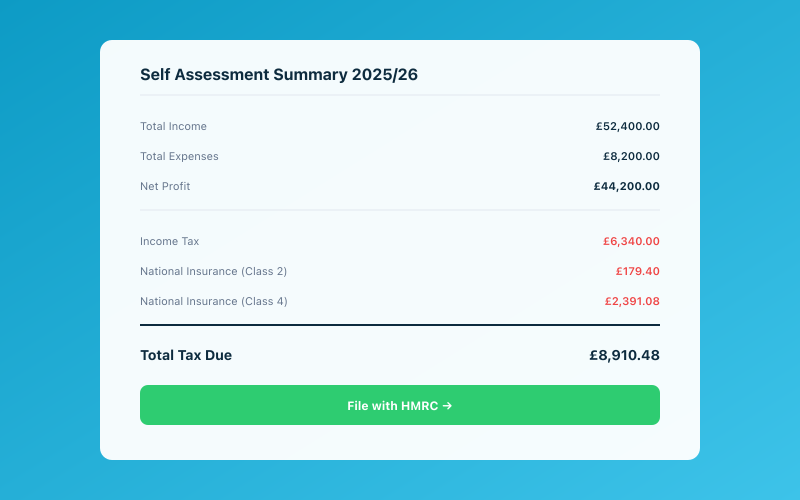 Your Accounted dashboard shows your real-time tax position
However, there are a few things that are time-sensitive and worth being aware of early on:
Notify HMRC. You or someone acting on your behalf should inform HMRC of your spouse's death. If your spouse was employed, their employer will handle some of this, but if they were also self-employed or had their own tax affairs, HMRC needs to know directly. You can call the HMRC Bereavement Helpline, which is specifically set up to deal with these situations with sensitivity.
Notify the Department for Work and Pensions (DWP). If your spouse was receiving any benefits, including State Pension, these need to be reported. The Tell Us Once service, available through the registrar when you register the death, can notify multiple government departments at once — including HMRC, DWP, and the local council.
Secure financial accounts. Your spouse's bank accounts will typically be frozen once the bank is notified of the death. If you had joint accounts, you should still be able to access them, but sole accounts will require probate before funds can be released. If your business relied on your spouse's income in any way, or if they handled any of your business finances, you'll need to make alternative arrangements quickly.
Income Tax in the Year of Death
Your spouse's income tax affairs need to be settled for the period from the start of the tax year to the date of death. This means a final Self Assessment tax return may need to be filed.
If your spouse was employed, their employer will have been operating PAYE, and there may be a tax refund due if they died partway through the year (since their full Personal Allowance would have been allocated across the full year, but they only earned for part of it).
If your spouse was self-employed, their business will need final accounts prepared up to the date of death, and a Self Assessment return filed for that period. Any tax due becomes a debt of the estate.
As the surviving spouse, you don't inherit your partner's tax liabilities personally — they're paid from the estate. But if you were involved in the business (for example, as a partner or by sharing business assets), the practical separation can be more complex.
Your own Self Assessment continues as normal. Being widowed doesn't change how your business income is taxed. However, there are some reliefs and allowances that may apply.
Marriage Allowance After Bereavement
If you were claiming Marriage Allowance (where one spouse transfers part of their Personal Allowance to the other), the transfer continues for the full tax year in which the death occurs. This means you'll still benefit from the additional allowance for the remainder of that tax year.
From the following tax year, the Marriage Allowance will stop, and you'll revert to your standard Personal Allowance. If your spouse was the one receiving the transferred allowance, and they had already received the benefit through their PAYE code for the full year, a small underpayment may arise — but HMRC generally handles this through the estate.
If the situation was the other way round — your spouse transferred their allowance to you — you'll keep the benefit for the year of death but need to adjust your expectations for the following year, as your tax-free amount will reduce.
Inheritance Tax — The Spousal Exemption
One of the most important tax protections for married couples is the Inheritance Tax (IHT) spousal exemption. Any assets passed between spouses — whether during lifetime or on death — are completely exempt from Inheritance Tax. There is no upper limit on this exemption.
This means that if your spouse leaves everything to you, no IHT is due, regardless of the value of the estate. This includes business assets, property, savings, investments, and personal possessions.
Additionally, any unused portion of your spouse's nil-rate band (currently £325,000) can be transferred to you. This means that when you eventually die, your estate could benefit from a doubled nil-rate band of £650,000. Similarly, if the family home is being passed to direct descendants, the residence nil-rate band (currently £175,000) can also be transferred, potentially giving a combined threshold of £1 million.
These transferable allowances don't happen automatically — they need to be claimed by the executors of the second estate when the surviving spouse eventually dies. But it's important to be aware of them now, as they should inform your own estate planning going forward.
What Happens to Your Spouse's Business?
If your deceased spouse was also self-employed or ran their own business, several things need to happen:
The business needs to be wound down or transferred. If the business was a sole trader operation, it legally died with the owner. Any remaining contracts, obligations, and assets become part of the estate. The executor (which may be you) will need to decide whether to complete outstanding work, sell the business, or simply close it down.
Final accounts and tax returns must be filed. The executor is responsible for preparing final accounts and filing the deceased's last Self Assessment return. Any tax due is paid from the estate.
VAT deregistration. If the business was VAT-registered, HMRC needs to be notified, and a final VAT return filed.
Employee obligations. If the business had employees, they'll need to be dealt with — either transferred to a new owner, made redundant, or otherwise handled in accordance with employment law.
If you're dealing with this situation, our guide on closing a sole trader business covers the practical steps involved.
Impact on Your Own Business
Your spouse's death may have direct implications for your own self-employment, even if you ran entirely separate businesses.
If your spouse worked in your business, you'll need to find alternative arrangements. If they were paid a salary, this will stop, which may actually increase your taxable profit (since you'll no longer have the salary deduction). You may need to hire someone else or take on the work yourself.
If your spouse handled your bookkeeping or admin, you'll need to ensure continuity. Using accounting software like Accounted can help here — Penny keeps your records organised and can guide you through tasks that your spouse may have previously handled. It's one less thing to worry about during an incredibly difficult time.
If you shared business assets, the ownership position will change. Assets that were jointly owned will pass to you (if held as joint tenants) or will form part of the estate (if held as tenants in common). The tax treatment of these assets — particularly for Capital Gains Tax purposes — depends on how they were held and what happens to them next.
If your income drops because you're unable to work at full capacity during bereavement, this will affect your tax position for the year. Lower income means lower tax, but it also means potentially lower Payments on Account for the following year. You can apply to reduce your Payments on Account if you expect your income to be significantly lower than HMRC's estimate.
Bereavement Benefits
As a surviving spouse, you may be entitled to certain bereavement benefits.
Bereavement Support Payment is available if your spouse paid National Insurance contributions and you were under State Pension age at the time of their death. It consists of an initial lump sum of either £2,500 or £3,500 (depending on whether you have dependent children) followed by monthly payments of either £100 or £350 for up to 18 months.
Bereavement Support Payment is not taxable and doesn't affect your Self Assessment. It's designed to help with immediate financial pressures and is worth claiming promptly, as you must apply within 21 months of the death.
Widowed Parent's Allowance was replaced by Bereavement Support Payment for deaths after April 2017, but if your spouse died before that date, you might still be receiving it. WPA is taxable and should be included on your Self Assessment return.
State Pension. You cannot inherit your spouse's new State Pension directly, but you may be able to inherit a portion of their additional State Pension (SERPS or State Second Pension) if they had one. The rules are complex and depend on when your spouse reached State Pension age and the type of pension they had.
Practical Steps — A Checklist
Dealing with tax after bereavement is nobody's idea of a priority, but handling things methodically can prevent problems later. Here's a practical checklist:
- Use the Tell Us Once service when registering the death to notify government departments
- Notify HMRC directly if your spouse was self-employed
- Secure financial accounts and arrange access to funds you need
- Notify pension providers — both private pensions and the State Pension
- Apply for Bereavement Support Payment within 21 months
- Arrange for your spouse's final tax return to be prepared and filed
- Review your own tax position — Marriage Allowance, Payments on Account, and any business changes
- Update your will and estate planning to reflect your new circumstances
- Seek professional advice if the estate is complex or involves significant business assets
This is a lot to take in, and you don't need to do it all at once. Take it one step at a time, and don't hesitate to ask for help — from family, from your accountant, or from HMRC's bereavement team, who are trained to handle these situations with care.
Related reading:
- Closing a Sole Trader Business — Tax Implications
- Self-Assessment and Marriage Tax
- How Married Couples Can Save Tax
Accounted helps UK sole traders stay on top of their bookkeeping and tax. Start your free 30-day trial at getaccounted.co.uk.
Related Reading
Start your free trial and let Penny handle your bookkeeping automatically.
Penny, your AI bookkeeper, tracks your tax position in real time and flags opportunities to reduce your bill. Meet Penny →
Tax & Compliance Specialists
Our tax specialists have decades of combined experience in UK sole trader and small business taxation, MTD compliance, and HMRC submissions. All content is reviewed against current HMRC guidance before publication and updated quarterly to reflect legislative changes.
Ready to try Accounted?
Join UK sole traders who are simplifying their bookkeeping and tax.
Start your 14-day free trial