Seasonal Businesses — Tax Planning When Income Is Uneven
Not every business earns the same amount every month. If you're a gardener, your summer is frantic and your winter is quiet. If you sell Christmas decorations, November and December are everything. If you run a seaside ice cream van, the British weather dictates your entire year.
Seasonal and uneven income is completely normal — but it creates real challenges when it comes to managing cash flow, setting aside money for tax, and keeping your finances on an even keel. The tax system doesn't care when you earned the money — it cares about how much you earned in the full tax year. Which means you need a strategy.
Here's how to manage the financial side of a seasonal business properly.
Why Seasonal Income Makes Tax Tricky
HMRC taxes you on your total profits for the tax year (6 April to 5 April). It doesn't matter whether you earned £40,000 evenly across twelve months or £40,000 in a three-month burst followed by nine quiet months — the tax bill is the same.
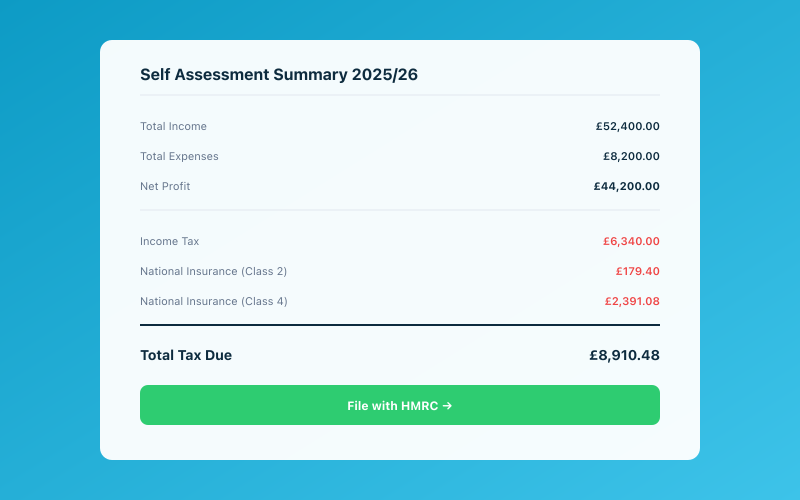 Your Accounted dashboard shows your real-time tax position
For 2025/26, as a sole trader, you'd pay:
Income tax on £40,000 profit:
- £0 on the first £12,570 (Personal Allowance)
- 20% on £27,430 (£12,570 to £40,000) = £5,486
- Class 2: £3.45 × 52 weeks = £179.40
- Class 4: 6% on £27,430 (£12,570 to £40,000) = £1,645.80
Total tax and NI: approximately £7,311
That's straightforward enough to calculate. The problem is having the money available to pay it.
If you earned most of that £40,000 between May and September, you might have spent it on living expenses during the quiet months from October to April. When the Self Assessment bill arrives in January (or July, for payments on account), the money might not be there.
This is the single biggest financial risk for seasonal businesses, and it catches people out every year.
Setting Aside Money for Tax
The most important thing you can do is set aside money for tax as you earn it. This sounds simple, but it requires discipline — especially when the bills keep coming during quiet months and that tax savings pot looks tempting.
How much to set aside: A common rule of thumb is 25-30% of your profits. For a more precise figure, use the tax rates above to estimate your liability based on your expected annual profit.
If your expected annual profit is:
- £20,000: Set aside roughly 15-18% (your effective rate is lower because of the Personal Allowance)
- £30,000: Set aside roughly 20-22%
- £40,000: Set aside roughly 23-25%
- £50,000+: Set aside 28-30% or more (higher rate tax kicks in at £50,270)
Where to keep it: Open a separate savings account specifically for tax. Don't mix it with your business current account or your personal savings. A notice account or easy-access savings account works well — you'll earn a small amount of interest while keeping the money accessible. Just remember that interest on savings is taxable income too, though the Personal Savings Allowance gives you £1,000 tax-free (£500 for higher-rate taxpayers).
When to set it aside: Every time you receive income, transfer the appropriate percentage to your tax savings account. Don't wait until the end of the month or the end of the season — do it immediately, before the money gets absorbed into daily expenses. Accounted can help you track how much you've earned and how much you should be setting aside, so you always know your position.
Payments on Account — The Seasonal Business Trap
Payments on account are advance payments towards your next year's tax bill, based on your previous year's liability. If your Self Assessment bill is more than £1,000 (and more than 80% of your total tax liability isn't collected at source), HMRC will require two payments on account — each equal to half of the previous year's bill.
These are due on 31 January and 31 July.
For a seasonal business, this creates a potential mismatch. Let's say you had a bumper 2024/25 season and your tax bill was £8,000. In addition to paying that £8,000 by 31 January 2026, you'd also pay £4,000 as the first payment on account for 2025/26. That's £12,000 due in January. Then another £4,000 in July.
If your 2025/26 season is quieter, those payments on account might be more than you actually owe. You can apply to reduce your payments on account using form SA303 (or through your online tax account) if you believe your profits will be lower. But be cautious — if you underestimate and end up owing more, HMRC will charge interest on the shortfall.
Plan for payments on account from the start. If you're in your first year of trading, you won't have payments on account — but your second January will hit harder because you'll pay the balance for year one plus the first payment on account for year two.
Cash Flow Management Throughout the Year
Cash flow — the actual movement of money in and out — is different from profit. You can be profitable on paper but still run out of cash if your income and expenses don't align in timing.
Here's a practical approach to managing cash flow across the year:
Create a month-by-month cash flow forecast. Estimate your expected income and expenses for each month of the year. For a seasonal business, this will show clearly where the peaks and troughs are. Include everything — stock purchases, vehicle costs, insurance renewals, pitch fees, tax payments, and personal drawings.
Build a buffer during peak season. Aim to save enough during your busy months to cover your fixed costs during quiet months, plus your tax liability. This means not spending everything you earn during the good times.
Reduce costs in quiet months. Look for expenses you can eliminate or reduce when business is slow. Can you downgrade your phone plan? Pause subscriptions you're not using? Avoid committing to costs that don't generate income during the off-season.
Consider what you can earn in the off-season. Many seasonal business owners develop complementary income streams for quiet periods. A gardener might offer indoor plant care or Christmas wreath-making in winter. A seaside trader might do online sales or craft fairs. Diversifying smooths out the income curve.
Invoice promptly and chase payment. If you invoice clients rather than taking payment at the point of sale, send invoices immediately and follow up on late payments. In a seasonal business, a late payment in your peak month could leave you short during the quiet period that follows.
Expenses and Timing
The timing of when you incur expenses matters for your tax calculation, particularly if you use cash basis accounting (which most sole traders with turnover under £150,000 do).
Under cash basis, income is recorded when received and expenses when paid. This means:
- If you buy stock in March for your summer season, the expense falls in the tax year it's paid
- If a customer pays a deposit in March for a June booking, the income falls in the tax year it's received
Under accrual basis (traditional accounting), income and expenses are matched to the period they relate to, regardless of when money changes hands.
For most seasonal businesses, cash basis is simpler and the default. But if you have significant timing differences — large stock purchases before a season, or deposits received well in advance — it's worth considering whether accrual accounting gives a more accurate picture.
Either way, the key is recording everything accurately and consistently. Accounted handles this automatically — you choose your accounting method, and Penny categorises transactions accordingly.
Make sure you're claiming all the expenses you're entitled to. Seasonal businesses often have specific costs that are easy to overlook:
- Storage costs for off-season equipment or stock
- Maintenance and repairs carried out during quiet periods
- Training and courses taken during the off-season
- Marketing to prepare for the next season
- Vehicle costs for seasonal-use vehicles (if using actual costs, claim based on business mileage proportion)
Making Tax Digital and Quarterly Updates
From April 2026, sole traders with income over £50,000 will need to submit quarterly updates to HMRC under Making Tax Digital for Income Tax. This is particularly relevant for seasonal businesses because:
- Quarterly updates will show your income and expenses for each quarter, not the full year
- In a quiet quarter, you might show very low or no income
- In a busy quarter, your income will spike
This doesn't change your actual tax liability — it's still calculated on the full year — but it does mean HMRC will have a quarter-by-quarter view of your finances. And it means you need to keep your records up to date throughout the year, not just at year-end.
For seasonal businesses, this is arguably a positive change. Having quarterly snapshots of your finances means you can spot trends, identify problems early, and adjust your cash flow planning. But it does require consistent record-keeping, even during quiet months when the temptation is to let things slide.
Using Quiet Periods Productively
The off-season isn't wasted time if you use it well. Here are some productive ways to spend your quiet months:
Sort out your bookkeeping. Review your records, reconcile your bank statements, and make sure everything is up to date. This is much easier in January than it is when you're serving fifty customers a day in July.
Plan for next season. Review what worked and what didn't. Adjust your pricing, product range, and marketing strategy. Write or update your business plan.
Invest in marketing. Build your website and grow your social media presence. The off-season is when you lay the groundwork for a successful peak.
Maintain equipment and review insurance. Service your vehicle, repair equipment, and deep-clean your workspace. Also check that your insurance cover is adequate and competitively priced — our insurance guide covers what you need.
Getting Through the First Year
The first year of a seasonal business is the hardest financially because you have no track record, no reserves, and often no idea what your actual income will be. Here are some tips for getting through it:
Start with low overheads. Don't commit to expensive equipment, vehicles, or premises until you know the business works. Hire or borrow what you can for the first season.
Keep your day job if possible. Many seasonal businesses start as side hustles alongside employment. This gives you a financial safety net while you build up the business. Just be aware that you'll need to declare both incomes on your tax return.
Track everything from day one. Every sale, every expense, every mile driven. Good records from the start make your first tax return much simpler and help you understand your true profitability.
Be conservative with your estimates. Assume the worst-case scenario for your first season and plan accordingly. If things go better than expected, that's a bonus. If they go as expected, you're prepared.
Seasonal businesses can be wonderfully rewarding. The rhythm of busy and quiet periods suits many people better than the relentless grind of year-round trading. The key is approaching the financial side with discipline and foresight — because the tax bill arrives regardless of whether the sun was shining.
Related Reading
Start your free trial and let Penny handle your bookkeeping automatically.
Accounted helps UK sole traders stay on top of their bookkeeping and tax. Start your free 30-day trial at getaccounted.co.uk.
Penny, your AI bookkeeper, tracks your tax position in real time and flags opportunities to reduce your bill. Meet Penny →
Tax & Compliance Specialists
Our tax specialists have decades of combined experience in UK sole trader and small business taxation, MTD compliance, and HMRC submissions. All content is reviewed against current HMRC guidance before publication and updated quarterly to reflect legislative changes.
Ready to try Accounted?
Join UK sole traders who are simplifying their bookkeeping and tax.
Start your 14-day free trial