Self Assessment When You Have Multiple Income Sources
More and more people in the UK have income coming in from multiple directions. You might be employed full-time but freelancing on the side. Perhaps you rent out a spare room, earn interest on savings, and pick up occasional gig economy work. Or maybe you run two completely separate self-employed businesses.
Whatever your situation, if you have multiple income sources, Self Assessment is how HMRC works out your total tax liability for the year. And while the process isn't dramatically different from filing with a single income, there are some important nuances to get right.
This guide covers everything you need to know about declaring multiple income streams on your Self Assessment return.
Why Multiple Income Sources Mean You Need Self Assessment
If all your income comes from a single employer, your tax is handled through PAYE — your employer deducts it from your salary before you ever see it. Simple.
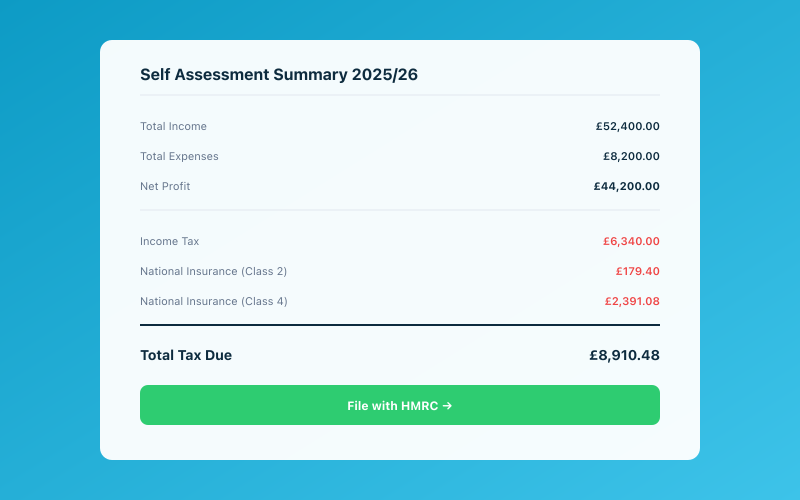 Your Accounted dashboard shows your real-time tax position
But the moment you add another income source into the mix, PAYE can't capture the full picture. That's where Self Assessment comes in. You'll need to file a return if:
- You're employed and self-employed at the same time.
- You have rental income from property you own.
- You earn more than £10,000 from savings or investments (or more than £2,500 in untaxed savings interest).
- You have foreign income.
- You earn over £150,000 from any combination of sources.
- You need to pay the High Income Child Benefit Charge (income over £60,000).
Even if tax has already been deducted from some of your income — through PAYE or at source — you still need to declare everything on your return so HMRC can calculate whether you've paid the right amount overall.
For a detailed look at how employment and self-employment interact, see our guide on tax when employed and self-employed.
How Different Income Types Are Reported
Your Self Assessment return has separate sections for different types of income. Each one has its own rules, allowances, and reporting requirements. Let's walk through the main ones.
Employment Income
If you're employed, your employer will give you a P60 at the end of the tax year showing your total earnings and the tax and National Insurance that's been deducted. You enter these figures in the employment section of your return.
HMRC often pre-fills this section based on information from your employer, but always double-check the figures match your P60. If you had more than one employer during the year, you'll need a separate entry for each.
Self-Employment Income
Self-employment income is reported in the self-employment pages of the return. You'll need to declare your total turnover (gross income) and your allowable business expenses. The difference — your profit — is what gets taxed.
If you run more than one self-employed business, you can either report them separately (using multiple sets of self-employment pages) or combine them if they're essentially the same trade. Most people find it cleaner to keep them separate.
Remember the £1,000 trading allowance — if your self-employed income from a particular trade is under £1,000, you may not need to declare it. But if you're already filing Self Assessment for other reasons, it's usually simpler to include everything.
Rental Income
Property income goes in the property section of your return. You'll declare your total rental income and any allowable expenses (repairs, letting agent fees, insurance, and so on). The taxable profit is your rental income minus allowable expenses.
If your rental income is less than £1,000, you can use the property income allowance instead of declaring it. Above that threshold, you'll need to report the full figures and claim actual expenses.
For mortgage interest on residential lets, remember that tax relief is now given as a 20% tax credit rather than a deduction against income — a change that particularly affects higher rate taxpayers.
Savings and Investment Income
Interest from savings accounts, dividends from shares, and other investment income each have their own sections. Key allowances for 2025/26 include:
- Personal savings allowance: £1,000 for basic rate taxpayers, £500 for higher rate taxpayers, nil for additional rate taxpayers.
- Dividend allowance: £500 tax-free.
- Starting rate for savings: Up to £5,000 of savings income taxed at 0% if your non-savings income is below £17,570.
These allowances can interact in complex ways, so it's worth understanding which ones apply to you.
Other Income
This catch-all section covers things like:
- Casual income that doesn't fit elsewhere.
- State benefits that are taxable (such as the State Pension).
- Income from trusts.
- Foreign income.
Each type has its own reporting requirements, and some may qualify for specific reliefs or allowances.
How Your Tax Is Calculated on Multiple Incomes
Here's where it gets interesting. HMRC doesn't tax each income source separately — they add everything together to work out your total taxable income, and then apply the tax bands.
The Tax Bands for 2025/26
- Personal allowance: £12,570 (tax-free).
- Basic rate (20%): £12,571 to £50,270.
- Higher rate (40%): £50,271 to £125,140.
- Additional rate (45%): Over £125,140.
Your personal allowance is set against your non-savings, non-dividend income first (usually employment and self-employment income), then savings income, then dividend income.
An Example
Let's say you earn £30,000 from employment, £8,000 profit from freelancing, and £4,000 from rental income in the 2025/26 tax year.
Your total income is £42,000. After deducting the personal allowance of £12,570, your taxable income is £29,430. All of this falls within the basic rate band, so you'd pay 20% income tax on £29,430 = £5,886.
Your employer will have deducted tax on the £30,000 through PAYE. HMRC will calculate the remaining tax due on your self-employment and rental income and tell you what you owe.
Now imagine that same person also earns £15,000 more from freelancing, taking the total to £57,000. The first £50,270 is taxed at the basic rate, but the remaining £6,730 (£57,000 minus £50,270) would be taxed at 40%. That's a significant jump, and it's the kind of thing that can catch people out when they add an extra income source.
National Insurance on Multiple Incomes
National Insurance works slightly differently. If you're employed, your employer deducts Class 1 NI from your salary. If you're also self-employed, you'll pay Class 2 and Class 4 NI on your self-employment profits through Self Assessment.
Importantly, there's an annual maximum on National Insurance contributions. If you're paying NI through both employment and self-employment, HMRC will check that you haven't overpaid and refund any excess. This is calculated automatically as part of your Self Assessment.
Practical Challenges of Managing Multiple Income Streams
Keeping Records Separate
The most important practical step is keeping clear, separate records for each income source. Don't mix your freelance income with your rental income, and don't let personal spending get tangled up with business expenses.
Using dedicated bank accounts for each business activity makes this much easier. And bookkeeping software like Accounted can help you categorise transactions automatically, so you always know exactly where your money is coming from and going to.
Cash Flow and Payments on Account
With multiple income sources, your Self Assessment bill can be surprisingly large — especially if much of your income hasn't had tax deducted at source. If your bill is over £1,000, HMRC will require you to make payments on account: advance payments towards next year's tax, due on 31 January and 31 July.
This can be a cash flow challenge, particularly in your first year of Self Assessment. Planning ahead and setting aside money throughout the year is essential. A good rule of thumb is to save 25-30% of your untaxed income for tax and NI.
For more on how payments on account work, see our guide to payments on account.
Tax Codes and PAYE Adjustments
If you're employed and also have other income, HMRC may adjust your PAYE tax code to collect some of the tax on your other income through your salary. This can be helpful (it spreads the cost), but it can also be confusing if you don't understand why your take-home pay has changed.
Check your tax code each year and make sure you understand what it includes. If it looks wrong, contact HMRC or check through your online tax account.
Common Pitfalls to Avoid
Forgetting to Declare All Income
This is the most common mistake. It's easy to forget about a small income source — particularly if it's sporadic or you don't think of it as "real" income. But HMRC increasingly receives information from third parties (banks, platforms, letting agents), so they may already know about income you haven't declared.
When in doubt, declare it. You can always check with HMRC if you're unsure whether something needs to be reported.
Double-Counting Expenses
If you use the same asset (like a vehicle or home office) for multiple income-generating activities, make sure you're not claiming the full cost against each one. Expenses should be apportioned fairly across the activities they relate to.
Ignoring the Impact on Benefits and Allowances
Higher total income can affect things like Child Benefit (the High Income Child Benefit Charge kicks in at £60,000), your personal allowance (which reduces by £1 for every £2 earned over £100,000), and eligibility for the Marriage Allowance.
Always look at the full picture of your combined income, not just each source in isolation.
Missing Deadlines
With multiple income sources, your return may take longer to prepare. Don't leave it until the last minute. The online filing deadline for the 2025/26 tax year is 31 January 2027, but filing early gives you time to sort out any issues and plan for your tax bill. See our Self Assessment deadlines guide for all the key dates.
Getting Organised for Success
Managing multiple income sources doesn't have to be stressful. The key is organisation:
- Track everything as you go — don't wait until January.
- Use separate accounts for different income streams where possible.
- Set aside tax money regularly throughout the year.
- Review your situation annually to check for changes in allowances or thresholds.
- File early to give yourself time and avoid the January rush.
The more income sources you have, the more valuable good bookkeeping software becomes. Penny, the AI bookkeeper in Accounted, is designed to handle exactly this kind of complexity — pulling in transactions from multiple accounts and keeping everything properly categorised and ready for your tax return.
Related reading:
- Tax When You're Employed and Self-Employed
- What Counts as Trading Income for Self Assessment?
- How to File Your Self Assessment Tax Return in 2026
Accounted helps UK sole traders stay on top of their bookkeeping and tax. Start your free 30-day trial at getaccounted.co.uk
Related Reading
Start your free trial and let Penny handle your bookkeeping automatically.
Accounted files your Self Assessment directly to HMRC, with your return pre-populated from your records. See Self Assessment filing →
Tax & Compliance Specialists
Our tax specialists have decades of combined experience in UK sole trader and small business taxation, MTD compliance, and HMRC submissions. All content is reviewed against current HMRC guidance before publication and updated quarterly to reflect legislative changes.
Ready to try Accounted?
Join UK sole traders who are simplifying their bookkeeping and tax.
Start your 14-day free trial