Self Assessment Deadlines 2025/26: Every Date You Need to Know
Why Self Assessment Deadlines Matter
Missing a Self Assessment deadline costs you money. HMRC charges penalties for late filing and late payment, and those penalties stack up fast. Whether you are a plumber filing for the first time or a seasoned freelancer, knowing every key date for the 2025/26 tax year keeps you out of trouble and keeps your cash where it belongs.
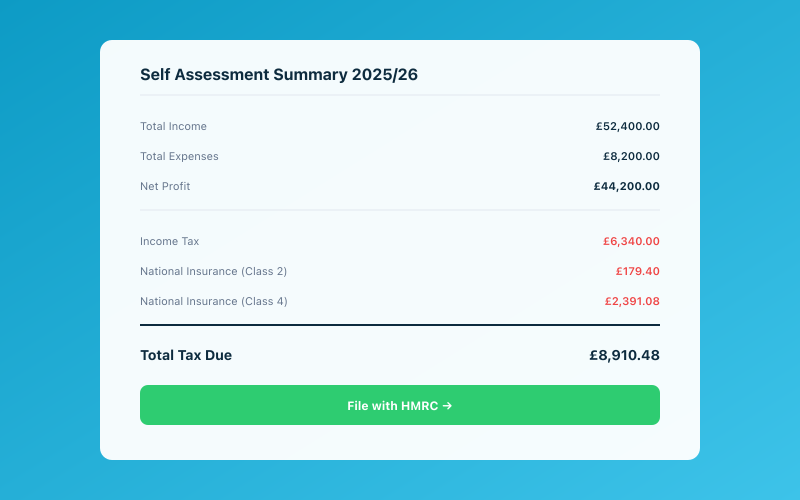 Your Accounted dashboard shows your real-time tax position
This guide covers every deadline you need to know, what happens if you miss them, and how the newer points-based penalty system works.
The 2025/26 Tax Year: Key Dates
The 2025/26 tax year runs from 6 April 2025 to 5 April 2026. Your Self Assessment tax return for this period must be filed and paid in the months that follow.
5 October 2026 — Register for Self Assessment
If you became self-employed or started receiving untaxed income during 2025/26, you must register with HMRC by 5 October 2026. This applies if you started as a sole trader, became a partner in a business, received rental income, or earned untaxed income above £1,000.
Registration is done online through the HMRC website. You will receive a Unique Taxpayer Reference (UTR) number by post, usually within 10 working days. Do not leave this to the last minute — you need your UTR to file your return.
31 October 2026 — Paper Tax Return Deadline
If you want to file a paper tax return, it must reach HMRC by 31 October 2026 — three months earlier than the online deadline. There is very little reason to file on paper these days. Online filing is faster, you get an extra three months, and tools like Accounted can pull your figures together automatically.
31 January 2027 — Online Filing Deadline
This is the big one. Your online Self Assessment tax return must be submitted by midnight on 31 January 2027. Two things are due on this date:
- Your completed tax return — submitted online to HMRC
- Your tax bill — the balancing payment for 2025/26, plus your first payment on account for 2026/27 if applicable
31 January 2027 — First Payment on Account
If your tax bill is over £1,000 and less than 80% was collected at source through PAYE, HMRC will require payments on account. The first payment on account for 2026/27 is due on 31 January 2027 alongside your 2025/26 balancing payment. It is usually half of your previous year's tax bill.
31 July 2027 — Second Payment on Account
The second payment on account for 2026/27 is due on 31 July 2027. If your income has dropped significantly, you can apply to reduce your payments on account through your HMRC online account.
What Happens If You Miss a Deadline
Late Filing Penalties
Miss the 31 January filing deadline and the penalties start immediately:
- 1 day late — £100 fixed penalty (even if you owe no tax)
- 3 months late — £10 per day for up to 90 days (maximum £900)
- 6 months late — £300 or 5% of the tax due, whichever is greater
- 12 months late — another £300 or 5% of the tax due, whichever is greater
Filing a year late could cost you £1,600 in penalties alone, on top of whatever tax you owe.
Late Payment Penalties
If you do not pay by 31 January, HMRC charges:
- 30 days late — 5% of the tax unpaid
- 6 months late — a further 5% of the amount still outstanding
- 12 months late — another 5% on top
HMRC also charges interest on late payments at the Bank of England base rate plus 2.5%.
Can You Appeal a Penalty?
Yes, but only with a reasonable excuse. HMRC accepts serious illness, the death of a close relative, or postal delays outside your control. "I forgot" will not cut it.
The Points-Based Penalty System
HMRC has been rolling out a new points-based penalty system, particularly under Making Tax Digital. Instead of an immediate financial penalty for a single late submission, you receive a penalty point each time you miss a deadline. Once you hit the threshold for your submission frequency, you receive a £200 penalty — and every further late submission triggers another £200.
For quarterly submissions (most MTD-enrolled sole traders), the threshold is 4 points. For annual submissions, it is 2 points.
To reset your points to zero, you need to meet all submission deadlines for a set period — typically 24 months for annual obligations or 12 months for quarterly ones — and clear all outstanding submissions.
Late Payment Under the New System
Late payment penalties work differently too. Payments up to 15 days late incur no penalty. Between 16 and 30 days, you are charged at an annualised rate on the outstanding amount. After 30 days, the rate increases. Interest applies from day one.
How to Avoid Missing Deadlines
File Early
You can submit your 2025/26 return as soon as the tax year ends on 5 April 2026. Filing early does not mean you pay early — payment is still due 31 January 2027. But you will know exactly what you owe with time to prepare.
Set Aside Tax Money
Move 25-30% of every payment you receive into a separate savings account. When January comes around, the money is already there.
Keep Records Up to Date
If you log income and expenses as they happen, filing your return takes minutes rather than hours. This is where Accounted comes in — its AI bookkeeper, Penny, categorises your transactions as they come in, so when filing season arrives, your figures are already sorted.
Use HMRC's Budget Payment Plan
HMRC offers a Budget Payment Plan that lets you set up a direct debit and make regular payments towards your estimated bill throughout the year.
Quick Summary
| Date | What Is Due | |------|------------| | 5 October 2026 | Register for Self Assessment (new taxpayers) | | 31 October 2026 | Paper tax return deadline | | 31 January 2027 | Online tax return + balancing payment + 1st payment on account | | 31 July 2027 | 2nd payment on account |
Do Not Let Deadlines Catch You Out
Self Assessment does not have to be stressful. The key is staying organised, knowing your dates, and keeping your records in order throughout the year. If you want a tool that does the heavy lifting — tracking your income, sorting your expenses, and reminding you when deadlines approach — give Accounted a try. Start your free trial today and let Penny keep your books in order so you can focus on your actual work.
Related Reading
Start your free trial and let Penny handle your bookkeeping automatically.
Penny, your AI bookkeeper, tracks your tax position in real time and flags opportunities to reduce your bill. Meet Penny →
Tax & Compliance Specialists
Our tax specialists have decades of combined experience in UK sole trader and small business taxation, MTD compliance, and HMRC submissions. All content is reviewed against current HMRC guidance before publication and updated quarterly to reflect legislative changes.
Ready to try Accounted?
Join UK sole traders who are simplifying their bookkeeping and tax.
Start your 14-day free trial