15 Self Assessment Mistakes That Cost You Money
Self Assessment errors fall into two categories: mistakes that mean you pay more tax than you should, and mistakes that trigger penalties from HMRC. Both cost you money, and both are avoidable. Over years of helping sole traders and landlords with their tax returns, we have identified the same errors coming up again and again.
Here are the fifteen most common Self Assessment mistakes, what they cost you, and how to make sure you never make them.
1. Not Claiming All Allowable Expenses
This is the single most expensive mistake on the list. Many self-employed people miss legitimate expenses because they have lost receipts, forgotten about purchases, or simply did not know they could claim them. Common missed expenses include professional subscriptions, business insurance, bank charges on business accounts, stationery, postage, software subscriptions, and the cost of specialist clothing or safety equipment.
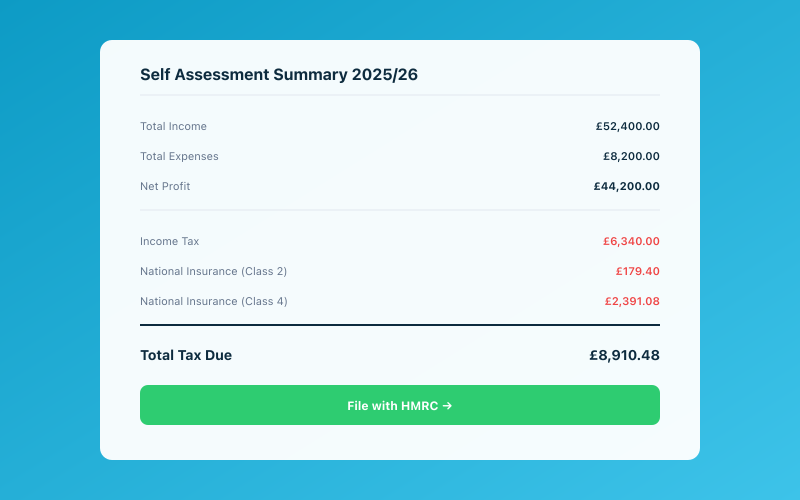 Your Accounted dashboard shows your real-time tax position
If you have taxable profits of £30,000 and miss £2,000 of legitimate expenses, you overpay income tax by £400 (at the basic rate) plus Class 4 National Insurance of £120. That is £520 lost every year.
Penny prevents this by categorising every transaction from your bank feed and prompting you to capture receipts via WhatsApp. When everything is tracked from day one, expenses do not go missing.
2. Forgetting Working-from-Home Costs
If you work from home, you can claim a proportion of your household costs — heating, electricity, broadband, rent or mortgage interest, council tax, and water rates. Alternatively, you can use HMRC's simplified flat rate of £6 per week (£312 per year) without needing to keep detailed records.
Many sole traders forget this entirely or underestimate their claim. If you use a room exclusively for work, or work from home for 25 or more hours per month, the claim can be significant.
Penny reminds you to claim working-from-home costs and calculates both the actual method and the flat rate method, so you can choose whichever gives you the bigger deduction.
3. Using the Wrong Tax Code for Employment Income
If you have employment income alongside self-employment, your tax code determines how much tax your employer deducts. If it is wrong, you could be overpaying or underpaying through PAYE. The standard code for 2025/26 is 1257L. If yours is different, make sure you understand why. Accounted flags discrepancies between your employment income and expected deductions.
4. Not Claiming Pension Tax Relief
If you contribute to a personal pension, the provider claims basic rate relief automatically. But if you are a higher rate or additional rate taxpayer, the extra relief must be claimed through your Self Assessment return. Many people either forget to include their pension contributions on the return or do not realise they are entitled to additional relief.
A higher rate taxpayer contributing £10,000 gross to a pension who forgets to claim additional relief loses £2,000. Penny tracks your pension contributions and ensures they are included in your Self Assessment data with the correct figures.
5. Forgetting Student Loan Repayments
If you have a student loan and are self-employed, repayments are collected through Self Assessment rather than PAYE. You need to declare which plan you are on (Plan 1, Plan 2, Plan 4, or Postgraduate) and pay the appropriate percentage of income above the threshold.
The mistake goes both ways. Some people forget to declare their student loan entirely. Others declare the wrong plan type, resulting in incorrect repayment amounts. Plan 2 has a threshold of £27,295 while Plan 1's threshold is £24,990. Getting the plan wrong changes the amount you owe.
6. Declaring Duplicate Income
If you receive income through a payment platform and also through your bank account, it is easy to double-count it. The customer pays via Stripe, Stripe takes a fee and pays you the net amount, and you see both the platform notification and the bank credit. If you record both as income, you are overstating your turnover.
Penny identifies settlement payments from platforms like Stripe, PayPal, and Square, and ensures income is counted only once.
7. Getting the Dates Wrong on the Cash Basis
Under the cash basis, income is taxed in the year you receive payment, not the year you invoice or do the work. If you issued an invoice in March 2025 but were not paid until May 2025, that income belongs in the 2025/26 tax year, not 2024/25.
The same applies to expenses: they are deductible when you pay them, not when you receive the bill. Getting this wrong shifts income or expenses between tax years, which can trigger queries from HMRC if their records do not match yours.
8. Not Claiming Losses
If your business makes a loss, you can set it against other income, carry it forward, or carry it back. Many people leave the loss on the self-employment pages without actively claiming it, which means it does not reduce their tax bill. If you have employment income, claiming sideways loss relief can generate a refund of PAYE already paid.
9. Missing Capital Allowances
If you buy equipment, tools, vehicles, or other capital assets for your business, you claim capital allowances rather than deducting the full cost as a revenue expense. The Annual Investment Allowance gives you 100% relief on the first £1 million of qualifying expenditure each year. But you have to claim it — it is not applied automatically.
10. Forgetting Bank Interest and Dividend Income
Bank interest is taxable above your Personal Savings Allowance (£1,000 for basic rate, £500 for higher rate). Dividends above the £500 allowance are also taxable. HMRC receives data on both directly from financial institutions, so omitting them will almost certainly be detected.
11. Not Registering for Self Assessment on Time
If you start self-employment or begin receiving rental income, you must register for Self Assessment by 5 October following the end of the tax year. Late registration can lead to penalties and delays your ability to file.
12. Entering Gross Figures Instead of Net (or Vice Versa)
Mixing up gross and net amounts is a common error. The self-employment pages ask for turnover (gross income) and then expenses separately. If you enter net profit where turnover is requested, your return will be wrong. The same applies to property income, where the return asks for total rents received before deductions.
13. Forgetting Payments on Account
If your Self Assessment tax bill is over £1,000 and less than 80% was deducted at source (through PAYE), HMRC requires payments on account. These are two advance payments towards next year's tax bill, each equal to half of the current year's liability, due on 31 January and 31 July.
People forget about the July payment regularly. If your income has dropped, you can apply to reduce your payments on account, but you need to do this proactively. Penny tracks your estimated tax position and reminds you about upcoming payments on account.
14. Missing the Marriage Allowance
If you are married or in a civil partnership and one of you earns less than the personal allowance while the other is a basic rate taxpayer, you can transfer £1,260 of unused personal allowance. This saves the higher-earning partner £252 per year.
The marriage allowance can be backdated for up to four years, so if you have never claimed, you could recover up to £1,008 in overpaid tax. It is claimed through HMRC's online portal, not through Self Assessment itself.
15. Filing Late and Paying Late
The 31 January deadline for both filing and paying is absolute. A late filing penalty of £100 applies immediately, even if you owe nothing. Late payment interest accrues from 1 February at 7.25%, and after 30 days a 5% surcharge applies to unpaid tax. Filing and paying just one month late on a £5,000 bill could cost you £380 in penalties and interest combined.
The Common Thread: Poor Record-Keeping
Look at this list and you will notice a pattern. Almost every mistake traces back to incomplete, disorganised, or missing records. When you are trying to reconstruct a year's worth of activity from memory and bank statements, errors are inevitable.
This is the problem Accounted was built to solve. Penny categorises every transaction as it happens, prompts you for receipts, tracks deadlines, monitors thresholds, and prepares your Self Assessment data throughout the year. By the time you file, there are no gaps to fill and no guesses to make.
Start your free trial of Accounted today and make sure none of these fifteen mistakes appear on your next tax return.
Related Reading
Start your free trial and let Penny handle your bookkeeping automatically.
Penny, your AI bookkeeper, tracks your tax position in real time and flags opportunities to reduce your bill. Meet Penny →
Tax & Compliance Specialists
Our tax specialists have decades of combined experience in UK sole trader and small business taxation, MTD compliance, and HMRC submissions. All content is reviewed against current HMRC guidance before publication and updated quarterly to reflect legislative changes.
Ready to try Accounted?
Join UK sole traders who are simplifying their bookkeeping and tax.
Start your 14-day free trial