10 Common VAT Return Mistakes and How to Avoid Them
Filing a VAT return should be straightforward, but the reality is that VAT is one of the most complex areas of UK tax. The rules around what is taxable, what is exempt, what is zero-rated, and what is outside the scope of VAT create countless opportunities for error. HMRC regularly identifies millions of pounds in VAT return errors, and the penalties for getting it wrong range from assessment corrections to deliberate behaviour surcharges.
This guide covers the ten most common VAT return mistakes we see, explains why each one happens, and shows you how to avoid them.
1. Filing for the Wrong VAT Period
This sounds basic, but it is more common than you would expect. VAT periods can be monthly, quarterly, or annual, and they do not necessarily align with calendar quarters or your accounting year. If you have recently changed your VAT period or switched accounting software, it is easy to include transactions from the wrong date range.
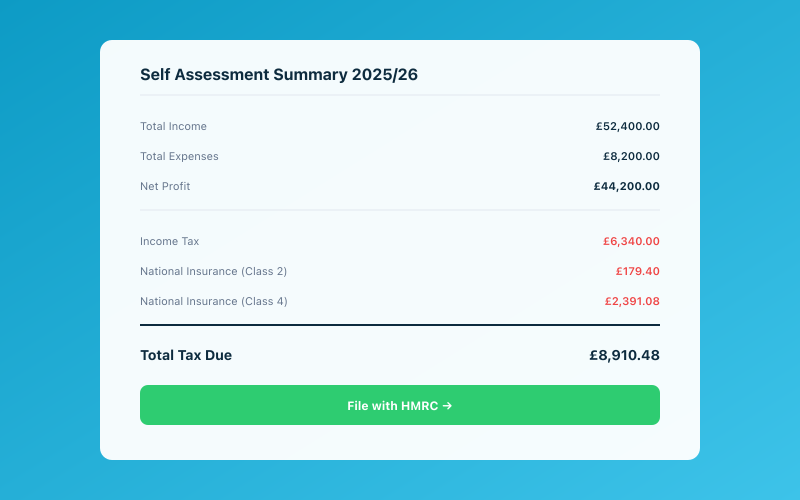 Your Accounted dashboard shows your real-time tax position
Always verify your VAT period dates before starting your return. HMRC sends reminders with the specific dates your return covers. If you are using Accounted, Penny automatically filters transactions to the correct VAT period based on your HMRC registration, so the risk of including wrong-period transactions is eliminated.
2. Including Exempt Supplies in Your Output Tax
Not all income is subject to VAT. If your business provides a mix of taxable and exempt supplies, you need to separate them. Exempt supplies — which include most financial services, insurance, education and training by eligible bodies, and certain health services — should not have VAT charged on them, and they should not be included in your Box 6 (total value of sales excluding VAT) in a way that triggers VAT on those amounts.
The complication arises with partial exemption. If you make both taxable and exempt supplies, you cannot recover all of your input VAT and must use a partial exemption method to calculate how much you can reclaim. Getting this calculation wrong is one of the most costly VAT errors.
3. Forgetting the Reverse Charge on Services from Overseas
If you buy services from a supplier based outside the UK, you may need to apply the reverse charge. This means you account for VAT on the purchase as if you had supplied the service to yourself. You include the VAT in both your output tax (Box 1) and your input tax (Box 4), so the net effect is often nil. But if you forget to apply the reverse charge entirely, your return is wrong, and HMRC can issue an assessment.
Common examples include software subscriptions from US-based companies, digital advertising services from overseas platforms, and professional services from consultants based in the EU or elsewhere. If the supplier did not charge you UK VAT, check whether the reverse charge applies.
4. Not Applying the Domestic Reverse Charge for Construction
Since March 2021, the VAT domestic reverse charge applies to most supplies of construction services between VAT-registered businesses within the CIS. Subcontractors should not charge VAT to CIS-registered contractors on qualifying supplies — the contractor accounts for the VAT instead. Failing to apply this correctly is one of the most common VAT errors in the construction sector, and HMRC has flagged it as a compliance focus area.
Accounted handles CIS and VAT reverse charge transactions automatically. When Penny identifies a CIS-related transaction, the correct reverse charge treatment is applied, and the VAT return figures are adjusted accordingly.
5. Incorrect Treatment of Fuel Scale Charges
If your business provides fuel for private motoring by employees or directors, you have two choices: either reclaim all the input VAT on fuel and apply the fuel scale charge (which adds an amount of output tax based on the vehicle's CO2 emissions), or reclaim only the business proportion of fuel VAT and not apply the scale charge.
The most common mistake is reclaiming all the input VAT without adding the scale charge, effectively getting full VAT recovery on fuel that was partly used privately. This is an error that HMRC's automated checks can spot, because the fuel input VAT is high relative to business mileage claimed.
The fuel scale charges are updated quarterly by HMRC, so make sure you are using the correct figures for each VAT period.
6. Missing Bad Debt Relief
If you have invoiced a customer, charged VAT, and paid that VAT to HMRC, but the customer never pays you, you can reclaim the VAT under the bad debt relief rules. However, this is subject to conditions. The debt must be at least six months old from the date payment was due, you must have written it off in your accounts, and the original supply must have been for a sum not exceeding the amount on which VAT was paid to HMRC.
Many businesses either do not know about bad debt relief or forget to claim it at the right time. You cannot claim before the debt is six months overdue, and the time limit for claiming is generally four years and six months from when the VAT became due. Penny tracks overdue invoices and flags when bad debt relief becomes available.
7. Errors in Partial Exemption Calculations
If your business makes both taxable and exempt supplies, you need to perform a partial exemption calculation every VAT period to determine how much input VAT you can recover. The standard method apportions input VAT based on the ratio of taxable to total supplies.
Common errors include forgetting the annual adjustment, using wrong figures in the ratio calculation, and failing to apply the de minimis threshold. If your exempt input tax is below £625 per month on average and less than 50% of total input tax, you can treat it as fully recoverable.
8. Not Accounting for EC Sales Correctly Post-Brexit
Since Brexit, sales of goods to EU customers are exports (zero-rated with evidence), while services to EU businesses are generally outside the scope of UK VAT. However, certain services to EU consumers may still be subject to UK VAT. The common mistake is treating all EU sales as they were pre-Brexit. The rules are fundamentally different, and incorrect treatment means you are either over-paying or under-paying VAT.
9. Including Non-VAT Invoices in Input Tax
Not every invoice you receive includes VAT, and not every charge described as VAT is actually UK VAT. Before claiming input tax, verify that the supplier is VAT-registered by checking their VAT number, that the invoice meets HMRC's requirements for a valid VAT invoice (including the supplier's name and address, VAT number, invoice date, description of goods or services, and the VAT amount), and that the VAT relates to a supply made to your business.
Common problem invoices include those from non-VAT-registered suppliers who have incorrectly charged VAT and invoices from overseas suppliers showing their local VAT rather than UK VAT. Penny verifies VAT numbers on supplier invoices and flags any input tax claims where the underlying invoice may not meet HMRC's requirements.
10. Missing the Submission Deadline
Under Making Tax Digital for VAT, late submission penalties follow a points-based system. You receive one point for each late submission. Once you accumulate the threshold number of points (four points for quarterly filers), a £200 penalty is charged, with further penalties for each subsequent late submission.
The deadline for submitting your VAT return and making payment is one calendar month and seven days after the end of the VAT period. For a standard quarterly return ending 30 June, the deadline is 7 August. If you pay by direct debit, HMRC collects payment three working days after the deadline, so make sure the funds are available.
Setting up automatic reminders is essential. Accounted sends deadline notifications well in advance, and Penny prepares your VAT return data throughout the period so there is no last-minute rush.
Building Good VAT Habits
Most VAT errors are not the result of deliberate non-compliance. They happen because VAT is complex, the rules change frequently, and busy business owners have limited time to stay on top of every nuance. The best defence against errors is a combination of good software, consistent record-keeping, and awareness of the common pitfalls described above.
Accounted's approach to VAT is designed to catch these errors before they reach your return. Penny's categorisation checks for reverse charge requirements, validates VAT numbers, tracks bad debt relief timing, and ensures transactions are allocated to the correct period. The confidence scoring system highlights any VAT treatment that needs your review.
Start your free trial of Accounted today and file your next VAT return with confidence that these common mistakes have been caught before submission.
Related Reading
Start your free trial and let Penny handle your bookkeeping automatically.
Penny, your AI bookkeeper, tracks your tax position in real time and flags opportunities to reduce your bill. Meet Penny →
Tax & Compliance Specialists
Our tax specialists have decades of combined experience in UK sole trader and small business taxation, MTD compliance, and HMRC submissions. All content is reviewed against current HMRC guidance before publication and updated quarterly to reflect legislative changes.
Ready to try Accounted?
Join UK sole traders who are simplifying their bookkeeping and tax.
Start your 14-day free trial