How to Claim Home Office Expenses: Simplified vs Actual Costs
If you work from home — whether full-time or just a few days a week — you can claim a portion of your household costs as a business expense. This reduces your taxable profit and therefore the amount of tax you pay.
But there are two different methods for calculating the claim, and choosing the wrong one could mean leaving money on the table. This guide explains both methods, shows you worked examples, and helps you decide which one is right for you.
The Two Methods
HMRC allows self-employed people who work from home to claim expenses using one of two methods:
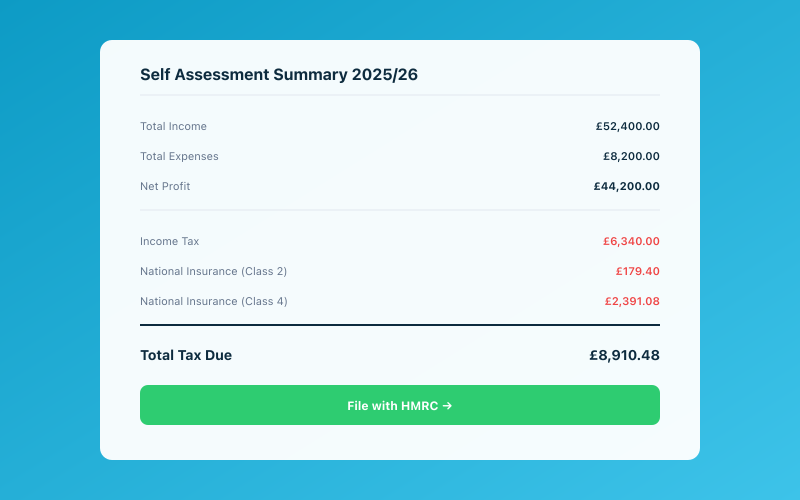 Your Accounted dashboard shows your real-time tax position
- Simplified expenses (also called the flat rate method)
- Actual costs (also called the proportion method)
You can switch between them from one year to the next, but you can only use one method per tax year.
Method 1: Simplified Expenses
The simplified expenses method uses a flat rate set by HMRC based on the number of hours you work from home per month.
The Rates
| Hours worked from home per month | Monthly flat rate | |---|---| | 25 to 50 hours | £10 | | 51 to 100 hours | £18 | | 101 or more hours | £26 |
If you work from home fewer than 25 hours per month, you cannot use the simplified method (though you can still claim under the actual cost method if the amounts are meaningful).
How It Works
You keep a record of the hours you work from home each month. At the end of the year, you add up the flat rate amounts and claim the total as an expense on your Self Assessment.
Worked Example: Simplified Expenses
Sarah is a freelance graphic designer who works from home full-time, roughly 40 hours per week.
She works from home more than 101 hours per month, so she claims £26 per month.
Annual claim: £26 x 12 = £312
That is her entire home office expense claim for the year. Simple, no receipts needed, no calculations about room proportions or bill amounts.
Pros of Simplified Expenses
- Very easy to calculate
- No need to gather household bills
- No need to measure rooms
- HMRC is unlikely to query the claim
- Good for people who rent and have no mortgage interest to claim
Cons of Simplified Expenses
- The flat rates are quite low
- You cannot claim mortgage interest under this method
- If your household bills are high, the actual cost method may give a much larger claim
Method 2: Actual Costs
The actual cost method requires you to work out the proportion of your household expenses that relate to business use. The calculation involves two factors: the proportion of your home used for work, and the proportion of time that space is used for business.
Which Costs Can You Claim?
Under the actual cost method, you can claim a business proportion of:
- Gas and electricity
- Water rates (if you use water in your work)
- Council tax
- Mortgage interest (not the capital repayment, just the interest portion)
- Rent (if you rent your home)
- Home insurance
- Broadband and phone line
- General repairs and maintenance to the property
You cannot claim for costs that are purely personal, such as a TV licence (unless you genuinely use a TV for business), or for mortgage capital repayments.
How to Calculate the Proportion
The standard approach is to divide the area of your dedicated workspace by the total area of your home, then adjust for the proportion of time the space is used for business.
Step 1: Room proportion
If your home has five rooms of roughly equal size (excluding bathrooms, hallways and kitchen) and you use one room exclusively as an office, your room proportion is 1/5 = 20%.
If rooms are different sizes, you can use floor area instead. If your office is 12 square metres and your home is 80 square metres of usable space, the proportion is 12/80 = 15%.
Step 2: Time proportion
If you use the room exclusively for business during working hours but it is also used as a spare bedroom at weekends, you might estimate 80% business use. If it is a dedicated office used only for work, you could reasonably claim 100%.
Step 3: Apply the proportion
Multiply your allowable household costs by the room proportion and then by the time proportion.
Worked Example: Actual Costs
James is a self-employed IT consultant who works from a dedicated home office. His home has six rooms of roughly equal size, and the office is used exclusively for business.
His annual household costs:
| Expense | Annual cost | |---|---| | Gas and electricity | £2,400 | | Council tax | £1,800 | | Mortgage interest | £4,200 | | Home insurance | £480 | | Broadband | £360 | | Water rates | £420 | | Total | £9,660 |
Room proportion: 1/6 = 16.67%
Time proportion: 100% (dedicated office)
Business proportion: 16.67% x 100% = 16.67%
Annual claim: £9,660 x 16.67% = £1,610
Compare that with the simplified method. James works well over 101 hours a month from home, so he would claim £312 per year under simplified expenses. The actual cost method gives him more than five times that amount.
Worked Example: Renter Without Mortgage
Emma is a freelance writer who rents a two-bedroom flat. She uses the second bedroom as her office about 80% of the time (it doubles as a guest room occasionally).
Her annual costs:
| Expense | Annual cost | |---|---| | Rent | £12,000 | | Gas and electricity | £1,200 | | Council tax | £1,440 | | Broadband | £300 | | Contents insurance | £180 | | Total | £15,120 |
The flat has four rooms of similar size (living room, kitchen-diner, two bedrooms). Room proportion: 1/4 = 25%.
Time proportion: 80%.
Business proportion: 25% x 80% = 20%.
Annual claim: £15,120 x 20% = £3,024
Under simplified expenses, Emma would claim £312 (assuming 101+ hours per month). The actual cost method gives her nearly ten times more.
Pros of Actual Costs
- Usually gives a significantly higher claim
- Particularly beneficial if you have a mortgage or pay rent
- Reflects the true cost of working from home
Cons of Actual Costs
- More record-keeping required — you need to keep all household bills
- You need to calculate room proportions
- Capital gains tax implications if you claim mortgage interest (see below)
The Capital Gains Tax Warning
If you own your home and claim actual costs including mortgage interest, there is a potential capital gains tax implication when you sell. HMRC could argue that part of your home was used exclusively for business, and that portion might not qualify for Private Residence Relief (which normally exempts your main home from capital gains tax).
In practice, this is mainly a risk if you have a room used exclusively and entirely for business with no personal use whatsoever. If the room has some personal use (even occasional), the risk is much lower.
Many sole traders manage this by ensuring their home office has some personal use — keeping personal books in the room, using it occasionally as a guest room, or having the family computer there. This dual use helps maintain Private Residence Relief while still allowing a business expense claim.
If you are concerned, speak to your accountant about the right approach for your situation.
Which Method Should You Choose?
As a general rule:
- Choose simplified expenses if you work from home part-time, have low household bills, rent cheaply, or want minimal record-keeping
- Choose actual costs if you work from home full-time, pay significant rent or mortgage interest, have high energy bills, or have a dedicated workspace
For most full-time home workers, the actual cost method produces a substantially higher claim. The extra record-keeping is modest — you need to keep your household bills, which you probably do anyway.
How Penny's Home Office Calculator Helps
Accounted includes a home office calculator that takes the complexity out of the actual cost method. You enter your household bills and provide basic information about your home — number of rooms, the size of your workspace, and how much you use it for business. Penny calculates the allowable proportion and applies it to your expenses automatically.
She also tracks the claim throughout the year as new bills come in, so you can see the running total rather than waiting until year end to work it out.
If you are not sure which method is better for you, the calculator shows both figures side by side. You can see at a glance whether simplified or actual costs gives the higher claim and make your choice based on real numbers.
Claim What You Are Entitled To
Working from home costs money, and HMRC recognises that by allowing you to claim a proportion of those costs. Too many sole traders either claim nothing (because they do not realise they can) or use the simplified method without checking whether actual costs would give a much better result. Take ten minutes to work out both options — it could save you hundreds of pounds in tax. Start your free trial of Accounted and use Penny's home office calculator to find out exactly how much you can claim.
Related Reading
-
Can I Claim Clothing as a Business Expense? HMRC Rules Explained
-
Mixed-Use Property Tax: When Your Home is Also Your Business
Start your free trial and let Penny handle your bookkeeping automatically.
Penny, your AI bookkeeper, tracks your tax position in real time and flags opportunities to reduce your bill. Meet Penny →
Tax & Compliance Specialists
Our tax specialists have decades of combined experience in UK sole trader and small business taxation, MTD compliance, and HMRC submissions. All content is reviewed against current HMRC guidance before publication and updated quarterly to reflect legislative changes.
Ready to try Accounted?
Join UK sole traders who are simplifying their bookkeeping and tax.
Start your 14-day free trial