Working From Home: How to Claim Tax Relief as a Sole Trader
Working From Home: How to Claim Tax Relief as a Sole Trader
If you run your business from home — even partially — you're probably entitled to claim tax relief on a portion of your household costs. It's one of the most commonly missed deductions for sole traders, and it can save you hundreds of pounds a year.
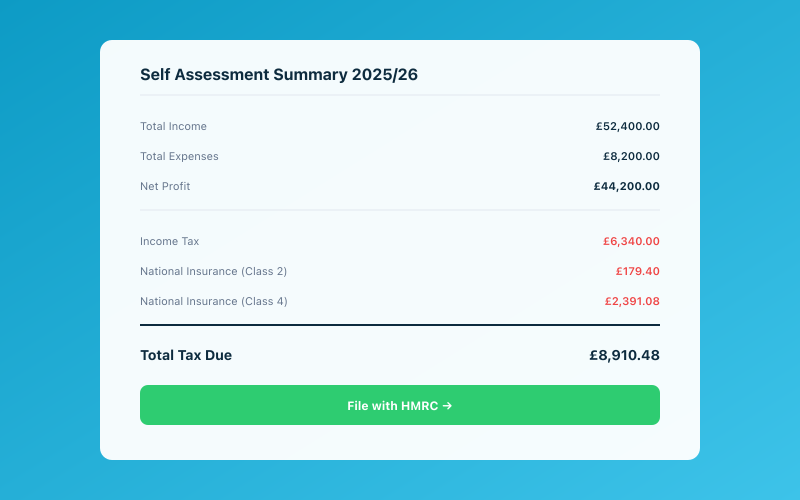 Your Accounted dashboard shows your real-time tax position
There are two methods for calculating your claim: the simplified method and the actual costs method. Each has its advantages, and the right choice depends on your situation.
Method 1: The Simplified Method (Flat Rate)
HMRC offers a simplified expenses system that lets you claim a flat rate based on the number of hours you work from home each month. No receipts needed. No complicated calculations. Just count your hours.
Here are the current rates:
| Hours worked from home per month | Monthly flat rate | |----------------------------------|-------------------| | 25 to 50 hours | £10 | | 51 to 100 hours | £18 | | 101 hours or more | £26 |
If you work from home full-time (say, 40 hours a week), that's roughly 160+ hours per month, so you'd claim £26 per month or £312 per year.
Pros of the simplified method
- Dead simple — no need to track actual bills
- No receipts or utility statements required
- HMRC won't question your calculation if your hours are reasonable
Cons of the simplified method
- The amounts are quite low — £312/year maximum
- Doesn't reflect your actual costs, which are likely much higher
- You can't claim the flat rate and actual costs for the same expense
For many sole traders, particularly those with higher household costs, the actual costs method gives a significantly larger deduction.
Method 2: The Actual Costs Method
With this method, you calculate the business proportion of your actual household running costs and claim that as an expense. It takes more effort, but it often produces a much larger deduction.
Which costs can you include?
- Mortgage interest or rent
- Council tax
- Gas and electricity
- Water rates
- Home insurance
- Broadband and phone (the business portion)
- General repairs and maintenance
You cannot include mortgage capital repayments — only the interest portion. And you can't include costs that aren't affected by your business use, such as the TV licence (unless you genuinely use it for work).
How to calculate your business proportion
There are two common approaches, and HMRC accepts both:
Room-based calculation: Divide the number of rooms used for business by the total number of rooms in your home (excluding bathrooms and kitchens, typically).
Example: You use 1 room out of 4 as your office. Your business proportion is 25%.
Time-based calculation: If you use a room for both business and personal purposes (the kitchen table, the spare bedroom that's also a guest room), you can adjust by the hours of business use.
Example: You use a room that's 1 of 4 rooms, but only for business 40 hours out of a 168-hour week. Business proportion: 25% x (40/168) = roughly 6%.
The room-based calculation is simpler and gives a higher figure if you have a dedicated workspace. The time-based adjustment is fairer if you're working from a shared space.
A worked example
Let's say your annual household costs are:
- Rent: £12,000
- Council tax: £1,800
- Gas and electricity: £2,400
- Water: £600
- Broadband: £480
- Home insurance: £360
- Total: £17,640
You have a dedicated home office — 1 of 5 rooms. Business proportion: 20%.
Your claim: £17,640 x 20% = £3,528 per year.
Compare that to £312 with the simplified method. The actual costs method gives you more than ten times the deduction in this scenario.
Which Method Saves You More?
In almost every case, the actual costs method wins — provided you have a dedicated workspace and you're willing to keep records of your bills.
The simplified method only makes sense if:
- You work from home occasionally (under 25 hours/month means you can't claim at all)
- Your household costs are very low
- You really can't be bothered with the paperwork
For everyone else, the actual costs method is worth the extra effort. The tax saving on a £3,500 deduction at the basic rate (20%) is £700. At the higher rate (40%), it's £1,400. That's real money.
If you're claiming lots of other sole trader expenses, the working-from-home deduction stacks on top. Every pound of expenses reduces your taxable profit, which also reduces your Class 4 National Insurance.
What About a Dedicated Home Office?
If you have a room used exclusively for business, the calculation is more straightforward — you simply use the room-based proportion without any time adjustment.
However, there's a potential capital gains tax implication to be aware of. If part of your home is used exclusively for business, that portion could theoretically be subject to Capital Gains Tax when you sell your home. In practice, HMRC rarely pursues this for small home offices, and your main residence relief should cover most situations — but it's worth noting.
Many accountants advise using the room for some personal purpose (even occasionally) to maintain the full Private Residence Relief. Something to discuss with your accountant if you're a homeowner.
Record-Keeping Requirements
If you use the actual costs method, keep evidence of your household expenses: utility bills, rent receipts or mortgage statements, council tax bills, broadband invoices, and insurance documents. You don't need to submit these with your tax return, but keep them for at least 5 years after the filing deadline.
HMRC's digital record-keeping requirements under Making Tax Digital mean you should be storing these digitally anyway. A photo of each bill is sufficient.
Working From Home AND Renting an Office
What if you split your time between a home office and a rented workspace (a co-working space, for example)? You can claim both — but you'll need to adjust your home office proportion to reflect that you're not working from home full-time.
If you rent a co-working space three days a week and work from home two days a week, your home business use drops to roughly 40% of what it would be for full-time home working. Apply that reduction to your room-based proportion.
You can also claim the full cost of your rented workspace as a business expense, so the combined deduction may be quite generous.
Claiming Via Accounted
Tracking household expenses for your working-from-home claim doesn't need to be a chore. In Accounted, you can:
- Set your home office proportion once, and it's applied automatically
- Snap photos of utility bills and they're categorised and stored
- See your running total of home office deductions throughout the year
- Switch between simplified and actual costs methods to compare which gives you a better result
Everything feeds into your year-end summary and Self Assessment submission automatically. No spreadsheets, no shoeboxes of receipts, no end-of-year panic.
The Bottom Line
Working from home as a sole trader? Claim the tax relief. It's legitimate, it's straightforward, and it can knock hundreds — or thousands — off your tax bill.
For most people, the actual costs method is significantly more generous than the flat rate. Keep your household bills on file, calculate your business proportion honestly, and claim with confidence.
Ready to simplify your bookkeeping? Try Accounted free for 14 days →
Related Reading
Start your free trial and let Penny handle your bookkeeping automatically.
Penny, your AI bookkeeper, tracks your tax position in real time and flags opportunities to reduce your bill. Meet Penny →
Tax & Compliance Specialists
Our tax specialists have decades of combined experience in UK sole trader and small business taxation, MTD compliance, and HMRC submissions. All content is reviewed against current HMRC guidance before publication and updated quarterly to reflect legislative changes.
Ready to try Accounted?
Join UK sole traders who are simplifying their bookkeeping and tax.
Start your 14-day free trial