Can I Claim My Phone Bill as a Business Expense?
Your phone is essential to your business. You use it to call clients, send invoices, check your bank, and manage your diary. So can you claim the cost against your tax? Yes — but probably not all of it, unless you have a separate business phone.
Here is how to get it right.
The Basic Rule
HMRC allows you to claim the business proportion of your phone costs. The key word is "proportion." If you use one phone for both personal and business purposes, you can only claim the percentage that relates to your business use. You cannot claim the whole bill just because you sometimes use the phone for work.
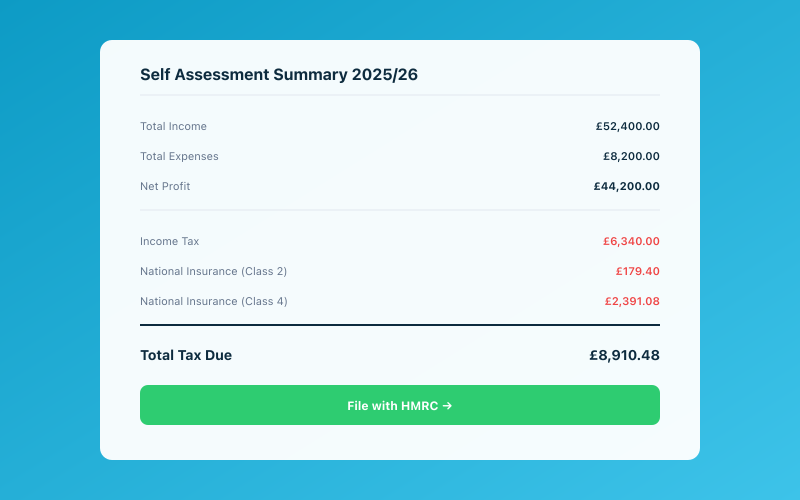 Your Accounted dashboard shows your real-time tax position
If you have a separate phone used exclusively for business, you can claim 100% of the cost — the contract, the handset, and any accessories.
Two Phones or One?
This is the first decision to make, and it affects everything else.
Option 1: Separate Business Phone
If you have a dedicated business phone that you only use for work, life is simple. You claim:
- 100% of the monthly contract or pay-as-you-go costs
- 100% of the handset cost (this may need to be treated as a capital asset if it cost more than £1,000, but most phones fall under the Annual Investment Allowance)
- 100% of any business accessories — cases, screen protectors, car phone holders
You do not need to keep a log of calls or calculate percentages. The whole bill is a business expense because the whole phone is a business asset.
This is the cleanest approach, and if your phone costs are significant, it is worth considering. A basic SIM-only business contract can be as little as £8–£15 a month, and it makes your record keeping much simpler.
Option 2: One Phone for Everything
Most sole traders use one phone for personal and business. In this case, you need to work out what percentage of your usage is business-related and claim that proportion.
There are two ways to do this.
Method 1: Actual Usage Split
This is the more accurate method. You look at your phone usage and work out the business percentage based on actual data.
How to Calculate It
- Pick a representative month (not your busiest or quietest month — a normal one)
- Go through your call log and data usage
- Categorise each call or period of usage as business or personal
- Calculate the business percentage
- Apply that percentage to your monthly bill
For example:
- Your monthly phone bill is £40
- You make 100 calls per month, of which 60 are to clients, suppliers, or business contacts
- 60% of your calls are business-related
- You can claim 60% of £40 = £24 per month
You do not need to do this every month. HMRC accepts that you calculate the split once using a representative period and then apply that percentage going forward. If your usage pattern changes significantly (for example, you take on a lot more clients), recalculate.
What Counts as Business Usage?
- Calls to clients and customers
- Calls to suppliers
- Calls to your accountant or bank about business matters
- Using mobile data to access business apps, email, or cloud storage
- Using your phone as a sat-nav to get to client sites
- Taking photos of receipts for your records
- Business messaging (WhatsApp groups with clients, for example)
What Does NOT Count?
- Personal calls and texts
- Social media for personal use
- Streaming music or video
- Personal app downloads
- Calls to friends and family, even if you discuss work
Method 2: Simplified Percentage
If tracking actual usage feels like too much work, you can use a simpler approach. Estimate a reasonable business percentage and apply it consistently.
HMRC does not publish an official "simplified rate" for phones the way they do for working from home or mileage. However, they accept a reasonable estimate as long as you can justify it.
Many sole traders claim 50% on the basis that they use their phone roughly equally for business and personal purposes. Others claim 60% or 70% if their business usage is clearly higher. The important thing is that your percentage is honest and defensible.
If HMRC ever queries it, you should be able to explain how you arrived at your figure. "I estimated 50% because I use my phone about half the time for work" is acceptable. "I claimed 100% because I need my phone for work" is not — that ignores the personal use.
What About Broadband?
The same rules apply to your home broadband if you work from home. You can claim the business proportion of the cost.
If you work from home full time and use the internet heavily for business, a claim of 50–60% of your broadband bill is typically reasonable. If you work from home part of the week, adjust downwards.
You can also include broadband in your working-from-home expenses calculation, either using the simplified flat rate (£10–£26 per month depending on hours worked) or the actual costs method. If you use the simplified flat rate for working from home, it is meant to cover all household costs including broadband, so do not claim broadband separately on top.
What About the Handset?
Personal Phone Used for Business
If you bought your phone for personal use but also use it for work, you can claim the business proportion of the cost. If your phone cost £800 and your business usage is 60%, you can claim £480 as a business expense.
For sole traders using the cash basis of accounting (which most sole traders use), you can deduct the business proportion of the cost in the year you bought it. No need to spread it over multiple years unless the phone cost more than £1,000.
Phone Bought on Contract
If the handset is included in your monthly contract payment, you are already claiming the business proportion of the full monthly bill, which includes the handset cost. Do not claim the handset separately — that would be double counting.
Phone Provided by Your Business
If you are a director of a limited company and the company buys you a phone, the company can claim the full cost as a business expense and there is no benefit in kind for the employee, provided the phone is primarily for business use. This is one of the few areas where a limited company has a clear advantage over a sole trader.
What Records Do You Need?
Keep the following:
- Phone bills — monthly statements showing the total cost
- Your calculation — a note showing how you worked out the business percentage. You only need to do this once per year unless your usage changes significantly.
- Evidence of business use — you do not need to log every call, but if HMRC asks, it helps to be able to show your call history for a sample month
If you claim a separate business phone at 100%, just keep the bills. No calculation needed.
Common Mistakes to Avoid
Claiming 100% on a Personal Phone
This is the most common mistake. Unless the phone is used exclusively for business, you cannot claim the whole bill. HMRC knows that people use their phones for personal purposes, and claiming 100% on a phone registered to your personal address is a red flag.
Forgetting to Claim Anything
The opposite mistake is just as common. Many sole traders forget to claim their phone costs at all, or assume they cannot because they use a personal phone. You absolutely can — just claim the business proportion.
Double Counting With Working From Home Allowance
If you use the HMRC simplified flat rate for working from home (£10–£26 per month), that is meant to cover a proportion of all your household costs, including broadband and phone. If you use this method, do not claim your phone bill separately unless you can demonstrate that the simplified rate does not include your phone costs (for example, if you use a separate business mobile).
If you use the actual costs method for working from home, you can claim your phone costs separately because you are calculating each expense individually.
How Accounted Handles Phone Expenses
When Penny sees a phone bill payment in your bank transactions, she will ask whether the phone is used for business only or shared with personal use. If it is shared, she will help you set a business percentage and apply it automatically each month. You set it up once, and Penny handles it from there — no need to remember to split the bill every month.
Want to make sure you are claiming everything you are entitled to? Start your free trial of Accounted and let Penny keep track of your expenses, including those easy-to-forget phone costs.
Related Reading
- Charitable Donations and Tax Relief for Sole Traders
- Self Assessment January Rush: How to File on Time Without the Stress
Start your free trial and let Penny handle your bookkeeping automatically.
Penny, your AI bookkeeper, tracks your tax position in real time and flags opportunities to reduce your bill. Meet Penny →
Tax & Compliance Specialists
Our tax specialists have decades of combined experience in UK sole trader and small business taxation, MTD compliance, and HMRC submissions. All content is reviewed against current HMRC guidance before publication and updated quarterly to reflect legislative changes.
Ready to try Accounted?
Join UK sole traders who are simplifying their bookkeeping and tax.
Start your 14-day free trial