Self Assessment January Rush: How to File on Time Without the Stress
Every year, millions of people leave their Self Assessment tax return until January. HMRC data consistently shows that around a third of all returns are filed in the final week before the 31 January deadline, with hundreds of thousands arriving on the last day itself. If you are reading this with a growing sense of urgency, you are far from alone.
The good news is that filing late does not have to be inevitable, and even if you are cutting it fine, a calm and methodical approach will get you through. This guide covers everything you need to know about filing during the January rush, the penalties you face if you miss it, and how to make sure next year is completely different.
What You Need Before You Start
Before you open your tax return, gather everything into one place. Chasing documents mid-way through is what turns a two-hour job into an all-day ordeal.
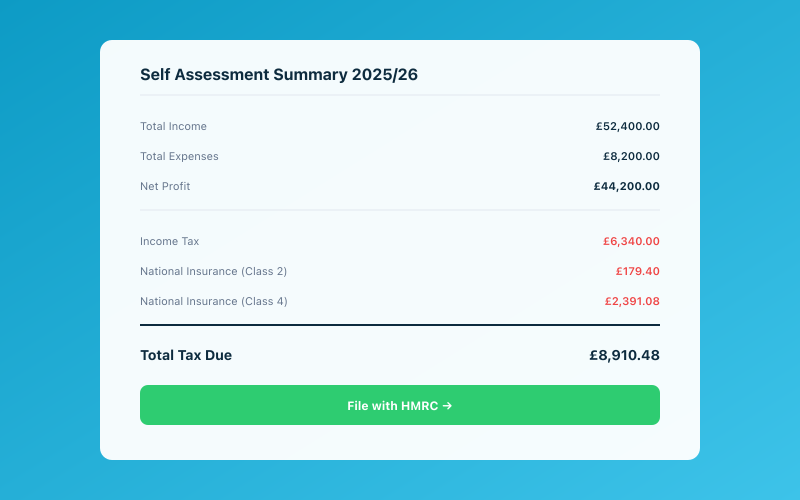 Your Accounted dashboard shows your real-time tax position
Income Documents
You need figures for every source of income during the 2024/25 tax year (6 April 2024 to 5 April 2025). This includes your P60 or P45 from employment, any P11D showing benefits in kind, bank statements showing self-employment income, rental income records, dividend vouchers, interest statements from banks and building societies, and any pension income statements.
Expense Records
If you are self-employed or a landlord, you need records of all allowable expenses. This means invoices, receipts, mileage logs, and records of any capital purchases. If you have been dropping receipts into a shoebox all year, now is the time to sort through them.
Your Government Gateway Login
You need your Government Gateway user ID and password. If you have forgotten these, recovering them takes time, so do this first. HMRC can send a new password by post, which takes seven to ten working days, or you can recover your user ID online if you have your email address and National Insurance number.
Your UTR and National Insurance Number
Your Unique Taxpayer Reference is the ten-digit number HMRC issued when you registered for Self Assessment. You will also need your National Insurance number, which appears on your payslips, P60, or any HMRC correspondence.
A Step-by-Step Approach to Last-Minute Filing
Step 1: Categorise Your Income
Work through each income source one at a time. Employment income is usually the simplest because your P60 gives you the exact figures. Self-employment income requires you to add up all invoices paid during the tax year. Rental income needs a property-by-property breakdown.
Step 2: Total Your Expenses
For self-employment, work through the standard categories: office costs, travel, clothing, staff costs, stock and materials, advertising, business premises costs, and professional fees. Do not guess at figures. HMRC can open an enquiry for up to twelve months after you file, and estimated figures are a common trigger.
Step 3: Check for Reliefs and Allowances
This is where people most commonly lose money. Make sure you have claimed pension contributions, Gift Aid donations, the trading allowance if your self-employment income is low, and any losses carried forward from previous years. If you work from home, you can claim a proportion of household costs or use HMRC's simplified expenses flat rate.
Step 4: Review Before Submitting
Read through every page of your return before you hit submit. Check that income figures match your P60 exactly. Make sure you have not accidentally entered annual figures where monthly ones are needed, or vice versa. Verify your bank details are correct for any refund.
Step 5: Pay What You Owe
Filing and paying are two separate obligations. Even if you file on time, you will face interest charges if your payment is late. If you cannot pay in full, contact HMRC about a Time to Pay arrangement before the deadline. They are generally more receptive to requests made proactively rather than after a payment has been missed.
What Happens If You Miss the Deadline
The penalty structure for late Self Assessment filing is severe and cumulative.
Immediate Penalties
An automatic penalty of £100 applies the moment you miss the 31 January deadline, even if you owe no tax or are due a refund. This penalty is not discretionary and HMRC will issue it automatically.
Three Months Late
After three months, HMRC charges £10 per day for up to 90 days, meaning a potential additional £900 on top of the initial £100.
Six Months Late
At six months, a further penalty of 5% of the tax due is added, with a minimum of £300.
Twelve Months Late
After a full year, another 5% penalty applies, again with a £300 minimum. In serious cases, the penalty can be up to 100% of the tax due.
Interest on Late Payment
Separately from filing penalties, interest accrues on any unpaid tax from 1 February. The current HMRC interest rate is 7.25%, which is significantly higher than most commercial borrowing rates.
Common Mistakes to Avoid in the Rush
When filing under pressure, certain errors crop up repeatedly. Watch out for these.
Entering gross figures instead of net, or the reverse. Your P60 shows both, and the return asks for specific ones. Using the wrong supplementary pages is another common error. If you have rental income, you need the property pages. If you have foreign income, you need the foreign pages. Missing a source of income entirely is also surprisingly common, particularly bank interest, which is now reported automatically to HMRC and will be flagged if you omit it.
Forgetting payments on account is a costly oversight. If your tax bill was over £1,000 last year and less than 80% was collected at source, you will have payments on account due. These are advance payments towards next year's bill, and they catch many people off guard.
Why Next Year Should Be Different
If filing your return felt like an emergency, it is worth asking why. In almost every case, the answer is the same: records were not kept up to date during the year, so everything had to be reconstructed from memory and bank statements in January.
This is exactly the problem that Accounted was built to solve. When you use Accounted throughout the year, your AI bookkeeper Penny categorises every transaction as it happens. You can snap receipts via WhatsApp and they are matched to expenses instantly. By the time January comes around, your tax return data is already complete.
Penny also sends seasonal tax nudges, so you are prompted to check your records, make pension contributions before deadlines, and review your position before the year-end rush. Instead of a frantic January, you get a calm review of figures you have been tracking all year.
The Maths of Staying Organised
Consider the time you have just spent gathering documents, reconciling figures, and filing your return. For most self-employed people, this represents at least a full working day, and often more. At an average self-employed hourly rate, that time has a real cost. Compare that with a few minutes each week categorising transactions in Accounted, and the efficiency gain is obvious.
Make This the Last Stressful January
Whether you have just filed in the nick of time or are dealing with the consequences of missing the deadline, the single best thing you can do right now is set up a system that prevents this from happening again. Accounted costs from just £14 per month, and Penny does the heavy lifting of keeping your records current, categorised, and ready for your return.
Start your free trial of Accounted today and make next January the first one where your Self Assessment is finished before the Christmas decorations come down.
Related Reading
-
Pension Contributions Before Tax Year End: Why April Matters
-
Tax-Efficient Pension Withdrawal Strategies for Self-Employed
Start your free trial and let Penny handle your bookkeeping automatically.
Penny, your AI bookkeeper, tracks your tax position in real time and flags opportunities to reduce your bill. Meet Penny →
Tax & Compliance Specialists
Our tax specialists have decades of combined experience in UK sole trader and small business taxation, MTD compliance, and HMRC submissions. All content is reviewed against current HMRC guidance before publication and updated quarterly to reflect legislative changes.
Ready to try Accounted?
Join UK sole traders who are simplifying their bookkeeping and tax.
Start your 14-day free trial