January Self Assessment Rush — How to Avoid the Panic
It happens every year without fail. The 31 January Self Assessment deadline rolls around, and millions of sole traders and freelancers across the UK find themselves in a familiar predicament: a shoebox of receipts, a foggy memory of what they earned nine months ago, and a creeping sense of dread.
HMRC reported that over 5.4 million people filed their 2023/24 tax returns in January 2025 alone, with more than 38,000 leaving it until the final hours of deadline day. That's a lot of last-minute stress — and most of it is entirely avoidable.
If you've ever been one of those January scramblers, this article is for you. Let's talk about why the rush happens, what it costs you, and — most importantly — how to make sure you never have to go through it again.
Why Does the January Rush Happen?
The most obvious reason is procrastination, but that's only part of the story. For many sole traders, the issue isn't laziness — it's the structure of the tax year itself.
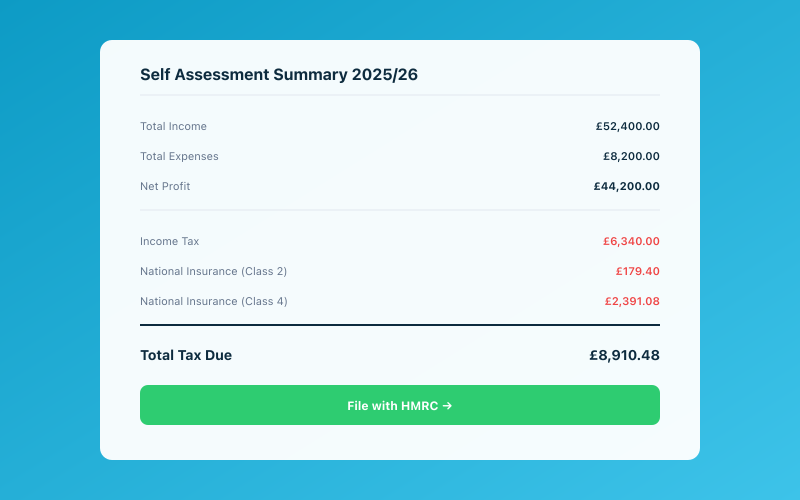 Your Accounted dashboard shows your real-time tax position
The 2025/26 tax year runs from 6 April 2025 to 5 April 2026. Your Self Assessment return for that year isn't due until 31 January 2027. That's nearly ten months after the tax year ends — plenty of time, in theory. But in practice, those months disappear fast.
There are other factors too:
- You're busy running your business. Tax admin feels like a distraction from the work that actually pays the bills.
- The task feels overwhelming. If you haven't kept tidy records, the prospect of sorting through a year's worth of transactions is daunting.
- You're waiting for information. Maybe you're chasing a client for a final invoice, or waiting for bank statements, or hoping your accountant will handle it.
- You're worried about the bill. Some people avoid filing because they're anxious about what they'll owe. The irony is that filing late almost always makes it more expensive, not less.
What the January Rush Actually Costs You
Filing at the last minute isn't just stressful — it can be genuinely expensive.
Penalties for late filing:
- 1 day late: £100 automatic penalty
- 3 months late: £10 per day, up to a maximum of £900
- 6 months late: 5% of the tax due, or £300, whichever is greater
- 12 months late: a further 5% of tax due, or £300, whichever is greater
Interest on late payment: HMRC charges interest on tax paid late. The current interest rate is 7.25% (as of late 2025), which is significantly higher than it was a few years ago.
Rushed errors: When you file in a panic, you're more likely to make mistakes — claiming the wrong amounts, missing legitimate expenses, or entering figures incorrectly. Errors can trigger HMRC enquiries, which are time-consuming and stressful even when you've done nothing wrong.
Missed deductions: If you're racing to file, you might not take the time to claim everything you're entitled to. That could mean paying hundreds of pounds more tax than necessary.
How to Avoid the Panic: A Month-by-Month Approach
The single best way to avoid the January rush is to spread the work across the year. Here's a simple framework.
April–June: Set up your systems. At the start of the new tax year, make sure your bookkeeping is ready to go. If you're using Accounted, your new year rolls over automatically. Set up folders for receipts, connect your bank account, and establish a routine for logging expenses.
July–September: Stay on top of it. Categorise transactions weekly or fortnightly — it takes minutes when you do it regularly. If you use Penny, our AI assistant, much of this can be automated. The goal is to avoid a backlog building up.
October–December: Start your return early. HMRC opens online filing for the current tax year from 6 April onwards. You don't have to wait until January. Filing early doesn't mean you have to pay early — your payment deadline is still 31 January — but it means the hard part is done, and you know exactly what you owe.
January: Relax. If you've followed the steps above, January becomes a non-event. Your return is filed, your payment is calculated, and all that's left is to transfer the money.
Five Practical Tips for a Stress-Free Filing
1. Record expenses as they happen. The best time to log a receipt is when you get it. Snap a photo, categorise it, and move on. If you leave it until the year end, you'll forget what half of them were for.
2. Separate your business and personal finances. A dedicated business bank account makes everything simpler. You can see your income and expenses at a glance without having to unpick personal transactions from business ones.
3. Set aside tax money throughout the year. A good rule of thumb is 25–30% of your profits. Transfer it to a separate savings account each month so it's there when you need it. Accounted can show you a running estimate of your tax liability, so you're never caught off guard. For more on handling a big tax bill, see our guide to planning for a large tax bill.
4. Don't wait for perfection. Your return doesn't have to be filed in one sitting. Start early, do what you can, and come back to fill in the gaps. HMRC allows you to amend your return within 12 months of the filing deadline, so small corrections can be made later.
5. Use software that does the heavy lifting. Manual spreadsheets are fine if you enjoy that sort of thing, but purpose-built software like Accounted saves significant time. Automatic bank feeds, expense categorisation, and built-in tax calculations mean less work for you and fewer opportunities for error.
What If You've Already Missed the Deadline?
If you're reading this and the 31 January deadline has already passed, don't bury your head in the sand. The penalties for late filing get progressively worse the longer you leave it.
File as soon as possible. If you have a reasonable excuse — serious illness, a close bereavement, a natural disaster — HMRC may waive the penalty. "I forgot" or "I was busy" won't usually qualify, but filing promptly limits the damage.
If you can't afford your tax bill in full, contact HMRC to set up a Time to Pay arrangement. They're generally willing to work with people who are upfront about their situation. You can often spread payments over 6–12 months.
The Bigger Picture
The January rush isn't just a personal inconvenience — it's a symptom of a system that asks people to look backwards at an entire year's finances in one go. That's why the shift towards Making Tax Digital and quarterly reporting, while initially more work, could actually make things easier in the long run. When you're updating your records every quarter, there's no massive catch-up to do at the end.
For now, the best defence against January stress is simply staying on top of things throughout the year. It doesn't take much — 15 minutes a week is usually enough for most sole traders.
For more on managing the January deadline, read our January stress guide for sole traders and our Self Assessment deadline overview for 2025/26.
Related reading:
Accounted helps UK sole traders stay on top of their bookkeeping and tax. Start your free 30-day trial at getaccounted.co.uk.
Related Reading
- Overlap Relief — Claiming Back Tax You've Overpaid
- Voluntary Disclosure to HMRC — Coming Clean About Past Mistakes
Start your free trial and let Penny handle your bookkeeping automatically.
Accounted files your Self Assessment directly to HMRC, with your return pre-populated from your records. See Self Assessment filing →
Tax & Compliance Specialists
Our tax specialists have decades of combined experience in UK sole trader and small business taxation, MTD compliance, and HMRC submissions. All content is reviewed against current HMRC guidance before publication and updated quarterly to reflect legislative changes.
Ready to try Accounted?
Join UK sole traders who are simplifying their bookkeeping and tax.
Start your 14-day free trial