How to Plan for a Big Tax Bill (And Not Panic in January)
There's a particular kind of dread that hits self-employed people in late December. The Christmas festivities are wrapping up, the new year is approaching, and lurking just around the corner is the 31 January Self Assessment deadline — along with a tax bill that might be much larger than you'd hoped.
If this sounds familiar, you're not alone. Every January, thousands of sole traders and freelancers face unexpected tax bills and scramble to find the money. Some end up on payment plans with HMRC. Others put it on credit cards. A few simply bury their heads in the sand and hope it goes away (spoiler: it doesn't).
But here's the good news: with a bit of planning throughout the year, you can take the sting out of even a large tax bill. In this guide, we'll show you exactly how to prepare, so that when January rolls around, you're ready — not panicking.
Why Tax Bills Catch People Out
Before we get into the solutions, it helps to understand why so many self-employed people are caught off guard by their tax bill.
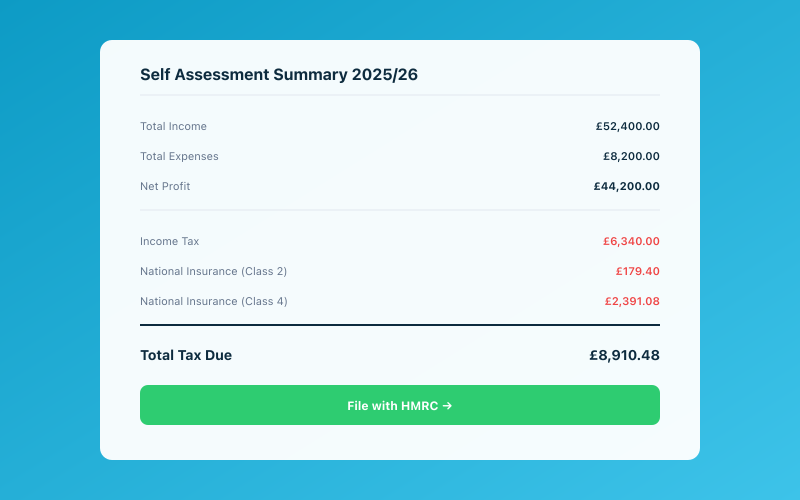 Your Accounted dashboard shows your real-time tax position
The Time Lag
When you're employed, tax is deducted from your pay in real time through PAYE. You never see the money, so you never miss it. When you're self-employed, you receive your full income and are responsible for setting aside money for tax yourself. The bill for the 2025/26 tax year isn't due until 31 January 2027 — potentially nine months after you earned the money. By then, it's easy to have spent it.
Payments on Account
To make matters more complex, HMRC requires most self-employed people to make payments on account — advance payments towards next year's tax bill. Each payment on account is half of the previous year's Self Assessment liability, due on 31 January and 31 July.
This means that in January, you might face a "triple whammy":
- Balancing payment for the tax year that just ended
- First payment on account for the current tax year
- Any Class 2 or Class 4 National Insurance owed
If your income has been growing, the total amount due in January can be eye-watering.
Income Variability
Self-employment income is rarely steady. You might have a brilliant quarter followed by a quiet one. If you don't adjust your tax savings to match your income, you can easily end up short.
Step 1: Know Your Numbers
The foundation of planning for a big tax bill is knowing what you're going to owe. You can't prepare for a number you can't see.
Estimate Your Tax Liability
Here's a rough guide to calculating your income tax and NI for 2025/26:
Income Tax:
- First £12,570 (personal allowance): 0%
- £12,571 to £50,270: 20% (basic rate)
- £50,271 to £125,140: 40% (higher rate)
- Above £125,140: 45% (additional rate)
Class 4 National Insurance:
- On profits between £12,570 and £50,270: 6%
- On profits above £50,270: 2%
Class 2 National Insurance:
- £3.45 per week if profits exceed £12,570 (collected through Self Assessment)
So if your taxable profit is £45,000, your rough tax bill is:
- Income tax: £0 + (£45,000 – £12,570) × 20% = £6,486
- Class 4 NI: (£45,000 – £12,570) × 6% = £1,945.80
- Class 2 NI: £3.45 × 52 = £179.40
- Total: approximately £8,611
That's the bill you need to save for — plus any payments on account.
Use Software to Track in Real Time
Rather than doing back-of-envelope calculations, using bookkeeping software gives you a much more accurate and up-to-date picture. Accounted's AI assistant Penny calculates your estimated tax position in real time as you record income and expenses throughout the year. No more guessing, no more nasty surprises.
Step 2: Set Money Aside from Day One
The most effective way to prepare for a big tax bill is to treat your tax savings as non-negotiable — just like rent or a mortgage payment.
The Percentage Method
Set aside a fixed percentage of every payment you receive into a separate savings account. The right percentage depends on your income level:
- Annual profit under £50,270: Set aside 25–30% (covering 20% income tax + 6% Class 4 NI + a buffer)
- Annual profit between £50,270 and £125,140: Set aside 35–40% on income in this band
- Not sure: 30% is a sensible starting point for most sole traders
Open a Dedicated Tax Savings Account
Don't keep your tax money in your main business or personal account — it's too easy to dip into. Open a separate savings account (ideally one that pays interest) and treat it as money that belongs to HMRC. You're just looking after it temporarily.
Some sole traders even open multiple savings accounts — one for tax, one for VAT (if registered), and one for an emergency fund. Whatever system works for you, the key is separation.
Automate the Process
Set up a standing order or automatic transfer to move money into your tax savings account on the day you receive each payment, or at least weekly. The less you have to think about it, the more consistently you'll do it. If you struggle with this discipline, you're not alone — our guide to dealing with financial anxiety as a sole trader has some practical tips.
Step 3: Understand Your Payment Schedule
Knowing when tax is due is just as important as knowing how much. Missing a deadline means interest and potentially penalties.
Key Dates
- 31 January: Self Assessment tax return deadline for the previous tax year. Also the deadline for paying:
- Any balancing payment for the previous tax year
- First payment on account for the current tax year
- 31 July: Second payment on account for the current tax year
- 5 October: Deadline to register for Self Assessment if you're newly self-employed
Can You Reduce Payments on Account?
If you know your income is going to be lower than last year, you can apply to reduce your payments on account. This is done through your Self Assessment return or by contacting HMRC. Be careful, though — if you reduce them too much and your actual liability is higher, HMRC will charge interest on the shortfall.
For a full explanation, see our detailed guide to payments on account.
Step 4: Reduce Your Tax Bill Legally
The best way to manage a big tax bill is to make it smaller in the first place. There are plenty of legitimate ways to reduce your tax bill as a sole trader.
Claim All Allowable Expenses
Every genuine business expense reduces your taxable profit. Common ones that sole traders overlook:
- Home office costs (flat rate or actual proportion)
- Business mileage at HMRC approved rates
- Professional subscriptions and training
- Accountancy fees and bookkeeping software
- Business insurance
- Phone and broadband (business proportion)
- Marketing and advertising costs
Make Pension Contributions
Pension contributions receive tax relief at your marginal rate — 20%, 40%, or 45%. The annual allowance is £60,000 in 2025/26. A well-timed pension contribution before the end of the tax year can significantly reduce your tax bill while building your retirement fund.
If you haven't contributed in previous years, you may be able to carry forward unused allowances and make a larger contribution. Read more in our guide to pension contributions before April.
Use Capital Allowances
If you've bought equipment, machinery, or vehicles for your business, you can claim capital allowances against your tax bill. The Annual Investment Allowance (AIA) lets you deduct the full cost of qualifying assets up to £1,000,000 per year.
Step 5: File Early
You might think there's no advantage to filing your Self Assessment return early — after all, the payment deadline is still 31 January regardless. But there are good reasons to submit your return as soon as the tax year ends:
- You know exactly what you owe, giving you months to save or plan.
- If you're due a refund, you get it sooner.
- You avoid the January rush, when HMRC's systems are under strain and helplines are jammed.
- You have time to sort out any problems — missing UTR numbers, queries from HMRC, or corrections to your figures.
The online filing window for the 2025/26 tax year opens on 6 April 2026. There's nothing stopping you from submitting in April or May, giving yourself eight or nine months of certainty.
Step 6: If You Can't Pay — Don't Ignore It
Even with the best planning, sometimes a tax bill is simply more than you can afford to pay in one go. This is stressful but manageable — as long as you act rather than hide.
Time to Pay Arrangement
HMRC offers Time to Pay (TTP) arrangements for taxpayers who can't meet their bill by the deadline. You can set up a payment plan online if your bill is £30,000 or less, or call HMRC's payment support helpline for larger amounts.
A TTP plan lets you spread the bill over up to 12 months (sometimes longer in exceptional circumstances). Interest will be charged on the outstanding amount, but you'll avoid the late payment penalties that would otherwise apply.
Don't Wait Until After the Deadline
The earlier you contact HMRC about payment difficulties, the more sympathetic they tend to be. If you call before the deadline and set up a plan, you demonstrate good faith. If you wait until penalties start landing, the conversation is much harder.
Build a Buffer for Next Time
Once you've weathered a difficult January, use the experience as motivation to build a proper cash reserve for next time. Aim for your full estimated tax bill plus 10–15% as a buffer, saved throughout the year. It takes discipline, but the peace of mind is worth every penny.
A Year-Round Tax Planning Calendar
Here's a simple calendar to keep you on track:
- April–June: File previous year's return early. Set your savings percentage for the new tax year. Review expenses and make sure you're claiming everything.
- July: Second payment on account is due (31 July). Review your halfway-year income position.
- August–September: Quiet months for many — a good time to review your financial position and adjust your savings rate if income has changed.
- October–December: Final push on expense claims and pension contributions before the tax year end. Confirm your January payment amount.
- January: Pay your tax bill (31 January). Breathe easy because you planned ahead.
The Right Mindset
Planning for a big tax bill is partly practical and partly psychological. The money sitting in your tax savings account isn't your money — it's HMRC's money that you're holding in trust. Once you genuinely internalise this, setting it aside stops feeling like a sacrifice and starts feeling like responsible business management.
And here's the silver lining: if your tax bill is big, it means you've earned well. That's something to feel good about, even as you write the cheque.
Accounted helps UK sole traders stay on top of their bookkeeping and tax. Start your free 30-day trial at getaccounted.co.uk
Related reading:
- Payments on Account Explained
- How to Pay Your Self Assessment Bill
- Dealing with Financial Anxiety as a Sole Trader
Related Reading
You may also find our Annual Investment Allowance Explained for Small Businesses helpful.
For step-by-step guidance, see our article on How to Handle an HMRC Tax Investigation.
Related reading: National Insurance Calculator for Self-Employed.
Related reading: Should I Register for VAT? Decision Framework.
For more on this topic, read Tax Implications of Closing Your Business.
For more on this topic, read Tax Relief on Charitable Donations for Business Owners.
Start your free trial and let Penny handle your bookkeeping automatically.
Penny, your AI bookkeeper, tracks your tax position in real time and flags opportunities to reduce your bill. Meet Penny →
Tax & Compliance Specialists
Our tax specialists have decades of combined experience in UK sole trader and small business taxation, MTD compliance, and HMRC submissions. All content is reviewed against current HMRC guidance before publication and updated quarterly to reflect legislative changes.
Ready to try Accounted?
Join UK sole traders who are simplifying their bookkeeping and tax.
Start your 14-day free trial