Carry Forward Pension Allowances: Use Previous Years' Unused Allowance
The pension annual allowance for 2025/26 is £60,000. But what if you had a brilliant year and want to put more away? Or what if you have not contributed much in recent years and want to make up for lost time? Carry forward lets you use unused annual allowance from the previous three tax years. Done right, you could contribute well over £100,000 in a single year and get full tax relief. Here is how it works.
What Is Carry Forward?
Carry forward is a rule that lets you bring unused pension annual allowance from the three previous tax years into the current year. If you did not use your full £60,000 allowance in those years, the leftover amount is available to use now.
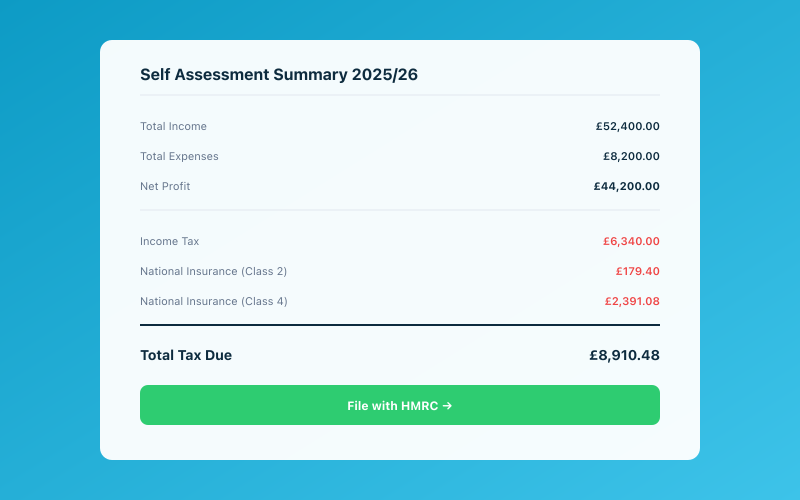 Your Accounted dashboard shows your real-time tax position
This is not a special scheme you apply for. It is built into the pension rules. You do not need to tell HMRC in advance. You simply make the contribution and claim the relief through your Self Assessment return.
This is especially useful for self-employed people whose finances vary from year to year. You do not lose allowance from lean years — you can use it when you are in a better position to contribute.
The Rules
Carry forward sounds straightforward, but there are specific conditions you need to meet.
You must have been a member of a registered pension scheme
To use unused allowance from a previous year, you must have been a member of a UK-registered pension scheme in that year. This does not mean you had to have contributed. Being a member with a £0 contribution is enough.
This catches out some people. If you only opened your first pension in 2024/25, you cannot carry forward unused allowance from 2022/23 or 2023/24 because you were not a member of any scheme in those years.
If you think carry forward might be useful in the future, one strategy is to open a pension now — even with a minimal contribution — so the clock starts ticking on your membership.
You must use the current year's allowance first
Carry forward is not a pick-and-mix. Your contributions in the current year are treated as using up the current year's annual allowance first. Only once the current year's £60,000 is used do the carried forward amounts come into play.
The order of carry forward
Unused allowance from previous years is used in chronological order — oldest first. So if you are contributing in 2025/26, the order is:
- 2025/26 annual allowance (£60,000)
- Unused allowance from 2022/23 (oldest carried forward year)
- Unused allowance from 2023/24
- Unused allowance from 2024/25 (most recent carried forward year)
Any unused allowance from 2021/22 or earlier is gone — you cannot reach back more than three years.
Your earnings must support the contribution
Tax relief on pension contributions is limited to your relevant UK earnings in the year you make the contribution. If your self-employed profit in 2025/26 is £90,000, you can only get tax relief on contributions up to £90,000 — even if your carry forward calculation says you could contribute £200,000.
This is an important point for self-employed people with variable income. The carry forward allowance might be large, but if this year's earnings are modest, you cannot use it all.
The annual allowance in previous years
The annual allowance has been £60,000 since 2023/24. Before that, it was £40,000 for several years (2016/17 to 2022/23). When calculating carry forward, you use the annual allowance that applied in each specific year, not the current year's allowance.
For carry forward into 2025/26:
| Tax year | Annual allowance | Your contribution | Unused allowance | |---|---|---|---| | 2022/23 | £40,000 | What you contributed | The difference | | 2023/24 | £60,000 | What you contributed | The difference | | 2024/25 | £60,000 | What you contributed | The difference | | 2025/26 | £60,000 | Current year | Current year |
Worked Example: Contributing Over £100,000
Let us walk through a realistic scenario.
The situation
Sarah is a self-employed IT consultant. Her profits have varied over the years. She opened a SIPP in 2020, so she has been a pension member throughout the carry forward period.
Here are her contributions:
| Tax year | Annual allowance | Contribution | Unused | |---|---|---|---| | 2022/23 | £40,000 | £5,000 | £35,000 | | 2023/24 | £60,000 | £8,000 | £52,000 | | 2024/25 | £60,000 | £10,000 | £50,000 |
Total unused allowance from previous years: £137,000
In 2025/26, Sarah has her best year ever. Her net profit is £150,000. She wants to make a large pension contribution.
The calculation
Sarah's maximum contribution with tax relief for 2025/26:
- Current year's allowance: £60,000
- Carry forward from 2022/23: £35,000
- Carry forward from 2023/24: £52,000
- Carry forward from 2024/25: £50,000
- Total available: £197,000
But her earnings are £150,000, so her tax-relieved contribution is capped at £150,000.
Sarah decides to contribute £140,000.
The tax saving
Sarah's income before the pension contribution is £150,000. After the £140,000 contribution, her taxable income drops to £10,000.
Without the contribution, her approximate tax bill would be:
- Personal allowance: £0 (lost because income exceeds £125,140)
- Basic rate (20%) on first £37,700: £7,540
- Higher rate (40%) on next £87,430 (£37,701 to £125,140): £34,972
- Additional rate (45%) on remaining £24,860: £11,187
- Total Income Tax: approximately £53,699
With the £140,000 contribution, her taxable income is £10,000:
- Personal allowance: £12,570 (fully restored, since income is below £100,000)
- Tax on £10,000: £0 (below the personal allowance)
- Total Income Tax: £0
Tax saving: approximately £53,699.
She also restores her full personal allowance, which she would have lost entirely without the contribution. And her £140,000 is now in a pension growing tax-free until she draws it in retirement.
This is an extreme example, but it illustrates how powerful carry forward can be. In practice, Sarah pays £112,000 to her SIPP (£140,000 minus 20% basic rate relief). The provider claims £28,000 from HMRC. She claims the remaining higher and additional rate relief through Self Assessment.
A More Modest Example
Not everyone has six-figure profits. Here is a more typical scenario.
The situation
James is a self-employed electrician with a SIPP since 2021 and small contributions (£2,000-£3,000 per year). In 2025/26, his profit is £55,000. He has £152,000 of carried forward allowance, but his earnings cap him at £55,000.
He contributes £25,000. His taxable income drops from £55,000 to £30,000, keeping him entirely within the basic rate band. He saves 40% tax on the £4,730 that would have been taxed at the higher rate. Total tax relief: £5,000 at basic rate plus approximately £946 in higher rate relief.
Common Carry Forward Mistakes
Not being a scheme member
The most common mistake. You cannot carry forward allowance from a year when you were not a member of any registered pension scheme. If you are thinking about making a large contribution in a future year, join a scheme now — even with a token amount.
Forgetting the earnings cap
Carry forward can give you a huge available allowance, but you still need earnings to match. If your self-employed profit is £30,000, you cannot get tax relief on more than £30,000 regardless of how much unused allowance you have.
Getting the annual allowance wrong for previous years
The annual allowance was £40,000 for 2022/23 and earlier carry forward years, not £60,000. Using the wrong figure inflates your carry forward calculation.
Ignoring the tapered annual allowance
If your adjusted income exceeded £260,000 in any of the carry forward years, your annual allowance for that year may have been tapered below the standard amount. You carry forward the unused portion of the tapered allowance, not the standard one.
Not claiming higher rate relief
If you are a higher or additional rate taxpayer, the pension provider only claims basic rate relief. You must claim the rest through Self Assessment. Forgetting this means you lose out on a significant chunk of your tax saving.
Plan Your Contributions with Accounted
Making a large pension contribution using carry forward requires knowing exactly what your self-employed profit is for the year. Contribute too much and you will not get tax relief on the excess. Contribute too little and you miss the opportunity. Accounted keeps your profit figure up to date throughout the year, so you can time your pension contributions with confidence.
If you are thinking about making a larger pension contribution this year, start by getting your numbers right. Try Accounted's free trial and let Penny help you understand exactly where you stand before you commit.
Related Reading
Start your free trial and let Penny handle your bookkeeping automatically.
Penny, your AI bookkeeper, tracks your tax position in real time and flags opportunities to reduce your bill. Meet Penny →
Tax & Compliance Specialists
Our tax specialists have decades of combined experience in UK sole trader and small business taxation, MTD compliance, and HMRC submissions. All content is reviewed against current HMRC guidance before publication and updated quarterly to reflect legislative changes.
Ready to try Accounted?
Join UK sole traders who are simplifying their bookkeeping and tax.
Start your 14-day free trial