Selling a Property Abroad: UK Tax Implications
If you're a UK resident and you sell a property abroad, HMRC wants to know about it. The UK taxes its residents on their worldwide income and gains, which means a villa in Spain, an apartment in France, or a holiday home in Portugal all fall within the scope of UK Capital Gains Tax when you sell them.
This guide covers the CGT rules for UK residents disposing of overseas property in the 2025/26 tax year, including how to report the gain, how double taxation relief works, and the currency pitfalls that catch people out.
UK Residents Are Taxed on Worldwide Gains
The fundamental rule is straightforward. If you're UK resident and domiciled (or deemed domiciled) for tax purposes, you're subject to UK Capital Gains Tax on all your gains, wherever in the world the asset is located.
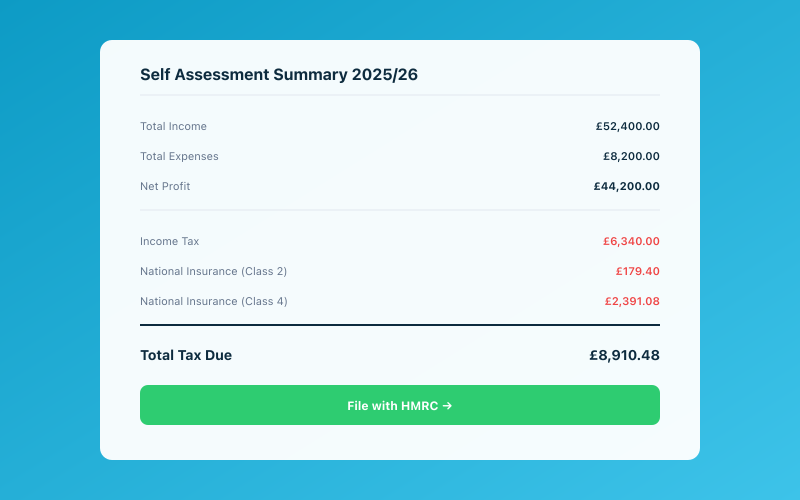 Your Accounted dashboard shows your real-time tax position
This applies whether you bought the property as an investment, a holiday home, or a place you lived in while working abroad. The only property that's exempt from CGT is your main residence under Private Residence Relief, and claiming a foreign property as your main residence while you also have a UK home is possible but heavily scrutinised by HMRC.
The Remittance Basis Exception
If you're UK resident but not domiciled, you may be able to use the remittance basis to avoid UK tax on foreign gains, but only if you don't bring the proceeds into the UK. From April 2025, the remittance basis was replaced by a new Foreign Income and Gains regime for new arrivals to the UK. If you arrived in the UK after April 2025 and qualify for the four-year FIG exemption, your foreign property gains may be exempt. This is a specialist area and you should take advice if it applies to you.
Calculating the Gain
The basic CGT calculation for overseas property works the same as for UK property:
Gain = Sale proceeds minus acquisition cost minus allowable costs minus any available reliefs
Allowable costs include:
- The original purchase price
- Legal fees on purchase and sale
- Stamp duty or equivalent tax paid in the country of purchase
- Estate agent fees on the sale
- The cost of capital improvements (not repairs or maintenance)
CGT Rates on Residential Property
For the 2025/26 tax year, CGT rates on residential property gains are:
- 18% for basic rate taxpayers
- 24% for higher and additional rate taxpayers
These rates apply after the £3,000 annual exempt amount has been used. Remember that the annual exemption covers all your capital gains in the year, not just property gains.
The Currency Question
Here's where selling overseas property gets complicated. The gain must be calculated and reported in pounds sterling, but the purchase, the sale, and any improvement costs may all have been in a foreign currency.
HMRC's rules require you to convert each transaction into sterling at the exchange rate on the date that transaction occurred. You don't use the exchange rate at the date of sale for everything.
How This Creates Hidden Gains (or Losses)
Suppose you bought a property in Spain for EUR 200,000 in 2015, when the exchange rate was EUR 1.40 to GBP 1. Your acquisition cost in sterling was approximately £142,857.
You sell in 2026 for EUR 250,000, when the exchange rate is EUR 1.15 to GBP 1. Your sale proceeds in sterling are approximately £217,391.
Your gain in euros is EUR 50,000. But your gain in sterling is £217,391 minus £142,857 = £74,534. The difference is caused by the pound weakening against the euro over that period. You're being taxed not just on the property's increase in value, but also on the currency movement.
This works both ways. If sterling had strengthened, your sterling gain would be smaller than the euro gain, and you might even have a sterling loss on a property that went up in value in local currency.
There's no separate relief for currency gains embedded in property transactions. The gain is what it is in sterling, and that's what you're taxed on.
Reporting: SA106 and Self Assessment
You report foreign property gains on the Capital Gains Tax pages of your Self Assessment tax return, supplemented by the foreign pages (SA106) if you're claiming double taxation relief.
The SA106 form is where you declare the foreign tax paid and claim credit against your UK tax liability. You'll need to show:
- The country where the property was located
- The gain calculated in sterling
- The foreign tax paid (converted to sterling at the rate on the date it was paid)
- The double taxation relief claimed
The 60-Day Reporting Rule Does NOT Apply
For UK residential property, there's a requirement to report the disposal and make a payment on account of CGT within 60 days of completion. This rule does not apply to overseas property.
If you sell a property abroad, you report and pay through your normal Self Assessment tax return by the 31 January deadline following the end of the tax year. So a sale completing in June 2025 would be reported on your 2025/26 tax return, due by 31 January 2027.
This is one area where overseas property is actually simpler than UK property.
Double Taxation Relief
Most countries tax property gains in the country where the property is located. If you sell a property in France, you'll likely pay French capital gains tax. If you sell in Spain, you'll pay Spanish CGT.
The UK has double taxation agreements (DTAs) with most countries. These agreements typically allow the country where the property sits to tax the gain, and then give you credit in the UK for the foreign tax paid.
How the Credit Works
Double taxation relief is given as a credit against your UK CGT, up to the amount of UK tax on the same gain. It works like this:
- Calculate your UK CGT liability on the foreign property gain
- Determine the foreign tax paid on the same gain
- The credit is the lower of the two amounts
If the foreign tax is higher than the UK tax, you don't get the excess back from HMRC. But you won't pay tax twice on the same gain. If the foreign tax is lower than the UK tax, you'll pay the difference to HMRC.
Countries Without a DTA
If the country where the property is located doesn't have a double taxation agreement with the UK, you can still claim unilateral relief under UK domestic law. The mechanics are similar: you get credit for foreign tax paid, limited to the UK tax on the same income or gain.
Capital Improvements vs Repairs
When calculating your gain, you can deduct the cost of capital improvements but not repairs or maintenance. This distinction is the same as for UK property:
- Capital improvement: Adding an extension, building a swimming pool, installing central heating for the first time. These enhance the property beyond its original state and are deductible from the gain.
- Repair: Replacing a broken boiler, repainting, fixing a roof. These restore the property to its original condition and are not deductible from the gain (though they may be deductible from rental income if the property was let).
Keep receipts and invoices for all capital works. If the work was done by local tradespeople and invoiced in a foreign currency, convert each invoice to sterling at the exchange rate on the date it was paid.
Inherited Property Abroad
If you inherited a foreign property and later sell it, your acquisition cost for CGT purposes is the market value at the date of death, not the original purchase price paid by the person who died. Probate valuations in some countries can be lower than actual market value, so it's worth getting an independent valuation at the date of death if possible.
Inheritance Tax may also apply to the estate, but that's a separate matter and is assessed at the point of death, not at the point of sale.
Practical Tips for Selling Property Abroad
- Get your records in order early. Dig out the original purchase completion statement, any improvement invoices, and the exchange rates for each transaction. HMRC's preferred source for historical exchange rates is its own published rates.
- Instruct a UK-qualified tax adviser alongside your overseas legal team. The overseas solicitor or notary will handle the local tax, but they won't calculate your UK liability.
- Don't forget about overseas withholding tax. Some countries withhold tax from the sale proceeds. This is usually available as a credit under the DTA, but you'll need to account for it.
- Consider timing. If you're close to the end of a tax year, completing the sale in the new tax year gives you a fresh £3,000 annual exemption.
Track Your Foreign Property with Confidence
Keeping accurate records of purchase costs, improvements, exchange rates, and foreign taxes paid is essential when selling property abroad. Accounted helps you track all of this in one place, and Penny can flag the key figures you'll need for your SA106. Start your free trial today and make sure your overseas property disposal is reported correctly and on time.
Related Reading
Start your free trial and let Penny handle your bookkeeping automatically.
Penny, your AI bookkeeper, tracks your tax position in real time and flags opportunities to reduce your bill. Meet Penny →
Tax & Compliance Specialists
Our tax specialists have decades of combined experience in UK sole trader and small business taxation, MTD compliance, and HMRC submissions. All content is reviewed against current HMRC guidance before publication and updated quarterly to reflect legislative changes.
Ready to try Accounted?
Join UK sole traders who are simplifying their bookkeeping and tax.
Start your 14-day free trial