The Tax Implications of Converting Commercial Property to Residential
Converting a commercial property into residential accommodation has become an increasingly popular strategy for property investors and developers in recent years. Whether you're turning a disused office block into flats, converting a shop into a house, or transforming a barn into holiday cottages, the potential returns can be attractive — but the tax implications are complex and can significantly affect the profitability of the project.
In this guide, we'll work through the main tax considerations involved in converting commercial property to residential use, covering Stamp Duty Land Tax, VAT, capital allowances, Capital Gains Tax, and the ongoing income tax treatment of the finished property.
Stamp Duty Land Tax on the Purchase
The first tax advantage of a commercial-to-residential conversion often comes right at the start: when you buy the property.
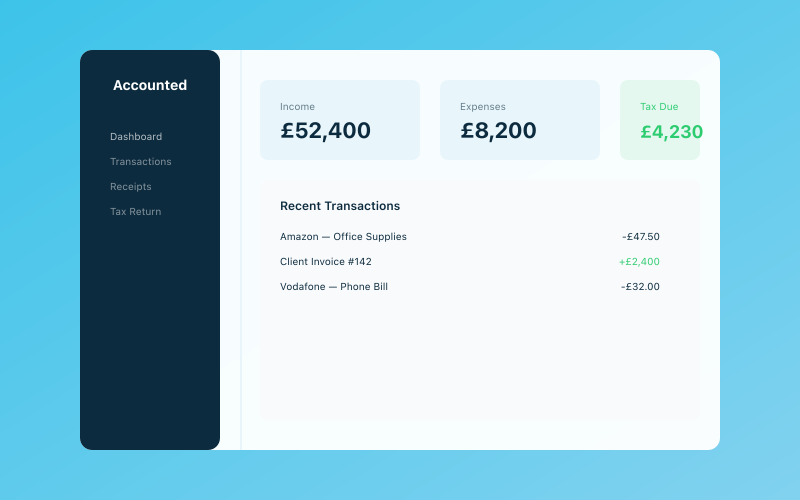 Your Accounted dashboard — income, expenses, and tax at a glance
Stamp Duty Land Tax (SDLT) rates for commercial (non-residential) property are different from residential rates, and in many cases they're more favourable — particularly for properties in the mid-range price brackets.
Commercial SDLT Rates (2025/26)
| Purchase price band | SDLT rate | |---|---| | Up to £150,000 | 0% | | £150,001 to £250,000 | 2% | | Above £250,000 | 5% |
Compare this with residential SDLT rates, where the 3% surcharge for additional properties means a buy-to-let investor would pay significantly more. For example, a property purchased for £300,000 would attract SDLT of:
- As a commercial property: £2,000 (0% on first £150,000, 2% on next £100,000, 5% on remaining £50,000) = £4,500
- As a residential buy-to-let (with 3% surcharge): £2,500 + £2,500 + £9,000 surcharge = £14,000
The saving of £9,500 in this example is substantial, and it's one of the reasons commercial-to-residential conversions are popular with savvy investors.
Mixed-Use Properties
If a property is partly commercial and partly residential at the time of purchase (for example, a shop with a flat above), it may qualify as mixed-use for SDLT purposes. Mixed-use properties attract the non-residential SDLT rates, which again can be more favourable than purely residential rates.
However, HMRC has been scrutinising mixed-use SDLT claims more closely in recent years, so make sure the property genuinely has both commercial and residential elements at the point of purchase.
VAT on the Conversion
VAT is one of the most significant — and most misunderstood — tax implications of a commercial-to-residential conversion. The rules are detailed, but getting them right can save you thousands.
The Reduced Rate of VAT
The conversion of a commercial property into residential dwelling(s) qualifies for the reduced rate of VAT at 5% on the construction services and building materials. This is a significant saving compared to the standard rate of 20%.
To qualify for the 5% rate, the property must not have been used as a dwelling in the two years immediately before the conversion work begins. Since you're converting from commercial use, this condition is typically met.
When Does the 5% Rate Apply?
The reduced rate applies to:
- Labour and materials supplied by builders, electricians, plumbers, and other tradespeople as part of the conversion
- The supply of building materials by the contractor (where they're supplied as part of a single supply of construction services)
It does not automatically apply to:
- Materials you buy separately from a builders' merchant (these are usually charged at 20% VAT, though you may be able to reclaim the difference if you're VAT registered)
- Professional fees such as architects, planning consultants, and surveyors (these are standard-rated at 20%)
- Furnishings and fittings installed after the conversion is complete
Zero Rating for Certain Conversions
In some cases, the conversion may qualify for zero-rate VAT (0%). This typically applies when:
- A non-residential building is being converted into a dwelling that will be sold (rather than let)
- The conversion creates a building that is designed as a dwelling or a number of dwellings, and the person carrying out the conversion intends to sell the finished product
The zero rate is most relevant for property developers who convert and sell. If you're converting to let, the reduced rate of 5% is more likely to apply.
VAT Registration
If you're undertaking a significant conversion project, it may be worth registering for VAT — even if your turnover doesn't exceed the VAT threshold of £90,000. Voluntary registration allows you to reclaim VAT on costs, which can produce savings. However, the interaction between VAT on property transactions is notoriously complex, and specialist advice is strongly recommended.
Capital Allowances
Capital allowances can be a valuable source of tax relief on a commercial-to-residential conversion, but the availability depends on the nature of the work and the intended use of the property.
Capital Allowances on Commercial Property
If you purchase a commercial property, you may be able to claim capital allowances on the plant and machinery (known as "embedded fixtures") already in the building. This includes items such as:
- Heating and ventilation systems
- Electrical systems and lighting
- Lifts
- Sanitary installations
- Cold and hot water systems
However, there are strict rules about how these allowances pass between buyers and sellers. A joint election under Section 198 of the Capital Allowances Act 2001 is typically required, and the previous owner's capital allowances history matters.
Allowances During Conversion
During the conversion process, expenditure on new plant and machinery installed in the property can qualify for capital allowances if the finished property will be used for a qualifying purpose. For furnished holiday lets, capital allowances are available on furniture, equipment, and certain building fixtures. For standard residential lettings, capital allowances on plant and machinery are generally not available — you'd be limited to the Replacement of Domestic Items Relief for furnishings.
For more on FHL capital allowances, see our guide to capital allowances for furnished holiday lets.
Structures and Buildings Allowance (SBA)
The Structures and Buildings Allowance provides a 3% per annum writing-down allowance on the cost of constructing or renovating qualifying structures. For a commercial-to-residential conversion, the construction costs may qualify — though the SBA is not available for residential property that will be let as a standard residential letting. It can apply where the property is used for a qualifying commercial purpose (such as an FHL that is treated as a trade).
Income Tax on Rental Profits
Once the conversion is complete and you start letting the residential property, you'll be subject to income tax on the rental profits in the usual way.
Standard Residential Letting
If the converted property is let as a standard buy-to-let, your rental income is added to your other income for the tax year, and you pay tax at your marginal rate:
- Personal allowance: £12,570 (tax-free)
- Basic rate: 20% on income from £12,571 to £50,270
- Higher rate: 40% on income from £50,271 to £125,140
- Additional rate: 45% on income above £125,140
You can deduct allowable expenses — letting agent fees, insurance, repairs, maintenance, and so on — but mortgage interest is subject to the Section 24 restriction, giving you a 20% tax credit rather than a full deduction. Our guide to Section 24 and mortgage interest covers this in detail.
Furnished Holiday Let
If you convert the commercial property into holiday accommodation that meets the FHL qualifying conditions, you'll benefit from more favourable tax treatment, including:
- Full deduction of mortgage interest (not subject to Section 24)
- Capital allowances on furniture and equipment
- Loss relief against other income
- FHL profits count as relevant earnings for pension purposes
The qualifying conditions require the property to be available for letting for at least 210 days per year and actually let for at least 105 days. See our guide to furnished holiday lettings for the full details.
Capital Gains Tax on Disposal
When you eventually sell the converted property, Capital Gains Tax (CGT) will be payable on any gain. The calculation takes into account your original purchase price, the cost of the conversion, and the sale proceeds.
Allowable Costs
For CGT purposes, you can deduct:
- The original purchase price of the commercial property
- SDLT paid on the purchase
- Solicitor's fees and other acquisition costs
- The cost of the conversion works (including VAT where you couldn't reclaim it)
- Professional fees directly related to the conversion (architect, planning, structural engineer)
- Selling costs (estate agent fees, solicitor's fees)
CGT Rates for Residential Property (2025/26)
- 18% for gains falling within the basic rate band
- 24% for gains falling within the higher rate band
The annual exempt amount for 2025/26 is £3,000 per person.
Developer vs Investor: A Crucial Distinction
If HMRC considers that your conversion project amounts to a trade (property development) rather than an investment, the profit on sale may be treated as trading income rather than a capital gain. Trading income is subject to income tax and National Insurance, which can be significantly more expensive than CGT.
The distinction between property development and property investment is fact-specific. Key factors include the number of projects you undertake, how quickly you sell after completion, and whether the project is an isolated venture or part of an ongoing pattern.
For a detailed comparison, see our guide to property developers vs property investors and how they're taxed differently.
Planning Permission and Permitted Development
While not strictly a tax issue, planning is worth mentioning because it affects the structure of the project and therefore the tax treatment.
Many commercial-to-residential conversions can be carried out under Permitted Development Rights (PDR), which means you don't need full planning permission. Instead, you apply for prior approval, which is a simpler and faster process.
Permitted development applies to certain types of commercial property (particularly offices and light industrial units) and has specific conditions regarding size, location, and the type of residential accommodation created. The availability of PDR can affect the timeline and cost of the project, both of which have tax implications.
Practical Considerations
Finance Structure
How you finance the conversion matters for tax. If you borrow to fund the purchase and conversion, the interest treatment depends on whether the finished property is let as a standard residential letting (Section 24 applies) or as an FHL (full deduction available). If you carry out the work through a limited company, the company can deduct interest as a business expense without the Section 24 restriction.
Record Keeping
Keep meticulous records of every cost associated with the purchase and conversion. Receipts, invoices, contracts, and correspondence should all be retained — they'll be needed for your tax return, any capital allowances claim, and the eventual CGT calculation.
Using a tool like Accounted to track costs as the project progresses can save a significant amount of time and reduce the risk of losing important documents. Having everything categorised and stored digitally from day one makes life much easier when it's time to file.
Professional Advice
Given the complexity of the tax rules around commercial-to-residential conversions — particularly the interaction of SDLT, VAT, capital allowances, and CGT — taking specialist tax advice before you start is strongly recommended. A few hundred pounds spent on advice at the outset can save thousands in unexpected tax bills down the line.
Accounted helps UK sole traders stay on top of their bookkeeping and tax. Start your free 30-day trial at getaccounted.co.uk
Related reading:
- Property Developers vs Property Investors — How They're Taxed Differently
- Capital Allowances for Furnished Holiday Lets
- Section 24 Mortgage Interest — The Complete Guide
Related Reading
- The Annual Tax on Enveloped Dwellings (ATED) — Who Pays It
- Letting Agent Fees — Are They Tax Deductible for Landlords?
- Ground Rent and Service Charges — Are They Tax Deductible?
You may also find our Buy-to-Let Tax Guide: Complete 2026 Overview helpful.
For step-by-step guidance, see our article on How to Calculate Rental Profit for Tax.
For more on this topic, read Furnished Holiday Let Tax Rules 2026.
Related reading: Landlord Allowable Expenses: Complete List.
For more on this topic, read Non-Resident Landlord Tax Rules UK.
For more on this topic, read Property Joint Ownership: Tax Rules for Couples.
See our detailed comparison: Property Trading vs Investment: Tax Differences.
For more on this topic, read Rent-a-Room Relief: £7,500 Tax-Free Income.
For more on this topic, read Tax Implications of Renting a Room in Your Own Home.
Explore our property features built specifically for UK landlords.
Accounted includes built-in property management — track rental income, Section 24, and allowable expenses across multiple properties. See property features →
Tax & Compliance Specialists
Our tax specialists have decades of combined experience in UK sole trader and small business taxation, MTD compliance, and HMRC submissions. All content is reviewed against current HMRC guidance before publication and updated quarterly to reflect legislative changes.
Ready to try Accounted?
Join UK sole traders who are simplifying their bookkeeping and tax.
Start your 14-day free trial