Property Developers vs Property Investors — Different Tax Rules Explained
If you make money from property in the UK, the way HMRC taxes you depends heavily on one question: are you a property developer or a property investor? The answer determines whether your profits are treated as trading income (subject to Income Tax and National Insurance) or capital gains (subject to Capital Gains Tax) — and the difference can amount to thousands of pounds.
Getting this classification wrong can lead to unexpected tax bills, penalties, and a very uncomfortable conversation with HMRC. This guide explains how the two activities are taxed differently, how HMRC decides which category you fall into, and what you can do to plan accordingly.
The Fundamental Difference
In simple terms:
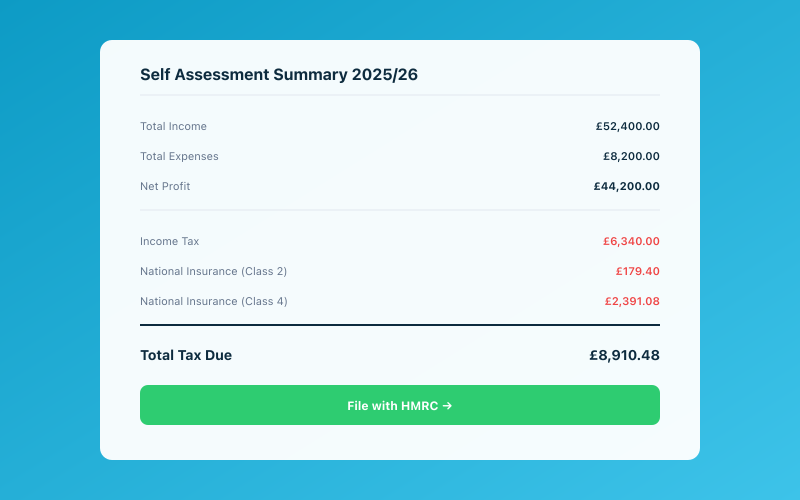 Your Accounted dashboard shows your real-time tax position
-
Property investors buy properties to hold and rent out. They earn rental income over time and may eventually sell at a profit. The rental income is taxed as property income, and any profit on sale is subject to Capital Gains Tax (CGT).
-
Property developers buy properties (or land) with the intention of improving or converting them and selling them at a profit. The profit on sale is treated as trading income — just like any other business — and is subject to Income Tax and National Insurance.
The distinction matters enormously because the tax rates and available reliefs are very different.
How Property Investors Are Taxed
Rental Income
Rental income is taxed as property income under Income Tax rules. For the 2025/26 tax year:
- Personal Allowance: £12,570 tax-free (shared across all income sources).
- Basic rate (20%): On taxable income between £12,571 and £50,270.
- Higher rate (40%): On taxable income above £50,270.
Investors can deduct allowable expenses from their rental income, including letting agent fees, maintenance and repairs, insurance, and accountancy costs. However, since April 2020, mortgage interest relief for individual landlords has been restricted to a basic rate tax credit (20%), rather than a full deduction — this is the Section 24 restriction that has significantly increased the tax burden for higher-rate taxpaying landlords.
Capital Gains Tax on Property Sales
When a property investor sells a rental property at a profit, Capital Gains Tax applies. The rates for residential property are:
- 18% for gains falling within the basic rate band.
- 24% for gains falling within the higher rate band.
Each individual also has an Annual Exempt Amount — currently £3,000 for 2025/26 — which can be set against gains before tax is calculated.
Crucially, investors can benefit from various CGT reliefs, including Private Residence Relief (if the property was once their main home) and the ability to offset capital losses from other disposals. There is also a 60-day reporting and payment requirement for UK residential property disposals.
For a detailed look at CGT on property, see our Capital Gains Tax property guide.
Allowable Costs for CGT Purposes
When calculating the capital gain, investors can deduct:
- The original purchase price (including Stamp Duty Land Tax and legal fees).
- The cost of improvements that added value to the property (a new extension, for example — but not routine repairs).
- Selling costs (estate agent fees, solicitor fees, EPC costs).
How Property Developers Are Taxed
Trading Income
Property development profits are treated as trading income, which means they are subject to Income Tax and National Insurance — just like a self-employed builder, plumber, or shop owner. The rates are the same:
- Personal Allowance: £12,570 tax-free.
- Basic rate (20%): £12,571 to £50,270.
- Higher rate (40%): Above £50,270.
On top of Income Tax, sole trader developers pay:
- Class 2 NI: £3.45 per week.
- Class 4 NI: 6% on profits between £12,570 and £50,270.
This means the combined marginal tax rate for a basic rate developer is around 29% (20% Income Tax plus 6% NI plus Class 2), compared to 18% CGT for a basic rate investor. At the higher rate, a developer pays 40% Income Tax plus NI, compared to 24% CGT for an investor. The difference is substantial.
Deductible Expenses for Developers
As a trader, developers can deduct a wide range of costs against their income:
- Purchase price of the property or land.
- Stamp Duty Land Tax.
- Legal and professional fees (solicitors, surveyors, architects, planning consultants).
- Construction and renovation costs — materials, labour, subcontractors.
- Finance costs — mortgage interest and arrangement fees are fully deductible for developers (unlike investors, who face the Section 24 restriction).
- Marketing and selling costs — estate agent fees, staging, photography.
- Project management and administrative costs.
The ability to fully deduct finance costs is one of the few tax advantages developers have over investors.
No CGT Annual Exempt Amount
Because development profits are trading income rather than capital gains, developers cannot use the CGT Annual Exempt Amount. Every pound of profit is taxable.
How Does HMRC Decide If You Are a Developer or an Investor?
This is where things get complicated. HMRC does not simply accept your own classification — they look at the overall picture. The key factors they consider are sometimes called the "badges of trade":
1. Your Intention When You Bought the Property
Did you buy it with the intention of holding it long-term for rental income, or did you always plan to sell it at a profit after improvement? HMRC may look at evidence such as:
- Your business plan or financial projections at the time of purchase.
- Whether you sought planning permission for development work shortly after buying.
- How the purchase was financed (development finance vs a buy-to-let mortgage).
2. The Length of Ownership
Investors typically hold properties for years. If you buy, renovate, and sell within a few months, it looks much more like trading.
3. The Number and Frequency of Transactions
A one-off sale of a rental property is unlikely to be classified as trading. But if you are buying, renovating, and selling multiple properties each year, HMRC is far more likely to consider you a developer.
4. The Nature and Extent of the Work
If you carry out substantial development work — converting a house into flats, building an extension, or a full gut renovation — it points towards development. If you simply buy, hold, and rent out with minimal changes, it points towards investment.
5. How the Purchase Was Financed
Bridging loans and development finance suggest trading. Long-term buy-to-let mortgages suggest investment.
6. Your Existing Business or Skills
If you already work in construction, property, or a related field, HMRC may argue that your property activities are an extension of your trade. This is not conclusive on its own, but it forms part of the overall picture.
The Grey Area
Many property activities do not fit neatly into one category. What about a landlord who renovates a property to increase its rental value, holds it for two years, and then sells? The answer depends on the specific facts — and this is where professional advice becomes valuable.
It is also possible to be both a developer and an investor simultaneously, with different properties treated differently. A portfolio landlord who occasionally takes on a development project would have rental properties taxed as investment income and the development project taxed as trading income.
VAT — A Critical Difference
VAT is one area where the distinction between developer and investor has particularly sharp consequences.
Investors
Residential rental income is exempt from VAT. This means investors do not charge VAT on rent and generally cannot reclaim VAT on their costs. If you also carry out taxable activities (such as commercial property letting where you have opted to tax), partial exemption rules apply.
Developers
Property development can trigger VAT obligations. The rules are complex, but in broad terms:
- New residential buildings are zero-rated for VAT. This means developers can reclaim VAT on construction costs but do not charge VAT on the sale — a significant cash-flow advantage.
- Renovations and conversions of existing buildings may qualify for a reduced VAT rate of 5% in certain circumstances (for example, converting a commercial building into residential use).
- Commercial property development is standard-rated at 20%.
If your taxable supplies exceed the £90,000 VAT registration threshold, you must register. Our VAT registration threshold guide has more detail.
Stamp Duty Land Tax
Both developers and investors pay SDLT when purchasing property. The rates are the same, but developers who buy and sell frequently pay SDLT more often, which increases their overall costs.
Both categories are subject to the 5% additional rate surcharge on second properties (for purchases of residential property where you already own another property). Developers who have purchased properties through a company may face the 17% flat rate for companies buying residential property worth more than £500,000.
Company Structure Considerations
Some property professionals operate through limited companies. For investors, this can help avoid the Section 24 mortgage interest restriction (companies can still deduct mortgage interest in full). For developers, corporation tax (currently 25% for profits over £250,000, with a small profits rate of 19% for profits under £50,000) may be lower than the combined Income Tax and NI rates for higher earners.
However, extracting profits from a company triggers additional tax (through dividends or salary), so the overall picture is not always straightforward. The right structure depends on your specific circumstances, borrowing needs, and long-term plans.
Record-Keeping
Whether you are a developer or an investor, HMRC expects thorough records:
- Keep all purchase and sale documentation — contracts, completion statements, solicitor correspondence.
- Record every expense with receipts or invoices.
- Maintain a clear paper trail showing your intentions at the time of each purchase.
- Photograph receipts as you go. Using Penny inside Accounted, you can categorise expenses automatically and keep everything organised.
- Separate records for each property or project.
For investors, keeping records that demonstrate long-term investment intent can be important if HMRC ever questions whether you are actually a developer. For developers, detailed project accounts show HMRC that you are reporting your trading profits accurately.
Getting It Right
The distinction between property development and property investment is one of the most contested areas in UK tax. The stakes are high — the wrong classification can mean paying significantly more tax than necessary, or facing penalties if HMRC disagrees with your position.
If you operate in both spaces, or if your activities sit in the grey area, professional advice is well worth the investment. An accountant with property tax experience can help you structure your affairs tax-efficiently and ensure you are prepared if HMRC asks questions.
Accounted helps UK sole traders stay on top of their bookkeeping and tax. Start your free 30-day trial at getaccounted.co.uk.
Related reading:
- Capital Gains Tax on Property — A Complete Guide
- VAT Registration Threshold Guide
- The Complete List of Sole Trader Expenses
Related Reading
- Holiday Lets vs Long-Term Lets — Which Is More Tax-Efficient?
- Joint Property Ownership — How to Split Rental Income for Tax
Explore our property features built specifically for UK landlords.
Accounted includes built-in property management — track rental income, Section 24, and allowable expenses across multiple properties. See property features →
Tax & Compliance Specialists
Our tax specialists have decades of combined experience in UK sole trader and small business taxation, MTD compliance, and HMRC submissions. All content is reviewed against current HMRC guidance before publication and updated quarterly to reflect legislative changes.
Ready to try Accounted?
Join UK sole traders who are simplifying their bookkeeping and tax.
Start your 14-day free trial