The VAT Threshold 2025/26: When You Must Register
The VAT Registration Threshold in 2025/26
The compulsory VAT registration threshold for 2025/26 is £90,000. If your taxable turnover exceeds this amount in any rolling 12-month period, you must register for VAT. This threshold has been set at £90,000 since April 2024.
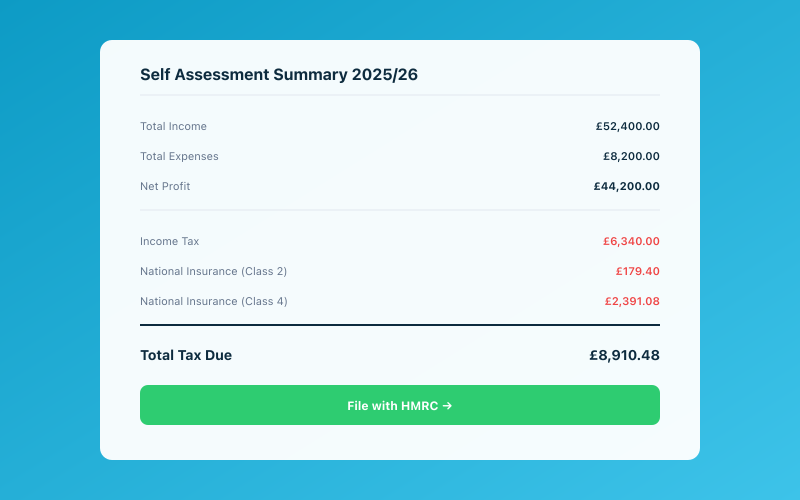 Your Accounted dashboard shows your real-time tax position
Getting VAT registration wrong — whether registering too late or failing to monitor your turnover — can result in penalties, backdated VAT bills, and serious cash flow problems. This guide explains exactly when you need to register, how to monitor your turnover, and what happens if you miss the deadline.
When Must You Register?
There are two tests for compulsory registration. You must register if either one is met.
The Historic Test (Looking Back)
At the end of any month, if your total VAT-taxable turnover for the previous 12 months exceeds £90,000, you must register. You have 30 days from the end of that month to notify HMRC, and your registration takes effect from the first day of the second month after you exceeded the threshold.
Example: On 31 October 2025, you realise your taxable turnover for the 12 months from 1 November 2024 to 31 October 2025 has reached £92,000. You must notify HMRC by 30 November 2025. Your VAT registration takes effect from 1 December 2025.
The Future Test (Looking Forward)
If at any point you expect your taxable turnover to exceed £90,000 in the next 30 days alone, you must register immediately. This typically applies when you win a large contract or receive an unusually big order.
Example: On 15 March 2026, you sign a contract worth £95,000 to be completed within the next month. Even though your rolling 12-month turnover is below £90,000, you must register because you expect to exceed the threshold in the next 30 days. You notify HMRC by 14 April 2026, and registration takes effect from 15 March 2026 (the date you became aware).
What Counts as Taxable Turnover?
Taxable turnover includes the total value of everything you sell that is not exempt from VAT. This includes:
- Standard rated supplies (most goods and services) at 20%
- Reduced rate supplies (some energy, children's car seats) at 5%
- Zero-rated supplies (most food, children's clothing, books) at 0%
Zero-rated sales count towards the threshold even though the VAT rate is 0%. This catches some people off guard — if you sell mostly zero-rated goods, you can hit the £90,000 threshold without ever charging VAT to your customers.
Exempt supplies (such as insurance, education, and residential property rental) do not count towards the threshold.
What About Occasional Large Sales?
If you make a one-off sale that pushes you over the threshold and you can demonstrate to HMRC that your turnover will not stay above £90,000 going forward, you may be able to avoid registration. This is the "exception from registration" and you must apply for it — it is not automatic. HMRC will look at whether the spike in turnover was genuinely temporary.
How to Monitor Your Turnover
The rolling 12-month test means you need to check your position at the end of every month. This is not something you can do once a year and forget about.
Practical Approach
At the end of each month, add up your total taxable turnover for the preceding 12 months. If it is approaching £90,000, start paying close attention. Once you cross the line, the clock starts ticking on your 30-day notification deadline.
Many small business owners use accounting software to track this automatically. Accounted monitors your turnover in real time, and Penny will flag when you are approaching the VAT threshold. This is far more reliable than manually checking a spreadsheet each month.
Common Mistakes
- Forgetting to include all revenue streams. If you have a main business and some freelance work on the side, all your taxable turnover is combined for VAT purposes (as long as it comes from the same legal entity — you as a sole trader).
- Not counting zero-rated sales. As mentioned above, zero-rated is still taxable turnover.
- Using the wrong 12-month period. The test is a rolling 12 months ending at the end of each calendar month, not your accounting year.
- Confusing turnover with profit. The £90,000 threshold is based on turnover (total sales), not profit. Your expenses are irrelevant.
Voluntary Registration
You can register for VAT even if your turnover is below £90,000. This is called voluntary registration, and it can sometimes work in your favour.
Benefits of Voluntary Registration
Reclaiming VAT on purchases. Once registered, you can claim back the VAT on your business purchases. If you spend a lot on materials, equipment, or other VAT-inclusive costs, this can be a significant saving.
Professional appearance. Some businesses, particularly those serving other VAT-registered businesses, find that having a VAT number adds credibility. It signals that the business has a certain level of turnover.
Preparing for the threshold. If your turnover is growing and you expect to hit £90,000 soon, registering early avoids the rush and lets you establish systems before it becomes compulsory.
Drawbacks of Voluntary Registration
Higher prices for non-VAT-registered customers. Your prices effectively go up by 20% for customers who cannot reclaim VAT, making you less competitive.
Administrative burden. You must submit VAT returns quarterly, keep detailed records, and comply with Making Tax Digital for VAT.
When Voluntary Registration Makes Sense
Voluntary registration is usually beneficial if:
- Most of your customers are VAT-registered businesses (they reclaim the VAT you charge, so your prices are effectively the same to them)
- You have high VAT-inclusive costs (materials, stock, equipment)
- You are close to the threshold and will need to register soon anyway
It is usually not worth it if:
- Your customers are mainly consumers or non-registered businesses
- Your costs are mostly staff wages (no VAT to reclaim on salaries)
- Your turnover is well below £90,000 with no growth expected
Penalties for Late Registration
If you should have registered but failed to do so, HMRC will register you from the date your obligation arose (not the date you eventually apply). You will then owe VAT from that effective registration date, calculated on all your taxable sales during that period.
The Financial Impact
You must pay output VAT on all sales since the date you should have been registered. You bear the cost yourself — you cannot retrospectively invoice customers for VAT in most cases.
HMRC charges percentage-based penalties: up to 5% of VAT due if up to 9 months late, up to 10% if 9-18 months late, and up to 15% if over 18 months late. Interest also runs from the date the VAT should have been paid.
The VAT Deregistration Threshold
If your taxable turnover drops below the deregistration threshold — £88,000 in 2025/26 — you can apply to deregister. This is optional; you can stay registered voluntarily if you prefer.
Deregistration makes sense if your turnover has fallen permanently (not just a temporary dip) and the administrative burden of VAT returns outweighs the benefit of reclaiming input VAT.
When you deregister, you may need to account for VAT on any stock and assets you hold at the deregistration date if you claimed input VAT on them when you bought them. There is an exception if the VAT due would be £1,000 or less.
What to Do When You Approach the Threshold
Step 1: Monitor Monthly
Check your rolling 12-month turnover at the end of each month. Set up a reminder or use software that does it for you.
Step 2: Plan Ahead
If you are approaching £90,000, start thinking about how VAT will affect your pricing, cash flow, and administration. Will you absorb the VAT or pass it on to customers?
Step 3: Choose a VAT Scheme
When you register, consider whether the flat rate scheme or cash accounting scheme might suit your business. These can simplify administration and improve cash flow.
Step 4: Set Up Digital Records
Making Tax Digital for VAT requires you to keep digital records and submit returns using compatible software. Get this set up before your first VAT return is due.
Accounted is fully MTD-compatible and makes VAT tracking straightforward. Penny categorises your transactions with the correct VAT treatment as they come in, so your VAT return practically prepares itself. If you are approaching the threshold or have recently registered, start your free trial and see how much time it saves you on VAT compliance.
Related Reading
Start your free trial and let Penny handle your bookkeeping automatically.
Penny, your AI bookkeeper, tracks your tax position in real time and flags opportunities to reduce your bill. Meet Penny →
Tax & Compliance Specialists
Our tax specialists have decades of combined experience in UK sole trader and small business taxation, MTD compliance, and HMRC submissions. All content is reviewed against current HMRC guidance before publication and updated quarterly to reflect legislative changes.
Ready to try Accounted?
Join UK sole traders who are simplifying their bookkeeping and tax.
Start your 14-day free trial