How Much Can I Earn Before Registering as Self-Employed?
The £1,000 Trading Allowance
If you earn money from self-employment or casual trading, you do not always need to tell HMRC about it. The trading allowance gives every individual up to £1,000 of tax-free trading income per tax year. If your gross self-employed income (that is, your total income before deducting any expenses) is £1,000 or less, you:
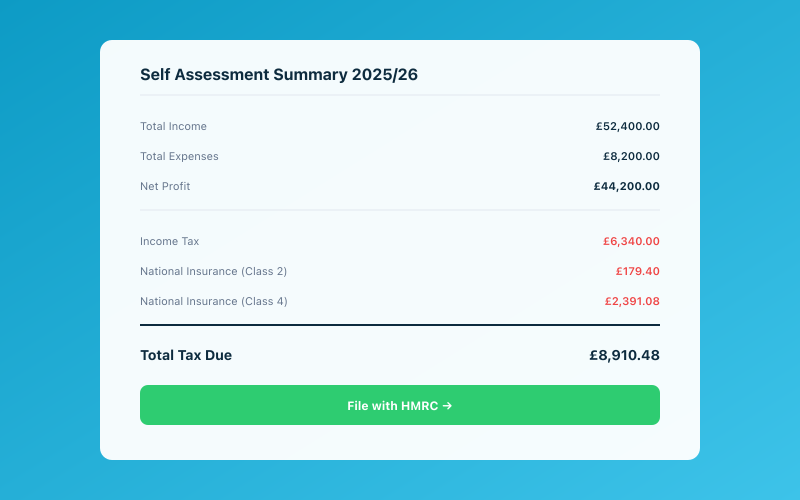 Your Accounted dashboard shows your real-time tax position
- Do not need to register as self-employed with HMRC
- Do not need to file a Self Assessment tax return (for this income alone)
- Do not need to pay any tax on it
This applies to the 2025/26 tax year and has been in place since 2017/18. The £1,000 threshold is based on your gross income, not your profit. So even if you had expenses that would bring your profit below £1,000, if your total receipts exceed £1,000 you still need to register.
What Counts as Trading Income?
The trading allowance covers income from:
- Selling goods or services on a self-employed basis
- Freelance or casual work
- Selling items you have made or bought for resale
- Providing services through platforms like Etsy, eBay (if trading rather than selling personal items), Fiverr, or Deliveroo
- Odd jobs like gardening, tutoring, or dog walking
It does not cover:
- Income from employment (that is already taxed through PAYE)
- Rental income from property (there is a separate £1,000 property allowance for that)
- Income from a partnership where you are already registered
A Common Example
Suppose you have a full-time job but earn £800 on the side selling handmade candles at craft fairs during the year. Your total self-employed income is £800, which is below the £1,000 trading allowance. You do not need to register as self-employed or report this income.
But if those candle sales grow to £1,200 the following year, you now exceed the £1,000 threshold and must register with HMRC.
What Happens When You Earn Over £1,000?
Once your gross self-employed income exceeds £1,000 in a tax year, you must register as self-employed with HMRC. The deadline for registration is 5 October following the end of the tax year in which you started trading.
For example, if you started a side business in July 2025 (during the 2025/26 tax year), you would need to register by 5 October 2026.
However, it is worth registering as soon as you know you will exceed the threshold, rather than waiting until the last minute. Registering early means you get your Unique Taxpayer Reference (UTR) number sooner, which you will need to file your Self Assessment tax return.
You Still Get the Trading Allowance
Even after registering, you can still use the £1,000 trading allowance. When filing your tax return, you have a choice:
- Use the trading allowance — Deduct the flat £1,000 from your gross income instead of your actual expenses. This is simpler but only beneficial if your actual expenses are less than £1,000.
- Claim actual expenses — Deduct your real business expenses from your income. This is better if your expenses exceed £1,000.
You cannot do both. You either use the trading allowance or claim actual expenses — not a combination of the two.
Penalties for Late Registration
If you fail to register with HMRC on time, you could face penalties. The penalty system works on a behaviour basis:
Failure to Notify
HMRC treats late registration as a "failure to notify." The penalty depends on whether the failure was:
- Non-deliberate — Where you genuinely did not know you needed to register. The penalty can range from 0% to 30% of the tax due for the period you should have been registered. In practice, if you come forward voluntarily and have a reasonable excuse, HMRC may charge no penalty at all.
- Deliberate — Where you knew you should register but chose not to. Penalties range from 20% to 70% of the tax due.
- Deliberate and concealed — Where you actively hid your self-employment. Penalties range from 30% to 100% of the tax due.
Interest on Late Tax
On top of any penalty, HMRC will charge interest on any tax that should have been paid earlier. The interest rate is the Bank of England base rate plus 2.5%.
The "Reasonable Excuse" Defence
If you have a genuine reason for not registering on time — such as serious illness, bereavement, or reliance on incorrect professional advice — HMRC may accept this as a reasonable excuse and waive or reduce the penalty. However, "I did not know I needed to register" is not always accepted, especially if HMRC considers the information was readily available.
The £1,000 Threshold and Multiple Income Sources
The £1,000 trading allowance is a single allowance that covers all your trading income combined. If you have multiple self-employed activities — say you earn £600 from tutoring and £500 from selling crafts — your total trading income is £1,100, which exceeds the threshold. You would need to register.
You cannot claim a separate £1,000 allowance for each activity.
What About the Property Allowance?
There is a separate £1,000 property allowance for income from land or property. This works in a similar way to the trading allowance: if your gross property income is £1,000 or less, you do not need to report it to HMRC.
The two allowances are independent. You could earn up to £1,000 from trading and up to £1,000 from property without needing to report either.
Should You Register Even If You Earn Under £1,000?
In some cases, yes. There are a couple of reasons you might choose to register voluntarily:
Building a National Insurance Record
When you are registered as self-employed and earning above the Small Profits Threshold (£6,845 for 2025/26), you pay Class 2 National Insurance contributions. These count towards your state pension entitlement. If you are not building NI credits through employment or other means, voluntary registration and paying Class 2 NI can protect your future state pension.
Claiming Losses
If your business makes a loss in its early years (expenses exceed income), you can only offset that loss against other income or carry it forward if you are registered and filing a tax return. If you do not register, you lose the ability to use those losses.
Establishing a Track Record
If you plan to grow your business, having a registered history with HMRC and filed tax returns creates a track record. This can be useful for mortgage applications, business loans, and building credibility.
How Accounted Helps You Stay on Top of Things
One of the biggest risks for new self-employed people is not realising they have crossed the £1,000 threshold until long after the fact. If you are doing small amounts of freelance work or side selling, it is easy to lose track of the total.
Accounted helps you monitor your self-employed income from the start. Connect your bank account and Penny, our AI bookkeeper, will track your business income as it comes in. If you are approaching the £1,000 mark, you will know about it in time to register and set up proper records — not months later when HMRC comes asking.
Whether you are just testing the waters with a side hustle or ready to go full-time, Accounted scales with you. Start your free trial today and let Penny keep your bookkeeping sorted from day one, so you never have to worry about missing a threshold or a deadline.
Related Reading
-
Can I Claim Travel Expenses as Self-Employed? The Complete Rules
-
Loss Relief for Sole Traders: How to Use Business Losses to Reduce Tax
Start your free trial and let Penny handle your bookkeeping automatically.
Penny, your AI bookkeeper, tracks your tax position in real time and flags opportunities to reduce your bill. Meet Penny →
Tax & Compliance Specialists
Our tax specialists have decades of combined experience in UK sole trader and small business taxation, MTD compliance, and HMRC submissions. All content is reviewed against current HMRC guidance before publication and updated quarterly to reflect legislative changes.
Ready to try Accounted?
Join UK sole traders who are simplifying their bookkeeping and tax.
Start your 14-day free trial