How to Claim Mileage as Self-Employed: HMRC Rates and Rules
If you use your own car, van, motorcycle, or bicycle for business purposes, you can claim tax relief on the mileage. HMRC offers two methods: simplified mileage rates (also called approved mileage allowance payments) or actual running costs. For most self-employed people, the simplified rates are easier to use and often more generous than tracking actual costs.
This guide covers the current rates, what qualifies as business mileage, the records you need to keep, and how to choose between the two methods.
HMRC Approved Mileage Rates for 2025/26
The approved mileage allowance payment (AMAP) rates for the 2025/26 tax year are:
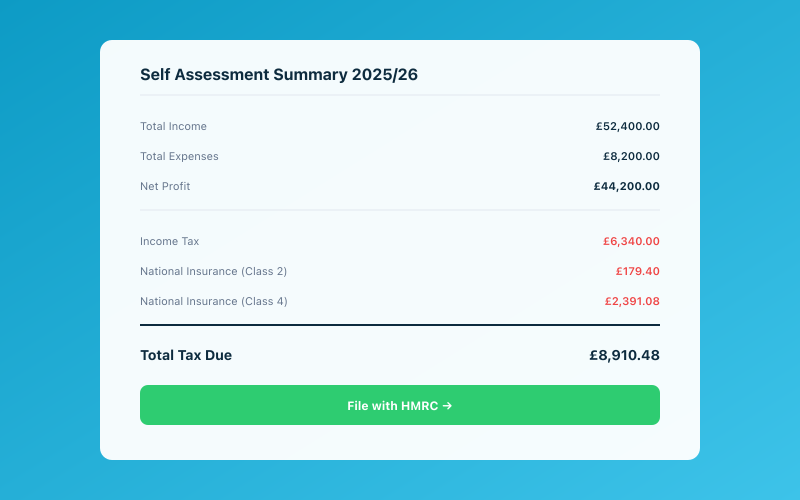 Your Accounted dashboard shows your real-time tax position
| Vehicle | First 10,000 miles | Over 10,000 miles | |---------|--------------------|--------------------| | Car or van | 45p per mile | 25p per mile | | Motorcycle | 24p per mile | 24p per mile | | Bicycle | 20p per mile | 20p per mile |
These rates are designed to cover all the costs of running the vehicle — fuel, insurance, road tax, servicing, repairs, depreciation, and breakdown cover. When you use the simplified mileage rates, you cannot claim any of these costs separately.
How the Rates Work
The 45p rate applies to the first 10,000 business miles you drive in the tax year. After that, the rate drops to 25p per mile. The threshold resets at the start of each tax year.
For example, if you drive 14,000 business miles in 2025/26:
- First 10,000 miles at 45p = £4,500
- Remaining 4,000 miles at 25p = £1,000
- Total mileage claim: £5,500
This £5,500 is deducted from your taxable profit, reducing your tax bill.
What Counts as Business Mileage
Not every journey in your car qualifies as business mileage. HMRC draws a clear distinction between business travel and commuting.
Journeys That Qualify
- Travelling from one business location to another (for example, from your office to a client's premises).
- Travelling to meet a client or supplier.
- Travelling to a temporary workplace. If you work at a location for less than 24 months and you do not expect it to become permanent, journeys to that location count as business mileage.
- Travelling to buy business supplies.
- Travelling to the bank or post office for business purposes.
- Travelling to a training course that is relevant to your business.
Journeys That Do Not Qualify
- Commuting — travelling from your home to your regular place of work is never business mileage. This is the most important rule to understand.
- Personal journeys of any kind.
- Journeys that are mainly personal but include a minor business element (for example, popping into a client's office on the way to the supermarket does not make the entire trip business mileage).
Home-Based Businesses
If you work from home and do not have a separate office, your home is your regular place of work. This means that any journey from your home to visit a client, attend a meeting, or pick up supplies is business mileage. This is a significant advantage of being home-based — you avoid the commuting exclusion entirely.
However, if you rent an office or workshop and travel there from home each day, that daily commute does not count.
Record Keeping Requirements
HMRC requires you to keep a contemporaneous mileage log — that is, a log made at or near the time of each journey, not reconstructed from memory months later. Your log should record:
- The date of each journey.
- The starting point and destination.
- The purpose of the journey (for example, "Client meeting with ABC Ltd" or "Collect supplies from B&Q").
- The total miles driven.
You do not need to record your odometer reading for every trip, but it helps if HMRC ever queries your figures. Having the odometer reading at the start and end of the tax year provides a useful cross-check against your claimed business miles.
What Happens Without a Log
If HMRC opens an enquiry and you cannot produce a mileage log, they may disallow your mileage claim entirely. Even a partial log is better than nothing, but the safest approach is to record every business journey as it happens.
Many people find it easiest to keep a small notebook in the car, use a notes app on their phone, or use dedicated mileage-tracking software.
Simplified Mileage Rates vs Actual Costs
HMRC gives you a choice between two methods.
Method 1: Simplified Mileage Rates
This is the method described above — 45p per mile for the first 10,000 miles, then 25p. It is straightforward, requires less paperwork, and covers all vehicle running costs in a single figure.
Method 2: Actual Running Costs
Under this method, you claim the actual costs of running the vehicle, apportioned between business and personal use. You track:
- Fuel costs
- Insurance
- Road tax
- MOT
- Servicing and repairs
- Breakdown cover
- Depreciation or lease payments
- Parking and tolls (business only)
You then calculate the business proportion based on the percentage of total miles that were for business. For example, if you drove 20,000 miles in total and 12,000 were for business, your business proportion is 60%. You claim 60% of all running costs.
Which Method Is Better?
For most sole traders, simplified mileage rates are the better choice. They are easier to administer, and the 45p rate is often more generous than the actual cost per mile for a typical car.
Actual costs may be better if you drive a large, expensive vehicle with high running costs, or if your total mileage is very high (meaning most of your miles would be at the lower 25p rate under simplified expenses).
Important: You Cannot Switch Freely
If you use the simplified mileage rate for a particular vehicle, you must continue using it for that vehicle for as long as you use it in your business. You cannot switch to actual costs later. The choice is made per vehicle, and once made, it is permanent for that vehicle. If you replace your car, you can choose afresh for the new vehicle.
Van Mileage
If you use a van for business, the same 45p/25p rates apply. HMRC treats vans and cars the same way under the simplified mileage scheme.
Alternatively, you can use the actual cost method for vans. Many tradespeople who drive vans with high running costs find the actual cost method more beneficial, especially for newer or more expensive vehicles.
For VAT-registered businesses using the Flat Rate Scheme, you cannot reclaim VAT on fuel separately — it is included in your flat rate percentage. Under standard VAT accounting, you can reclaim the VAT on fuel purchases, but only the business proportion.
Motorcycle and Bicycle Mileage
Motorcycles
The approved rate for motorcycles is 24p per mile for all business miles — there is no 10,000-mile threshold. The same record-keeping rules apply.
Bicycles
If you use a bicycle for business travel, you can claim 20p per mile. Again, there is no threshold. While the amounts are typically small, they add up for regular cyclists, and the claim is perfectly legitimate.
Passengers
If you carry a passenger who is also travelling for business purposes (for example, a business partner attending the same client meeting), you can claim an additional 5p per mile for each passenger. This applies to cars and vans.
Parking and Tolls
Whether you use simplified mileage rates or actual costs, you can claim business-related parking charges and road tolls separately. These are not covered by the 45p rate and are claimed as a separate business expense. Keep the receipts.
How Accounted Tracks Your Mileage
Accounted makes mileage claims simple. Log your business journeys and Penny, the AI bookkeeper, calculates your claim using the correct HMRC rates, tracks your running total against the 10,000-mile threshold, and includes the figure in your tax return automatically. Your mileage log is stored digitally, ready for HMRC if they ever ask.
Start your free trial of Accounted today and take the hassle out of mileage tracking — so you can claim every business mile without worrying about the paperwork.
Related Reading
-
Can I Claim Travel Expenses as Self-Employed? The Complete Rules
-
Can I Claim Clothing as a Business Expense? HMRC Rules Explained
-
Mixed-Use Property Tax: When Your Home is Also Your Business
Start your free trial and let Penny handle your bookkeeping automatically.
Penny, your AI bookkeeper, tracks your tax position in real time and flags opportunities to reduce your bill. Meet Penny →
Tax & Compliance Specialists
Our tax specialists have decades of combined experience in UK sole trader and small business taxation, MTD compliance, and HMRC submissions. All content is reviewed against current HMRC guidance before publication and updated quarterly to reflect legislative changes.
Ready to try Accounted?
Join UK sole traders who are simplifying their bookkeeping and tax.
Start your 14-day free trial