Joint Property Ownership — How to Split Rental Income for Tax
If you own a rental property with someone else — whether that's your spouse, civil partner, or a business associate — you'll need to work out how the rental income is split between you for tax purposes. Getting this right matters, because the way you divide the income can have a significant impact on the total tax you pay as a household.
In this guide, we'll explain the default rules for splitting rental income, how Form 17 can change the split for married couples and civil partners, and the key things to consider when deciding how to allocate rental income from a jointly owned property.
The Default Rules: How HMRC Splits Rental Income
The default position depends on the legal structure of your ownership and your relationship.
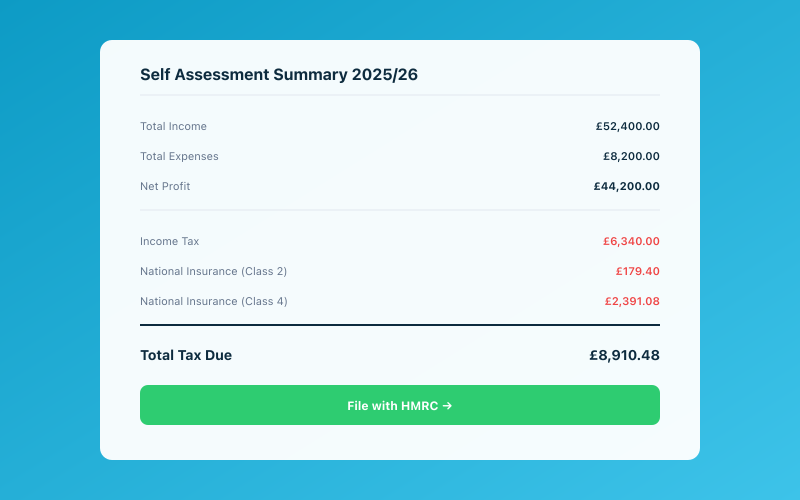 Your Accounted dashboard shows your real-time tax position
Married Couples and Civil Partners
For married couples and civil partners, HMRC applies a simple rule: regardless of the actual ownership split, rental income is treated as being shared 50/50 for tax purposes.
This applies even if one partner owns 90% of the property and the other owns 10%. Unless you take active steps to change this (which we'll cover shortly), HMRC will tax each of you on exactly half of the rental profit.
Unmarried Joint Owners
For unmarried individuals who own property together, the default is different. HMRC taxes each person according to their actual beneficial interest in the property.
If two friends buy a property together with a 60/40 split, the person with 60% is taxed on 60% of the rental income, and the person with 40% is taxed on their 40% share.
This makes the position for unmarried co-owners relatively straightforward — your tax share matches your ownership share. But for married couples, the automatic 50/50 split can create both opportunities and frustrations.
Why the Split Matters
The way rental income is divided between joint owners can affect the total amount of tax the household pays, because each person has their own:
- Personal allowance of £12,570
- Tax bands — basic rate at 20% (£12,571 to £50,270), higher rate at 40% (£50,271 to £125,140), and additional rate at 45% (above £125,140)
- Section 24 mortgage interest credit — which is always at 20% regardless of the individual's tax rate
If one partner earns £60,000 from employment and the other earns £15,000, splitting the rental income 50/50 means the higher earner pays 40% tax on their share while the lower earner pays 20% (or nothing, if they're still within their personal allowance). The household tax bill is lower than it would be if all the rental income were taxed at the higher earner's rate.
Conversely, if both partners earn similar amounts and are both basic rate taxpayers, the 50/50 split makes no difference to the total tax bill.
An Example
Scenario: Sarah earns £55,000 from her job and Tom earns £10,000 from part-time work. They jointly own a rental property that generates £12,000 in rental profit.
Under the 50/50 rule:
- Sarah's taxable rental income: £6,000 (taxed at 40% because it falls above £50,270) = £2,400 tax
- Tom's taxable rental income: £6,000 (taxed at 20% because his total income is £16,000, well within the basic rate band) = £1,200 tax
- Total household tax on rental income: £3,600
If they could allocate 90% to Tom and 10% to Sarah:
- Sarah's taxable rental income: £1,200 (taxed at 40%) = £480 tax
- Tom's taxable rental income: £10,800 (taxed at 20%) = £2,160 tax
- Total household tax on rental income: £2,640
The saving in this example is £960 per year — and on larger rental portfolios, the numbers can be much more substantial.
Form 17: Changing the Split for Married Couples
If you're married or in a civil partnership, you can override the 50/50 default by submitting Form 17 (a declaration of beneficial interests in joint property) to HMRC. This tells HMRC that you want to be taxed according to your actual ownership shares rather than the 50/50 split.
Key Requirements for Form 17
For a Form 17 declaration to be valid, several conditions must be met:
- You must be married or in a civil partnership — Form 17 is not available to unmarried co-owners (but they're already taxed on actual shares, so they don't need it)
- The property must be held in joint names — Form 17 doesn't apply to a property owned solely by one partner
- The beneficial ownership must genuinely be unequal — you can't use Form 17 to create an artificial split. The actual beneficial interests must reflect the declared percentages
- Both partners must sign the form — it's a joint declaration
How to Change the Beneficial Ownership
If you currently own the property 50/50 but want to change the split, you'll typically need a deed of trust (also called a declaration of trust) drawn up by a solicitor. This document formally records the change in beneficial interests — for example, stating that Partner A holds 90% and Partner B holds 10%.
Once the deed of trust is in place and the beneficial interests genuinely reflect the new split, you can submit Form 17 to HMRC. The new split takes effect from the date HMRC receives the form, not retroactively.
What Form 17 Looks Like in Practice
Form 17 is a short, one-page document. You'll need to include:
- Both partners' names and UTR (Unique Taxpayer Reference) numbers
- The address of the property
- The percentage split of beneficial ownership
- Both partners' signatures
- The date
You'll also need to include a copy of the deed of trust (or other evidence of the beneficial interests) when you submit the form. HMRC won't accept Form 17 without supporting evidence of the actual ownership split.
How Long Does It Last?
Once submitted, a Form 17 declaration remains in effect until:
- You submit a new Form 17 with different percentages
- The marriage or civil partnership ends
- One partner disposes of their interest in the property
- The property is sold
You don't need to renew it each year.
Considerations Before Filing Form 17
While Form 17 can deliver tax savings, it's not always the right move. Here are some important things to think about:
Capital Gains Tax Implications
If you change the beneficial ownership of a property between spouses, this is usually done on a no-gain, no-loss basis for Capital Gains Tax purposes — meaning there's no immediate CGT charge. However, when the property is eventually sold, the CGT will be calculated based on each person's share. If the lower-earning partner holds a larger share and their total gains are within their annual exempt amount (£3,000 for 2025/26) or taxed at the lower CGT rate, this can be advantageous.
But if circumstances change — for example, if the lower earner's income increases significantly — the beneficial split you set up might not be as tax-efficient in the future.
For more on property CGT, our guide to Capital Gains Tax on property explains the rates and reliefs available.
Stamp Duty Land Tax
Transferring a share of a property between spouses usually doesn't trigger Stamp Duty Land Tax (SDLT), provided there's no consideration passing (such as the receiving partner taking on a larger share of the mortgage). However, if there is consideration — for example, the transfer triggers a change in the mortgage liability — SDLT could apply.
Mortgage Lender Approval
Changing the beneficial ownership of a property might require your mortgage lender's consent, particularly if the mortgage is in joint names. Some lenders have restrictions on changes to the ownership structure while a mortgage is in place.
Divorce and Separation
If your relationship breaks down, the beneficial interests as declared in the deed of trust and Form 17 will be relevant — though courts have the power to override these in divorce proceedings. It's worth considering the broader implications of any ownership restructuring.
Joint Ownership with Business Partners
If you own property jointly with someone who isn't your spouse or civil partner, the tax position is simpler in some ways but more rigid:
- You're each taxed on your actual beneficial share — there's no 50/50 default to override
- There's no equivalent of Form 17 for unmarried co-owners
- Changing the beneficial split between unrelated parties may trigger SDLT and CGT
Partnership or Tenancy in Common?
The legal structure of the joint ownership matters:
- Joint tenants — each owner has an equal, undivided share. On death, the deceased's share passes automatically to the surviving owner(s). For tax purposes, income is typically split equally.
- Tenants in common — each owner holds a specific, defined share (which can be unequal). On death, the deceased's share passes according to their will. For tax purposes, income is split according to each person's share.
If you're buying a property with someone else for investment purposes, tenants in common is usually the more flexible option, as it allows unequal shares from the outset.
Record Keeping for Joint Ownership
Both joint owners need to report their share of the rental income on their individual Self Assessment tax returns. This means you'll each need access to:
- Rental income records
- Allowable expense receipts and invoices
- Mortgage interest statements
- Letting agent reports
It's good practice to maintain a single, comprehensive set of records for the property and then split the figures according to the agreed percentages. Using a tool like Accounted can help you keep everything organised and make it easy to extract the numbers each partner needs for their tax return.
For more on what HMRC expects in terms of records, see our guide to landlord record keeping.
Multiple Properties with Different Ownership Structures
Things can get more complex if you own several properties with different co-owners or in different ownership percentages. Each property's income and expenses need to be allocated according to the beneficial interests for that specific property.
For example, you might own one property 50/50 with your spouse, another 70/30, and a third entirely on your own. Each property's profit is calculated separately (though for Self Assessment purposes, they're all aggregated into a single UK property business figure), and your share of each property's profit is included in your return based on the relevant ownership split.
Our guide to tax when you own multiple properties covers the practicalities of managing a portfolio.
Summary
The way rental income is split between joint owners has a real impact on the total tax a household pays. For married couples and civil partners, the 50/50 default rule applies automatically, but Form 17 provides a route to a more tax-efficient split — provided the beneficial ownership genuinely reflects the declared percentages.
Before making any changes, consider the CGT implications, mortgage lender requirements, and your broader financial circumstances. And if in doubt, seek professional advice — the savings can be significant, but so can the complications if things aren't done correctly.
Accounted helps UK sole traders stay on top of their bookkeeping and tax. Start your free 30-day trial at getaccounted.co.uk
Related reading:
- Capital Gains Tax on Property — What Landlords Need to Know
- Section 24 Explained for Landlords
- Tax When You Own Multiple Rental Properties
Related Reading
- EPC Requirements for Rental Properties — Landlord Obligations
- Wear and Tear Allowance — What Replaced It and How It Works
Related reading: Section 24 Mortgage Interest Relief for Landlords.
Explore our property features built specifically for UK landlords.
Accounted includes built-in property management — track rental income, Section 24, and allowable expenses across multiple properties. See property features →
Tax & Compliance Specialists
Our tax specialists have decades of combined experience in UK sole trader and small business taxation, MTD compliance, and HMRC submissions. All content is reviewed against current HMRC guidance before publication and updated quarterly to reflect legislative changes.
Ready to try Accounted?
Join UK sole traders who are simplifying their bookkeeping and tax.
Start your 14-day free trial