Landlord Record Keeping — What HMRC Expects You to Keep
If you're a landlord, keeping proper records isn't optional — it's a legal requirement. HMRC expects you to maintain accurate, complete records of your rental income and expenses, and failure to do so can lead to penalties, estimated tax assessments, and a whole lot of unnecessary stress.
The good news is that landlord record keeping doesn't need to be complicated. Once you have a system in place, staying on top of it throughout the year is far easier than scrambling to piece everything together when your Self Assessment deadline looms. In this guide, we'll cover exactly what HMRC expects, how long you need to keep your records, and practical tips for staying organised.
Why Record Keeping Matters
HMRC's record-keeping requirements exist for a straightforward reason: they want to be able to verify that the figures on your tax return are accurate. If HMRC opens an enquiry into your return, the first thing they'll ask for is your records. If you can't produce them, you're in a difficult position.
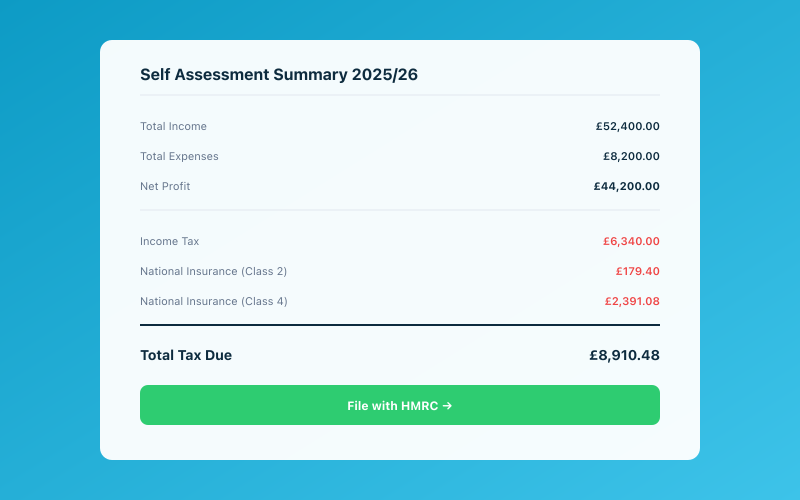 Your Accounted dashboard shows your real-time tax position
Beyond compliance, good records also help you:
- Claim all the expenses you're entitled to — without receipts and invoices, you might forget to include legitimate deductions
- Avoid overpaying tax — accurate records mean accurate figures, which means you're not paying more than you should
- Spot problems early — regular record keeping helps you identify issues like unpaid rent or unexpected costs before they become bigger problems
- Prepare for Making Tax Digital (MTD) — from April 2026, landlords with qualifying income over £50,000 will need to submit quarterly updates to HMRC digitally, making ongoing record keeping essential
What Records Do You Need to Keep?
HMRC doesn't prescribe a specific format for your records, but they do expect you to keep all the documents necessary to make a complete and accurate tax return. For landlords, this covers several categories.
Rental Income Records
You need a clear record of all rental income received. This includes:
- Rent received — bank statements, letting agent statements, or a rent book showing dates and amounts
- Advance rent — records of any rent paid in advance by tenants
- Deposit retentions — documentation showing any tenant deposits you've retained (with reasons)
- Insurance payouts — correspondence and payment records for any rent guarantee or loss-of-rent claims
- Other income — receipts for any additional income, such as parking space letting or charges for services
If you use a letting agent, their monthly or quarterly statements will usually form the backbone of your income records. Make sure you receive (and keep) itemised statements that show the gross rent, any deductions (such as management fees), and the net amount paid to you.
Expense Records
For every expense you claim as a deduction on your tax return, HMRC expects you to have a supporting document. This typically means:
- Invoices and receipts for repairs, maintenance, and professional services
- Letting agent fee statements showing management charges, tenant-find fees, and any other costs
- Insurance premium documents — renewal letters or policy schedules showing the amount paid
- Council tax bills (for void periods when you're liable)
- Utility bills (again, for void periods or if you include utilities in the rent)
- Ground rent and service charge demands — annual statements from the freeholder or management company
- Travel records — if you claim mileage for visiting your property, keep a log of dates, destinations, and miles driven
- Accountancy fees — invoices from your accountant or bookkeeper
Mortgage and Finance Records
Under Section 24, mortgage interest is no longer deducted from your rental income but instead claimed as a 20% tax credit. You still need to keep records of your finance costs:
- Annual mortgage statements — these show the interest paid during the year (separate from capital repayments)
- Loan statements — if you have other borrowing used for property purposes
- Records of arrangement fees and other incidental costs of obtaining finance
For guidance on how Section 24 works and how to claim the credit, see our guide to claiming mortgage interest relief after Section 24.
Capital Expenditure Records
If you've spent money on improvements (as opposed to repairs), or on furnishings and equipment, keep detailed records:
- Invoices for improvement works — extensions, new kitchens, bathroom installations, conversions
- Receipts for furniture and equipment — particularly important if you're claiming capital allowances (for furnished holiday lets) or Replacement of Domestic Items Relief
- Valuations — professional valuations at the date of purchase, the date of any significant changes, and the date of disposal (these are crucial for Capital Gains Tax calculations)
Tenant and Tenancy Records
While not strictly required for your tax return, it's good practice to keep:
- Tenancy agreements — showing the rent amount, start and end dates, and any special terms
- Inventory and check-in/check-out reports — useful if there's a dispute over deposit deductions
- Correspondence with tenants — particularly anything relating to rent changes, arrears, or repairs
How Long Must You Keep Records?
HMRC's rules on record retention are specific:
- If you file your tax return on time: Keep records for at least 5 years after the 31 January deadline for that tax year
- If you file late: Keep records for at least 5 years after the date you filed
For the 2025/26 tax year, the Self Assessment deadline is 31 January 2027. So you'd need to keep records until at least 31 January 2032.
Capital Gains Tax Records
If you're keeping records for Capital Gains Tax purposes — such as the original purchase price, improvement costs, and solicitor fees — you should keep these for as long as you own the property, plus five years after the tax year in which you dispose of it.
This means some records (like the original purchase invoice and solicitor's completion statement) may need to be kept for decades. Store these particularly carefully.
Digital vs Paper Records
HMRC accepts both digital and paper records. However, the direction of travel is firmly towards digital, particularly with Making Tax Digital on the horizon.
Paper Records
If you prefer paper, that's fine — but make sure you:
- Store documents in a safe, dry place
- Organise them by tax year
- Have a backup plan (photocopies or scans of the most important documents)
- Remember that paper fades and deteriorates over time
Digital Records
Digital record keeping is increasingly the more practical option. Benefits include:
- Searchability — you can find specific records quickly
- Space — no physical storage needed
- Backup — cloud storage means your records are safe even if your computer fails
- MTD readiness — you'll need digital records for Making Tax Digital anyway
You can scan paper receipts and store them digitally. HMRC accepts scanned copies as evidence, provided the scan is clear and legible. Many landlords use their smartphone to photograph receipts on the spot and upload them to a cloud-based tool.
Accounted's AI assistant Penny is designed to help with exactly this kind of ongoing record management. You can forward receipts and statements, and Penny will categorise them automatically — which means less time sorting through paperwork and more confidence that nothing has been missed.
Practical Tips for Staying Organised
1. Set Up a System From Day One
Don't wait until January to think about your records. Set up a clear filing system — whether that's a folder structure on your computer, a cloud-based bookkeeping tool, or a physical filing cabinet — and use it consistently.
A simple structure might look like:
- 2025-26/
- Income/ — letting agent statements, bank statements
- Expenses/ — receipts, invoices, bills
- Mortgage/ — annual statement, correspondence
- Tenancy/ — agreements, inventory, correspondence
2. Record Transactions as They Happen
The single biggest mistake landlords make is leaving everything to the end of the year. By then, receipts have been lost, bank statements are hard to find, and you've forgotten what half the transactions were for.
Get into the habit of recording income and expenses as they occur. Even a simple spreadsheet updated weekly is better than nothing.
3. Reconcile with Your Bank Statements
At least monthly, compare your records against your bank statements. This helps you catch anything you've missed — a letting agent fee, an insurance premium, or a repair payment that slipped through without a receipt.
4. Separate Personal and Property Finances
Using a dedicated bank account for your rental property makes record keeping dramatically easier. All income goes in, all expenses go out, and you have a clean audit trail. Mixing property transactions with personal spending creates confusion and makes it much harder to produce clean records if HMRC asks.
For more on separating your finances, our guide to what expenses landlords can claim covers the principles of allowable deductions.
What Happens If Your Records Are Inadequate?
If HMRC finds that your records are insufficient, several things can happen:
Penalties
HMRC can charge a penalty of up to £3,000 for failure to keep adequate records. In practice, penalties at this level are reserved for serious or repeated failures, but even a smaller penalty is an unwelcome cost.
Estimated Assessments
If HMRC can't determine your actual income and expenses from your records, they may issue an estimated assessment. These are typically on the generous side — generous to HMRC, that is. You could end up paying more tax than you actually owe, simply because you can't prove your expenses.
Enquiry Difficulties
If HMRC opens an enquiry and you can't produce adequate records, the enquiry is likely to take longer, cost more in professional fees, and result in a less favourable outcome. Good records are your best defence in any HMRC investigation.
Preparing for Making Tax Digital
From April 2026, landlords with qualifying income over £50,000 will need to keep digital records and submit quarterly updates to HMRC under Making Tax Digital for Income Tax Self Assessment (MTD for ITSA). This means:
- Records must be maintained in MTD-compatible software
- Income and expenses must be submitted to HMRC every quarter
- A final declaration replaces the current Self Assessment tax return
If your rental income is below the threshold, you won't be required to use MTD immediately, but the threshold is expected to be lowered over time. Getting into good digital record-keeping habits now will make the transition much smoother when it comes.
For the latest on what's changing, see our guide to Making Tax Digital for landlords.
Summary
Good record keeping is the foundation of accurate tax reporting and stress-free compliance. HMRC expects landlords to keep all documents supporting their income and expense figures, and to retain those records for at least five years after the filing deadline.
The best approach is to keep things simple, consistent, and up to date. Record transactions as they happen, reconcile regularly, and store everything digitally with a reliable backup. That way, whether you're filing your Self Assessment return or responding to an HMRC enquiry, you'll have everything you need at your fingertips.
Accounted helps UK sole traders stay on top of their bookkeeping and tax. Start your free 30-day trial at getaccounted.co.uk
Related reading:
- What Expenses Can Landlords Claim?
- Making Tax Digital for Landlords
- How to Claim Mortgage Interest Relief After Section 24
Related Reading
- EPC Requirements for Rental Properties — Landlord Obligations
- Wear and Tear Allowance — What Replaced It and How It Works
Explore our property features built specifically for UK landlords.
Accounted includes built-in property management — track rental income, Section 24, and allowable expenses across multiple properties. See property features →
Tax & Compliance Specialists
Our tax specialists have decades of combined experience in UK sole trader and small business taxation, MTD compliance, and HMRC submissions. All content is reviewed against current HMRC guidance before publication and updated quarterly to reflect legislative changes.
Ready to try Accounted?
Join UK sole traders who are simplifying their bookkeeping and tax.
Start your 14-day free trial