What Expenses Can Landlords Claim? The Definitive 2025/26 List
If you rent out property in the UK, you are running a business — and just like any business, you can deduct legitimate costs from your rental income before you pay tax. The trouble is, HMRC's rules on what counts as an allowable expense are not always obvious. Claim too little and you overpay tax. Claim something you shouldn't and you risk a penalty.
This guide sets out every expense a landlord can claim for the 2025/26 tax year, along with the expenses that catch people out because they are not allowable.
Repairs, Maintenance, and Renewals
Day-to-Day Repairs
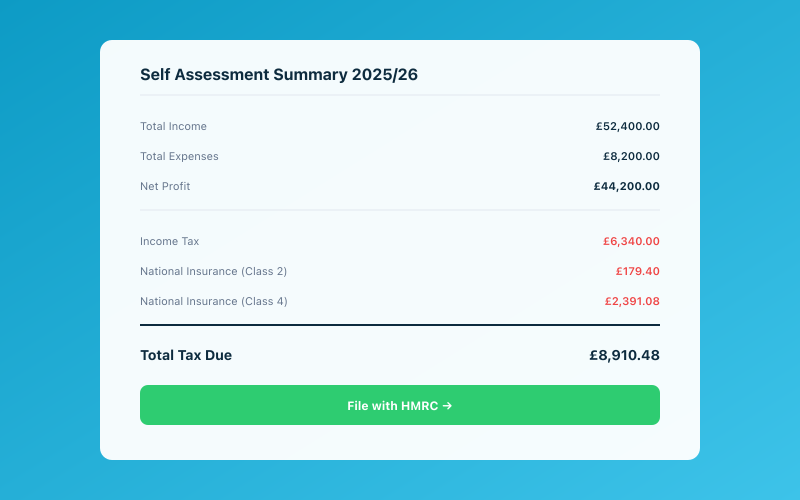 Your Accounted dashboard shows your real-time tax position
You can claim the full cost of repairing or maintaining a property in the year you incur the expense. This includes fixing a broken boiler, repainting walls, patching a leaking roof, replacing broken windows with like-for-like equivalents, and repairing plumbing or electrics. The key test is whether the work restores the property to its previous condition rather than improving it. Replacing a standard single-glazed window with an identical single-glazed window is a repair. Upgrading to double glazing is an improvement — more on that below.
Replacement of Domestic Items Relief
Since the old wear-and-tear allowance was scrapped in April 2016, furnished and part-furnished landlords claim relief under the replacement of domestic items scheme instead. You can deduct the cost of replacing moveable furnishings such as beds, sofas, carpets, curtains, white goods, and crockery, provided the replacement is broadly the same quality and type. If you upgrade, you can only claim the cost of a like-for-like equivalent. The first purchase of a furnishing in a property does not qualify — it must be a replacement.
Insurance
You can claim the full cost of landlord insurance, including buildings insurance, contents insurance, landlord liability insurance, and rent guarantee insurance. If you have a policy that covers both a rental property and your own home, you can only claim the portion that relates to the let property.
Letting Agent and Management Fees
Fees charged by letting agents for finding tenants, managing the property, conducting inspections, or arranging repairs are fully deductible. If you use a property management company, their fees count too.
Accountancy and Professional Fees
The cost of hiring an accountant to prepare your property accounts and tax return is allowable. So are legal fees directly related to renewing a lease of less than 50 years, evicting a non-paying tenant, or defending a rent tribunal claim. Legal fees for buying or selling a property are not allowable — those are capital costs.
Travel Costs
You can claim the cost of travelling to your rental property for the purpose of managing or maintaining it — for example, visiting to carry out an inspection, meet a tradesperson, or show a prospective tenant around. You can claim either the actual cost of fuel and running expenses, or the simplified mileage rate of 45p per mile for the first 10,000 miles and 25p per mile thereafter. Keep a mileage log with the date, destination, purpose, and distance of every trip.
Mortgage Interest and Finance Costs
The Section 24 Restriction
Since April 2020, landlords who are higher or additional rate taxpayers can no longer deduct mortgage interest from rental income. Instead, all individual landlords receive a basic rate tax credit equal to 20% of their finance costs. This means you still get tax relief, but only at 20% regardless of your marginal rate.
Finance costs include mortgage interest, interest on loans used to buy furnishings, and arrangement or renewal fees for mortgages.
How to Report It
On your Self Assessment return, you enter your full rental profit without deducting finance costs, then enter your finance costs separately. HMRC calculates the 20% tax reduction automatically.
Ground Rent and Service Charges
If your rental property is leasehold, you can claim the ground rent and any service charges you pay to the freeholder or management company. These are revenue expenses incurred wholly for the purpose of the letting.
Council Tax and Utility Bills
You can claim council tax and utility bills only for periods when you, rather than your tenant, are liable. This typically applies during void periods when the property is empty between tenancies, or if the tenancy agreement specifies that you cover certain bills.
Advertising Costs
The cost of advertising for tenants is allowable. This includes online listing fees on property portals, newspaper advertising, and signage.
Stationery, Postage, and Phone Calls
Small administrative costs relating to your rental business — printer paper, stamps, phone calls to tenants or tradespeople — are allowable.
Training Costs
HMRC allows landlords to deduct the cost of training courses directly relevant to their property rental business, such as a landlord accreditation course.
Pre-Trading Expenses
If you incurred allowable expenses in the seven years before your first letting income, you can treat them as if they were incurred on the first day of letting. This can include advertising for tenants or travel to view prospective investment properties.
What You Cannot Claim
Improvements and Upgrades
This is the expense that trips up more landlords than any other. If you improve a property rather than repair it — for instance, adding an extension, converting a loft, installing a new kitchen that is substantially better than the one it replaced, or upgrading single glazing to double glazing — the cost is capital expenditure. You cannot deduct it from rental income. It may, however, be added to the base cost of the property when you eventually sell, reducing your Capital Gains Tax liability.
Personal Use
If you use a property yourself for part of the year and let it for the rest, you must apportion expenses between personal and business use. The personal portion is not allowable.
The Initial Cost of Furnishing a Property
Buying furniture, appliances, or fittings for a property for the first time is capital expenditure, not a revenue expense. Only replacements qualify under the replacement of domestic items relief.
Clothing
You cannot claim for clothing, even if you only wear certain clothes when visiting your rental properties.
Capital Repayments on Your Mortgage
Only the interest portion of your mortgage payment is a finance cost. The capital repayment element is not an expense — it is simply reducing your loan balance.
Fines and Penalties
Fines for non-compliance with regulations — for example, a penalty for failing to protect a tenant's deposit — are not allowable.
Keeping Records
HMRC requires you to keep records of all rental income and expenses for at least five years after the 31 January filing deadline for the relevant tax year. For the 2025/26 tax year, that means keeping records until at least 31 January 2033.
You need to retain receipts, invoices, bank statements, mileage logs, and tenancy agreements. If HMRC opens an enquiry and you cannot produce adequate records, they may estimate your tax liability — and that estimate is unlikely to be in your favour.
How Accounted Makes Landlord Expenses Simple
Tracking every receipt, categorising expenses correctly, and remembering which costs are allowable and which are not is time-consuming. Accounted's AI bookkeeper, Penny, handles this automatically. Connect your bank account and Penny categorises your rental income and expenses as they come in, flags anything that looks like a capital expense rather than a revenue expense, and keeps your records in the format HMRC expects.
When Self Assessment time comes around, your numbers are already organised. No more digging through shoeboxes of receipts or spreadsheets you last updated three months ago.
Ready to take the headache out of landlord accounting? Start your free trial of Accounted today and let Penny track every allowable expense so you never pay more tax than you need to.
Related Reading
-
Section 24 Mortgage Interest Relief: How It Affects Your Tax in 2025/26
-
How to Prepare Your Bookkeeping for MTD Quarterly Submissions
Start your free trial and let Penny handle your bookkeeping automatically.
Penny, your AI bookkeeper, tracks your tax position in real time and flags opportunities to reduce your bill. Meet Penny →
Tax & Compliance Specialists
Our tax specialists have decades of combined experience in UK sole trader and small business taxation, MTD compliance, and HMRC submissions. All content is reviewed against current HMRC guidance before publication and updated quarterly to reflect legislative changes.
Ready to try Accounted?
Join UK sole traders who are simplifying their bookkeeping and tax.
Start your 14-day free trial