MTD for Landlords: What Property Income Owners Need to Know
MTD Isn't Just for the Self-Employed
When people talk about Making Tax Digital, the conversation usually centres on sole traders. But MTD for Income Tax applies equally to landlords who earn rental income and report it through Self Assessment.
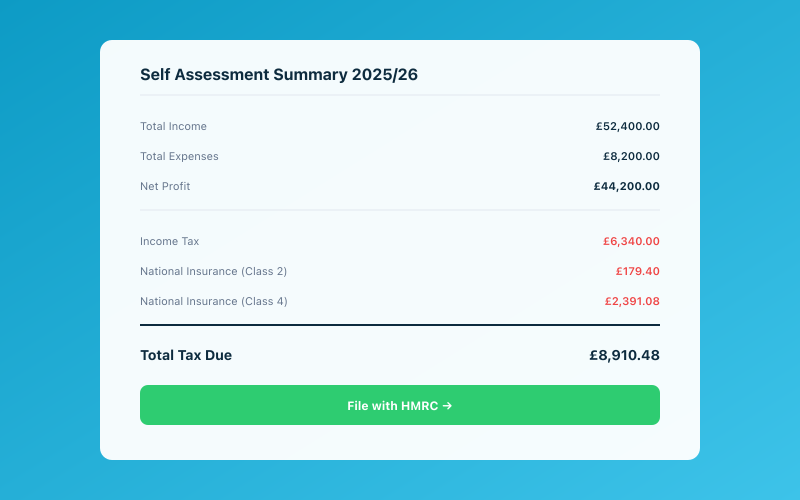 Your Accounted dashboard shows your real-time tax position
If you own property that generates income, you need to understand how MTD affects you. The rules are largely the same as for sole traders, but there are important differences around property income categories, allowable expenses, and how multiple properties are handled.
Which Landlords Are Affected?
The threshold for MTD is based on your gross income — that's total income before any expenses are deducted. And crucially, it's your combined income across all sources that report through Self Assessment.
From April 2026: Landlords with gross income over £50,000 From April 2027: Landlords with gross income over £30,000
Here's where it gets important: if you have both self-employment income and property income, they're added together. A sole trader earning £30,000 from their business and £25,000 from a rental property has a combined gross income of £55,000 — well above the £50,000 threshold.
What Counts as Gross Property Income?
Your gross property income includes:
- Rent received (or receivable) from tenants
- Service charges you receive as a landlord
- Premiums on lease grants (apportioned over the lease term)
- Income from furnished holiday lets
It does not include your mortgage repayments, insurance, or any other expenses. HMRC looks at the gross figure only when determining whether you meet the threshold.
Property Income vs Trading Income Under MTD
Under MTD, property income and trading income are reported as separate income sources. This means if you're both a sole trader and a landlord, you'll submit separate quarterly updates for each.
For example, a plumber who also rents out a flat would submit:
- A quarterly update for their plumbing business (trading income and expenses)
- A quarterly update for their rental property (property income and expenses)
Both go to HMRC through your MTD-compatible software, but they're distinct submissions with their own income and expense categories. The quarterly reporting calendar is the same for both — you'll just have two sets of figures to prepare each quarter.
Allowable Property Expenses
This is the bit landlords care about most. What can you actually claim against your rental income? The list is more generous than many people realise.
Mortgage Interest (With Restrictions)
Since April 2020, mortgage interest on residential lets is no longer deductible as an expense. Instead, you receive a 20% tax credit on your finance costs — meaning higher-rate taxpayers get less relief than before.
Under MTD, you'll still report mortgage interest in your quarterly updates, but it's treated differently in the final tax calculation via the End of Period Statement.
Repairs and Maintenance
You can claim for repairs that restore the property to its previous condition:
- Fixing a broken boiler
- Repainting walls between tenancies
- Replacing a cracked window
- Repairing a leaking roof
Improvements are different. Adding an extension, installing a new kitchen where there wasn't one, or converting a loft are capital expenditure — not deductible as revenue expenses, though they may qualify for other reliefs.
The distinction matters: like-for-like replacements are repairs (deductible), upgrades are improvements (capital).
Letting Agent and Management Fees
If you use a letting agent, their fees are fully deductible — tenant-finding fees, monthly management charges, inventory costs, and check-in/check-out fees.
Other Common Allowable Expenses
- Insurance — buildings, contents, landlord liability, rent guarantee
- Ground rent and service charges — for leasehold properties
- Council tax and utilities — only for void periods between tenancies
- Accountant and legal fees — the portion relating to property income
- Travel costs — visiting the property for maintenance or inspections
- Advertising — costs of finding tenants
- Replacement of domestic items — furniture, appliances, and kitchenware replacements in unfurnished lets
For a broader view, our complete expenses list covers both trading and property expenses.
Furnished Holiday Lets: Different Rules
Furnished Holiday Lets (FHLs) historically enjoyed tax advantages including full mortgage interest relief and capital allowances. However, from April 2025, the FHL tax regime was abolished. FHL properties are now treated the same as any other residential let — mortgage interest restricted to 20% credit, no capital allowances on furniture, and no favourable CGT treatment.
Under MTD, holiday let income is reported alongside your other property income. If you previously benefited from the FHL regime, review your overall tax position to understand the impact.
Multiple Properties: How to Report
If you own more than one rental property, you don't submit separate quarterly updates for each one. All your UK property income is combined into a single property business for MTD purposes.
This means:
- Total all rental income across all properties
- Total all property expenses across all properties
- Submit one quarterly update covering your entire property portfolio
You should still keep separate records for each property (for your own management purposes and in case of an HMRC enquiry), but the quarterly submission to HMRC is aggregated.
Overseas Property
If you own property abroad that generates rental income, that's treated as a separate overseas property business. It has its own quarterly updates, separate from your UK property income. The same expense rules broadly apply, but there may be additional considerations around double taxation relief.
Record-Keeping Requirements for Landlords
MTD requires digital records for all income and expenses. For landlords, this means tenancy agreements, rent receipts, tradesperson invoices, letting agent statements, and mortgage statements — all stored digitally. Even though you report in aggregate, keep records per property in case of an HMRC enquiry.
The Spreadsheet Problem
Many landlords manage rental accounts on a spreadsheet. Under MTD, a spreadsheet alone isn't sufficient — your records need to be in HMRC-compatible software that can submit quarterly updates via HMRC's API. Purpose-built software will save you time and reduce errors.
How Accounted Handles Property Income Alongside Trading Income
If you're a sole trader with rental income (or a landlord who also freelances), Accounted manages both income streams in one place. Set up your properties, connect your bank accounts, and let Penny categorise everything. At submission time, Accounted prepares both your trading and property updates with the correct HMRC categories.
No need for two separate tools. And if you're unsure whether you need an accountant for your property income, we've written a guide on that too. The key is getting organised early — it's a lot less daunting than it sounds.
Ready to simplify your bookkeeping? Try Accounted free for 14 days →
Related Reading
See how Accounted handles MTD and start your free trial.
Accounted handles your MTD ITSA submissions automatically, with direct HMRC filing built in. See how MTD works in Accounted →
Tax & Compliance Specialists
Our tax specialists have decades of combined experience in UK sole trader and small business taxation, MTD compliance, and HMRC submissions. All content is reviewed against current HMRC guidance before publication and updated quarterly to reflect legislative changes.
Ready to try Accounted?
Join UK sole traders who are simplifying their bookkeeping and tax.
Start your 14-day free trial