Section 24 Explained: How It Affects UK Landlords in 2025/26
What Is Section 24?
Section 24 of the Finance (No.2) Act 2015 fundamentally changed how landlords are taxed on their rental income. Before Section 24, individual landlords could deduct their full mortgage interest payments from their rental income before calculating tax. It was treated just like any other allowable expense.
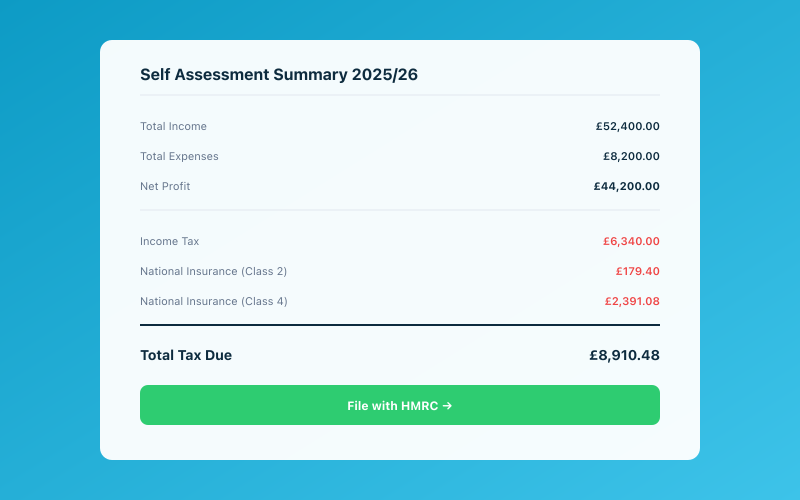 Your Accounted dashboard shows your real-time tax position
Since April 2020, that deduction has been fully replaced by a 20% tax credit. You can no longer subtract mortgage interest from your rental profit. Instead, you calculate your tax on the full rental profit (before interest), and then receive a credit equal to 20% of your mortgage interest costs.
For basic-rate taxpayers, the end result is roughly the same. For higher-rate and additional-rate taxpayers, the impact can be severe — and in some cases, it can push landlords into a higher tax bracket or even create a tax liability on rental income that produces no actual cash profit.
How the Old System Worked
Under the old rules, if you received £12,000 in rent and paid £8,000 in mortgage interest plus £2,000 in other expenses, your taxable profit was:
£12,000 – £8,000 – £2,000 = £2,000
A higher-rate taxpayer would pay 40% on that £2,000, giving a tax bill of £800.
Simple, logical, and the same as any other business expense deduction.
How Section 24 Works Now
Under the current rules, the same landlord calculates their profit without deducting mortgage interest:
£12,000 – £2,000 (other expenses only) = £10,000 taxable profit
A higher-rate taxpayer pays 40% on £10,000 = £4,000
Then they receive a 20% tax credit on their £8,000 mortgage interest: 20% × £8,000 = £1,600
Net tax: £4,000 – £1,600 = £2,400
Compare that to the £800 under the old system. The landlord's tax bill has tripled — on the same property, the same rent, and the same mortgage — from £800 to £2,400.
And remember, the actual cash profit hasn't changed. The landlord still only has £2,000 left after paying the mortgage and expenses. But they're now paying £2,400 in tax on it. They're paying more in tax than they actually earn in profit.
The Tax Band Problem
Section 24 doesn't just increase your tax bill on rental income. It can push your total income into a higher tax bracket, affecting the rate you pay on all your income.
A Worked Example
Sarah earns £42,000 from her employed job and has one buy-to-let property. Her rental figures:
- Rent received: £15,000
- Mortgage interest: £10,000
- Other expenses: £2,000
Under the old rules:
- Rental profit: £15,000 – £10,000 – £2,000 = £3,000
- Total income: £42,000 + £3,000 = £45,000
- All within the basic rate band (up to £50,270)
Under Section 24:
- Rental profit (before interest): £15,000 – £2,000 = £13,000
- Total income: £42,000 + £13,000 = £55,000
- £4,730 of that income is now taxed at 40% (above the £50,270 threshold)
Sarah has been pushed into the higher-rate tax band by Section 24, even though her actual cash position hasn't changed. She now pays 40% on income that doesn't exist as real profit.
The 20% tax credit on her £10,000 mortgage interest gives her £2,000 back, but she's lost far more through the band shift. Her effective tax rate on the rental income has increased dramatically.
Who Is Affected?
Section 24 applies to individual landlords who hold residential property in their own name (or jointly). It does not apply to:
- Limited companies — companies deduct mortgage interest as a normal business expense against Corporation Tax
- Commercial property — Section 24 only covers residential lettings
- Furnished Holiday Lets — these have traditionally been exempt, though the FHL rules are changing
If you're a basic-rate taxpayer and your rental income doesn't push you into the higher-rate band, the impact is neutral. The 20% tax credit effectively replaces the 20% relief you'd have received from the deduction.
But if you're a higher-rate taxpayer, or if your rental income plus other income pushes you past the basic-rate threshold, Section 24 costs you real money.
Strategies to Mitigate Section 24
1. Incorporating Your Property Business
The most commonly discussed strategy is transferring your properties into a limited company, since companies can still deduct mortgage interest in full against Corporation Tax at 19-25%.
However, incorporation is not straightforward:
- Stamp Duty Land Tax (SDLT) is payable on the transfer at the higher rate for additional properties (currently 5% surcharge on top of standard rates)
- Capital Gains Tax may be triggered on the transfer unless you can claim Incorporation Relief
- Mortgage refinancing is usually required, and commercial mortgage rates for limited companies are typically higher than personal buy-to-let rates
- Annual running costs increase — you'll need company accounts, Corporation Tax returns, and potentially payroll
For landlords with large portfolios and significant mortgage debt, incorporation can still make sense despite these costs. For those with one or two properties, the transaction costs often outweigh the tax saving. Get professional advice before proceeding.
2. Reducing Your Mortgage Debt
The simplest way to reduce the Section 24 impact is to reduce the mortgage interest you're paying. Overpaying your mortgage or using savings to pay down the balance directly reduces the amount caught by Section 24.
Of course, this requires having the capital available, and you need to weigh the tax saving against the opportunity cost of tying that money up in property equity.
3. Transferring Ownership Between Spouses
If one partner is a basic-rate taxpayer and the other is a higher-rate taxpayer, transferring ownership (or a share of ownership) to the basic-rate taxpayer can reduce the Section 24 impact. Transfers between spouses are generally free of Capital Gains Tax and SDLT.
A Declaration of Trust (Form 17 filed with HMRC) can split income in a different proportion to ownership — useful if you want to retain joint ownership but redirect income to the lower earner.
4. Increasing Rents
Not always popular with tenants, but if the market supports it, increasing rent improves your cash position and helps offset the additional tax burden. Section 24 hasn't changed the fundamental economics of rental income — it's changed how that income is taxed.
5. Claiming All Allowable Expenses
Ensure you're claiming every legitimate property expense. Repairs, maintenance, letting agent fees, insurance, ground rent, service charges, travel to properties, and professional fees all reduce your taxable rental profit. The lower your pre-tax profit, the less impact Section 24 has.
Recording Mortgage Interest Correctly
Even though you can't deduct mortgage interest from your profit, you still need to record it accurately for your tax return. The 20% tax credit is calculated on the actual interest paid during the tax year — not the total mortgage payment (which includes capital repayment).
Your mortgage lender will provide an annual interest statement. Make sure you use the interest figure, not the total payment figure. Overstating the interest is as problematic as understating it.
Accounted's property management features help landlords track mortgage interest separately from other expenses, ensuring the tax credit is calculated correctly when it's time to file.
Get Started with Accounted
Section 24 makes accurate record-keeping more important than ever for landlords. Accounted tracks your rental income, separates mortgage interest for the tax credit calculation, and gives you a clear picture of your real tax position throughout the year. Start your free trial today — no credit card required.
Related Reading
Penny, your AI bookkeeper, tracks your tax position in real time and flags opportunities to reduce your bill. Meet Penny →
Tax & Compliance Specialists
Our tax specialists have decades of combined experience in UK sole trader and small business taxation, MTD compliance, and HMRC submissions. All content is reviewed against current HMRC guidance before publication and updated quarterly to reflect legislative changes.
Ready to try Accounted?
Join UK sole traders who are simplifying their bookkeeping and tax.
Start your 14-day free trial