Tax-Efficient Company Cars: BIK Rates and Electric Vehicle Benefits
Company cars remain a popular employee benefit in the UK, but the tax treatment varies enormously depending on the type of vehicle you choose. With electric vehicles attracting a benefit-in-kind (BIK) rate of just 2% for the 2025/26 tax year, going electric through your company has never been more attractive. This guide explains how BIK rates work, the current rates by CO2 emissions, salary sacrifice schemes, and the rules around fuel benefit and vans.
How Benefit-in-Kind Tax Works
When your employer provides you with a company car that is available for private use, you are taxed on a benefit-in-kind. The taxable benefit is calculated by multiplying the car's list price (its P11D value, which includes VAT, delivery charges, and options but not the first year registration fee or vehicle excise duty) by the appropriate BIK percentage for that car.
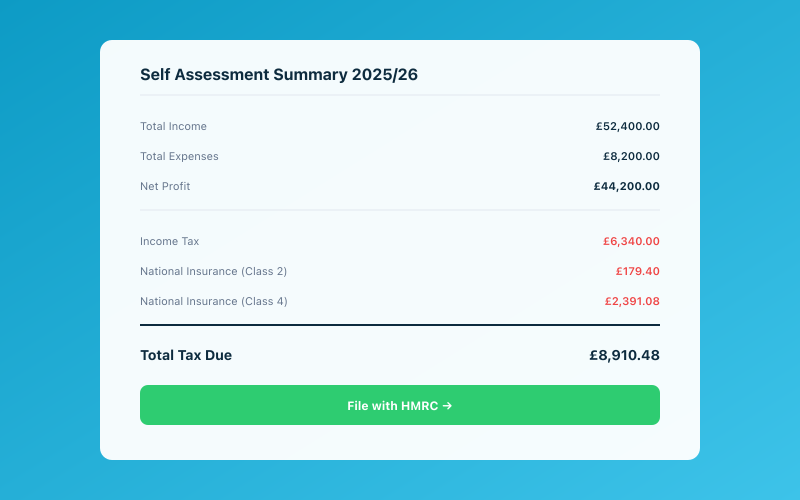 Your Accounted dashboard shows your real-time tax position
You then pay income tax on the resulting figure at your marginal rate. So if you are a basic rate taxpayer (20%), you pay 20% of the taxable benefit. If you are a higher rate taxpayer (40%), you pay 40%. The employer also pays Class 1A National Insurance at 15% on the benefit.
Example
A car with a P11D value of £35,000 and a BIK rate of 25% gives a taxable benefit of £8,750. A basic rate taxpayer would pay £1,750 per year in additional income tax (£8,750 x 20%), while a higher rate taxpayer would pay £3,500.
BIK Rates by CO2 Emissions
The BIK percentage is determined by the car's CO2 emissions and, for low-emission vehicles, its electric range. The rates are set by the government and published several years in advance to give employers and employees certainty when choosing vehicles.
For the 2025/26 tax year, the key rates are as follows.
Zero emission vehicles (fully electric) attract a BIK rate of 2%. Vehicles with CO2 emissions of 1-50g/km attract rates between 2% and 14%, depending on their electric range. A plug-in hybrid with emissions of 1-50g/km and an electric range of 130 miles or more gets the 2% rate, while one with a range of less than 30 miles gets 14%.
For conventional petrol and diesel cars, the rates climb steeply. A car emitting 100g/km attracts a 25% BIK rate. At 130g/km, the rate is 33%. At 160g/km and above, the rate reaches the maximum of 37%.
Diesel cars that do not meet the RDE2 (Real Driving Emissions 2) standard pay an additional 4% supplement, up to the 37% maximum.
Future Rates
The government has confirmed that electric vehicle BIK rates will increase gradually: 3% in 2026/27, 4% in 2027/28, and 7% in 2028/29. Even with these increases, electric vehicles will remain far more tax-efficient than their petrol or diesel equivalents for the foreseeable future.
Why Electric Vehicles Are So Tax-Efficient
The 2% BIK rate for fully electric vehicles creates remarkable tax savings compared with conventional cars. Consider two cars, both with a P11D value of £40,000.
An electric car at 2% BIK gives a taxable benefit of £800. A basic rate taxpayer pays just £160 per year in tax. A higher rate taxpayer pays £320.
A petrol car emitting 120g/km at 30% BIK gives a taxable benefit of £12,000. A basic rate taxpayer pays £2,400 per year. A higher rate taxpayer pays £4,800.
The electric car saves the higher rate taxpayer £4,480 per year in income tax alone. The employer also saves significantly on Class 1A NI: £120 versus £1,800.
On top of this, electric company cars are exempt from Vehicle Excise Duty (road tax) until April 2025, after which a flat rate applies, and they benefit from lower running costs due to cheaper fuel (electricity versus petrol or diesel) and reduced maintenance requirements.
Salary Sacrifice Schemes
Salary sacrifice is an arrangement where you agree to give up a portion of your gross salary in exchange for a non-cash benefit, in this case a company car. Because the salary reduction happens before tax and National Insurance are calculated, both you and your employer save on tax and NI contributions.
For electric vehicles, salary sacrifice is especially attractive because the BIK rate is so low. The combination of the salary sacrifice tax saving and the low BIK charge means that the effective cost of driving a new electric car can be significantly less than leasing one privately.
How It Works in Practice
Your employer leases the car and deducts the lease cost from your gross salary. You are then taxed on the BIK value rather than the salary you gave up. If the BIK value is lower than the salary sacrificed (which it almost always is for electric vehicles), you pay less tax and NI overall.
However, for cars with higher emissions, the Optional Remuneration Arrangements (OpRA) rules apply. Under OpRA, if the amount of salary sacrificed is higher than the BIK value, you are taxed on the higher of the two figures. This effectively eliminates the salary sacrifice advantage for high-emission vehicles. Electric vehicles with zero emissions are exempt from OpRA, which is why they benefit so strongly from salary sacrifice.
Fuel Benefit
If your employer provides fuel for private use in a company car, there is a separate fuel benefit charge. For 2025/26, the fuel benefit is calculated by multiplying a fixed amount (£27,800 for 2025/26) by the same BIK percentage used for the car.
This can be expensive. For a car with a 30% BIK rate, the fuel benefit is £8,340 per year. A higher rate taxpayer would pay £3,336 in additional tax. Unless you do substantial private mileage, it is usually more tax-efficient to pay for your own private fuel and only claim business mileage from your employer.
For electric vehicles, the fuel benefit charge still technically applies if the employer pays for private charging, but at 2% BIK the charge is only £556, which means the additional tax for a higher rate taxpayer is just £222 per year.
Van Benefit
The tax rules for company vans are different from cars. A van provided for private use attracts a flat rate BIK charge of £3,960 for 2025/26, regardless of the van's value or emissions. If the employer also provides fuel for private use, there is an additional flat fuel benefit charge of £757.
Zero emission vans attract a reduced BIK rate of £0 for 2025/26, making electric vans completely free of benefit-in-kind tax. This is an excellent incentive for tradespeople and businesses that rely on vans.
What Counts as a Van?
For BIK purposes, a van is a vehicle that is primarily designed for carrying goods and has a gross vehicle weight of not more than 3,500kg. Double-cab pickups with a payload of one tonne or more are treated as vans, though HMRC has tightened the rules around this in recent years, so it is worth checking the specific classification of any vehicle you are considering.
Pool Car Rules
A pool car is not treated as a benefit-in-kind at all, meaning no tax charge arises. To qualify as a pool car, the vehicle must meet all of the following conditions: it is available to more than one employee, it is not ordinarily used by one employee to the exclusion of others, any private use is merely incidental to business use, and it is not normally kept overnight at or near the home of any employee.
In practice, these conditions are difficult to meet, especially for small businesses. HMRC will examine the actual use of the vehicle, not just the intended use. If one employee regularly takes the car home, it will fail the pool car test.
Capital Allowances for the Business
The business itself can claim tax relief on company cars through capital allowances. For the 2025/26 tax year, new zero emission cars qualify for 100% first-year allowances, meaning the full cost can be deducted from profits in the year of purchase. Cars with CO2 emissions of 50g/km or less qualify for the main rate of 18% per year on a reducing balance basis. Cars emitting more than 50g/km are restricted to the special rate of 6% per year.
For leased cars, the full lease rental is generally deductible, but a 15% restriction applies to the lease rental of cars emitting more than 50g/km of CO2.
Let Accounted and Penny Help
Managing company car expenses, BIK calculations, and mileage records can be a headache, especially if you have multiple vehicles or are running a salary sacrifice scheme. Accounted keeps everything in one place, from lease payments to charging costs to mileage logs. Penny, your AI bookkeeper, automatically categorises vehicle-related expenses and helps you track the numbers you need for BIK reporting. Start your free trial today and take the complexity out of company car accounting.
Related Reading
Start your free trial and let Penny handle your bookkeeping automatically.
Penny, your AI bookkeeper, tracks your tax position in real time and flags opportunities to reduce your bill. Meet Penny →
Tax & Compliance Specialists
Our tax specialists have decades of combined experience in UK sole trader and small business taxation, MTD compliance, and HMRC submissions. All content is reviewed against current HMRC guidance before publication and updated quarterly to reflect legislative changes.
Ready to try Accounted?
Join UK sole traders who are simplifying their bookkeeping and tax.
Start your 14-day free trial