CIS for Subcontractors: A Plain English Guide
What Is the Construction Industry Scheme?
The Construction Industry Scheme — everyone calls it CIS — is HMRC's way of collecting tax from construction workers before they file their returns. If you're a subcontractor, the contractor deducts a percentage from your pay and sends it to HMRC on your behalf.
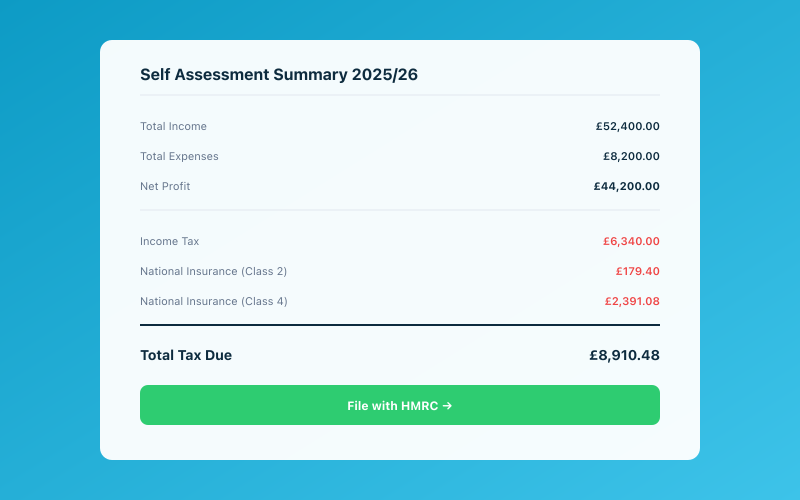 Your Accounted dashboard shows your real-time tax position
Think of it like PAYE for self-employed people in construction. The money deducted isn't extra tax — it's a payment on account towards your eventual tax bill. If too much has been deducted (which is common), you get it back when you file your Self Assessment.
The scheme exists because HMRC historically had trouble collecting tax from the construction industry, so they put the responsibility on contractors to deduct tax at source.
Who Counts as a Subcontractor?
You're a CIS subcontractor if you:
- Are self-employed (not on the contractor's payroll)
- Do construction work for a contractor
- Work in the UK construction industry
"Construction work" is defined broadly. It covers:
- Building, alterations, and repairs
- Demolition and dismantling
- Civil engineering (roads, bridges, etc.)
- Installation of heating, lighting, power, drainage, and ventilation
- Decorating and painting
- Site preparation and clearance
It does not cover:
- Architecture and surveying (professional services)
- Carpet fitting
- Delivering materials (without installing them)
- Making materials or plant (manufacturing)
If you're not sure whether your work falls under CIS, register anyway. There's no downside to being registered if it turns out you didn't need to be.
CIS Deduction Rates
Here's where it gets important. The rate at which contractors deduct tax from your payments depends on your registration status:
Registered: 20% Deduction
If you've registered with HMRC for CIS, contractors deduct 20% from your payments (after deducting the cost of materials you've supplied). This is the standard rate for most subcontractors.
Not Registered: 30% Deduction
If you haven't registered, contractors must deduct 30%. That's a significant chunk of your pay, and while you'll get the excess back eventually, it could be months before you see it. Register. Seriously.
Gross Payment Status: 0% Deduction
If you've been trading for a while and meet certain conditions (turnover thresholds, tax compliance history), you can apply for gross payment status. This means contractors pay you the full amount with no deductions. You're still responsible for paying your own tax, of course, but you keep control of your cash flow.
To qualify, you typically need three years of trading history and a clean compliance record with HMRC. It's worth applying if you're eligible — the cash flow benefit is substantial.
How to Register as a CIS Subcontractor
Registration is free and relatively painless:
- You'll need: Your National Insurance number, your legal business name, and your Unique Taxpayer Reference (UTR). If you don't have a UTR, register as self-employed first.
- Register online: Through your HMRC Government Gateway account, or by calling HMRC's CIS helpline.
- Verification: HMRC will verify your details and add you to the CIS system. This usually takes a few days.
Once registered, give your UTR to any contractor you work for. They'll verify you with HMRC before making your first payment, which confirms your deduction rate.
Verifying Subcontractors (For Contractors)
If you're a contractor — meaning you pay subcontractors for construction work — you have obligations too:
- Register as a CIS contractor with HMRC
- Verify every subcontractor before you pay them for the first time
- Deduct the correct percentage from payments
- File monthly CIS returns with HMRC
- Provide payment and deduction statements to your subcontractors
Verification is done online through the HMRC CIS system. You enter the subcontractor's details and HMRC tells you what deduction rate to apply.
Monthly CIS Returns
If you're a contractor, you need to file a monthly CIS return with HMRC by the 19th of each month. This return covers all payments made to subcontractors in the previous tax month (which runs from the 6th to the 5th — because HMRC loves making things straightforward).
The return includes:
- Details of each subcontractor you've paid
- The gross amount paid to each
- The cost of materials deducted
- The CIS deduction made
Even if you haven't paid any subcontractors in a particular month, you still need to file a nil return. Miss a filing deadline, and there's an automatic £100 penalty. Miss several, and it escalates quickly. Check the HMRC penalty structure if you want the full picture.
Reclaiming CIS Deductions on Your Tax Return
This is the part most subcontractors care about most: getting your money back.
When you file your Self Assessment tax return, you declare your total income and expenses as normal. Your actual tax liability is calculated. Then, all the CIS deductions that contractors have made throughout the year are credited against your tax bill.
If the deductions exceed what you owe, you get a refund. This is common for subcontractors who have significant allowable expenses — tools, vehicle costs, materials, working from home costs, and so on.
To claim correctly, you need your CIS payment and deduction statements from every contractor you've worked for. These should be provided to you, but in practice you sometimes need to chase them. Keep every statement — they're your proof of tax already paid.
What If You've Lost Your Statements?
If a contractor won't provide statements or has gone out of business, HMRC can look up the deductions on their system. But this takes time and can delay your refund. Far better to keep your records in order throughout the year.
CIS and Making Tax Digital
With Making Tax Digital for Income Tax rolling out, CIS subcontractors will need to submit quarterly updates of their income and expenses digitally. This doesn't change the fundamentals of CIS — contractors still deduct, you still reclaim — but it does mean you'll need HMRC-compatible software to submit those quarterly updates.
The quarterly submissions report your income and expenses, while CIS deductions are reconciled at the end of the year in your final declaration. The two systems run in parallel, so staying on top of your records is more important than ever.
Managing CIS in Accounted
We built CIS tracking into Accounted because we know how many sole traders in construction struggle with it. Here's what that looks like in practice:
- Automatic CIS categorisation: Penny recognises CIS payment patterns and categorises them correctly, including separating materials from labour
- Deduction tracking: Every CIS deduction is logged so you have a clear record at year end
- Contractor statements: Store and match contractor payment statements against your records
- Self Assessment integration: CIS deductions are automatically included when preparing your tax return, so nothing gets missed
For contractors, we handle monthly return preparation and subcontractor verification records. The whole point is to take something that's needlessly complicated and make it just... work.
Whether you're a subcontractor claiming back overpaid tax or a contractor filing monthly returns, staying organised is what saves you money and stress. For more on managing your tax obligations, check our sole trader tax deadlines guide.
Ready to simplify your bookkeeping? Try Accounted free for 14 days →
Related Reading
Start your free trial and let Penny handle your bookkeeping automatically.
Penny, your AI bookkeeper, tracks your tax position in real time and flags opportunities to reduce your bill. Meet Penny →
Tax & Compliance Specialists
Our tax specialists have decades of combined experience in UK sole trader and small business taxation, MTD compliance, and HMRC submissions. All content is reviewed against current HMRC guidance before publication and updated quarterly to reflect legislative changes.
Ready to try Accounted?
Join UK sole traders who are simplifying their bookkeeping and tax.
Start your 14-day free trial