Do I Pay Tax on Savings Interest? Personal Savings Allowance Explained
Interest rates have been higher than usual over the past couple of years, which means many people are earning meaningful interest on their savings for the first time in a long while. That raises an important question: do you have to pay tax on it?
The short answer is — maybe. It depends on how much interest you earn and which tax bracket you fall into. Here is how it works.
How Savings Interest Is Taxed
Savings interest counts as income. It is added to your other income (employment, self-employment, pensions, rental income) when HMRC works out your total tax bill.
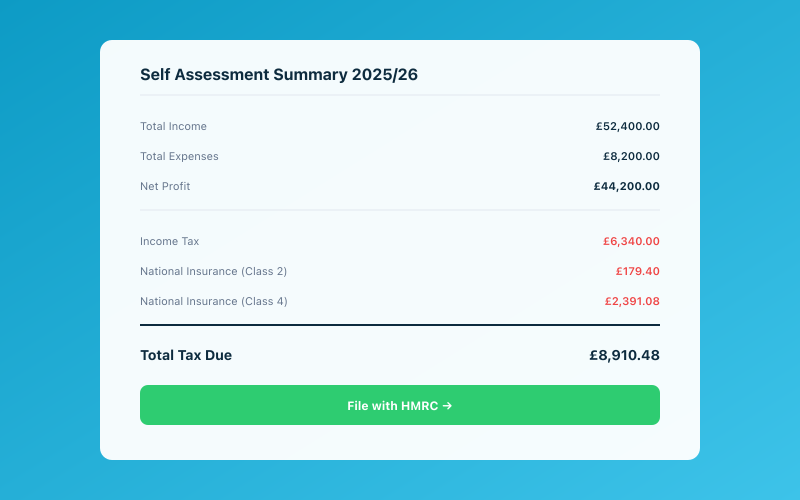 Your Accounted dashboard shows your real-time tax position
However, most people get a tax-free allowance on their savings interest, called the Personal Savings Allowance (PSA). This means you can earn a certain amount of interest each year without paying any tax on it.
The Personal Savings Allowance
The PSA was introduced in April 2016 and the amounts have not changed since. How much you get depends on your income tax band:
| Tax Band | Personal Savings Allowance | |----------|---------------------------| | Basic rate taxpayer (income up to £50,270) | £1,000 | | Higher rate taxpayer (income £50,271 to £125,140) | £500 | | Additional rate taxpayer (income above £125,140) | £0 |
If you are a basic rate taxpayer, you can earn up to £1,000 in savings interest per year without paying any tax. At a savings rate of 4%, you would need roughly £25,000 in savings before you started exceeding this allowance.
If you are a higher rate taxpayer, your allowance is halved to £500. At 4%, that is about £12,500 in savings before you exceed it.
If you are an additional rate taxpayer, you get no Personal Savings Allowance at all. Every pound of interest is taxable.
How to Work Out Your Tax Band
Your tax band is based on your total taxable income — not just your salary or business profits, but everything added together: employment income, self-employment profits, rental income, pension income, and savings interest itself.
For 2025/26:
- Total income up to £50,270: basic rate
- Total income £50,271 to £125,140: higher rate
- Total income above £125,140: additional rate
If your savings interest pushes you from basic rate into higher rate, the interest above the threshold is taxed at the higher rate, and your PSA drops to £500 for the portion of interest earned as a higher rate taxpayer.
The Starting Rate for Savings
There is another allowance that some people qualify for, called the starting rate for savings. This gives you up to £5,000 of savings interest at 0% tax, but it only applies if your other (non-savings) income is below £17,570.
Here is how it works:
- Take the basic personal allowance: £12,570
- Add the starting rate band: £5,000
- Total: £17,570
If your non-savings income (salary, self-employment profits, rental income, pensions) is below £12,570, you get the full £5,000 starting rate band for savings interest, on top of your PSA.
If your non-savings income is between £12,570 and £17,570, your starting rate band is reduced by £1 for every £1 of income above £12,570.
If your non-savings income is above £17,570, the starting rate band is completely used up, and you only get the standard PSA.
This is mainly relevant for people with very low income — perhaps retirees living primarily off savings, or people who are not working and living off savings temporarily.
How Do Banks Report Interest to HMRC?
Since April 2016, banks and building societies have paid savings interest gross — meaning they do not deduct tax before paying you. You receive the full amount of interest.
However, your bank reports how much interest it has paid you directly to HMRC. This happens automatically, and you do not need to do anything to make it happen. HMRC then includes this information in your tax calculation.
If You Are an Employee (PAYE)
If you are employed and your savings interest exceeds your PSA, HMRC will usually adjust your tax code to collect the tax through your salary. You might notice your tax code changing, which means HMRC is collecting the savings tax a little at a time through your pay. You do not normally need to file a Self Assessment return just because of savings interest.
If You Are Self-Employed
If you file a Self Assessment return, you need to include your savings interest on the return. There is a specific section for it. HMRC already knows how much you earned (because the bank told them), so make sure your figure matches.
The tax on your savings interest is then included in your overall Self Assessment tax bill.
If You Have Multiple Accounts
You need to add up the interest from all your accounts — current accounts, savings accounts, fixed-term bonds, notice accounts, and any other accounts that pay interest. Each bank reports its own figure to HMRC, but you are responsible for declaring the total on your Self Assessment if you file one.
ISAs: The Tax-Free Alternative
Interest earned in an Individual Savings Account (ISA) is completely tax-free. It does not count towards your Personal Savings Allowance, and you do not need to declare it on your tax return.
For 2025/26, the annual ISA allowance is £20,000. You can split this across different types of ISA:
- Cash ISA — straightforward savings, tax-free interest
- Stocks and Shares ISA — investments, tax-free gains and dividends
- Lifetime ISA — for first home purchase or retirement, with a 25% government bonus (age limit applies)
- Innovative Finance ISA — peer-to-peer lending
If your savings are large enough that you are exceeding your PSA, moving money into a Cash ISA is the simplest way to reduce your tax bill on interest. The interest rates on Cash ISAs are often competitive with standard savings accounts, so you are not usually sacrificing returns.
ISA vs PSA: Which Do You Need?
If your total savings interest is under your PSA (£1,000 for basic rate, £500 for higher rate), an ISA does not save you any tax — the interest would be tax-free anyway under the PSA.
If your interest exceeds your PSA, an ISA becomes valuable because it shelters interest from tax that would otherwise be payable.
As a general rule:
- Savings under roughly £25,000 (at 4% interest) and you are a basic rate taxpayer: PSA covers you, ISA is optional
- Savings over £25,000 or you are a higher rate taxpayer: ISA starts saving you real money
- Additional rate taxpayer: use your ISA allowance before anything else
Premium Bonds
Prizes from NS&I Premium Bonds are completely tax-free. They are not savings interest (they are prizes), so they do not count towards your PSA. If you want a tax-free home for some of your savings and you are comfortable with the variable return, Premium Bonds are worth considering.
You can hold up to £50,000 in Premium Bonds. The effective "interest rate" is around 4% based on the current prize fund rate, but your actual return depends on luck.
What About Fixed-Rate Bonds?
If you lock money away in a fixed-rate bond (say, a 2-year fixed saver), the interest is usually taxable in the year it is paid, not the year it accrues. Some bonds pay interest annually, while others pay it all at maturity.
This matters because a large lump of interest paid in one year could push you over your PSA or even into a higher tax band. Check the terms of any fixed-rate product to understand when the interest will be paid and plan accordingly.
How to Declare Savings Interest on Self Assessment
If you file a Self Assessment return, you declare your savings interest in the SA100 main return. There is a section called "Interest and dividends from UK banks and building societies."
You need to enter the total gross interest received during the tax year (6 April to 5 April). Your bank should provide an annual interest statement or tax certificate showing the exact figure. You can also usually find it in your online banking.
If you use Accounted, Penny can help you track interest payments that appear in your connected bank accounts, so you have the figures ready when it is time to complete your return.
Summary
- Most people can earn £500 to £1,000 in savings interest per year tax-free thanks to the Personal Savings Allowance
- Banks report your interest to HMRC automatically — you cannot hide it even if you wanted to
- If you exceed your PSA, consider using your £20,000 ISA allowance to shelter interest from tax
- Self-employed people declare savings interest on their Self Assessment return
If you are self-employed and want to make sure your tax calculation accounts for everything — including savings interest — Accounted's AI bookkeeper Penny keeps a real-time estimate of your total tax bill. Start your free trial and stay on top of what you owe, with no surprises.
Related Reading
Start your free trial and let Penny handle your bookkeeping automatically.
Penny, your AI bookkeeper, tracks your tax position in real time and flags opportunities to reduce your bill. Meet Penny →
Tax & Compliance Specialists
Our tax specialists have decades of combined experience in UK sole trader and small business taxation, MTD compliance, and HMRC submissions. All content is reviewed against current HMRC guidance before publication and updated quarterly to reflect legislative changes.
Ready to try Accounted?
Join UK sole traders who are simplifying their bookkeeping and tax.
Start your 14-day free trial