Property Allowance — The £1,000 Tax-Free Amount Explained
There's a neat little tax break that many people with small amounts of property income don't know about — the property allowance. It gives you up to £1,000 of tax-free property income per year, with no need to tell HMRC about it and no requirement to file a Self Assessment return (assuming you don't have other reasons to file one).
It sounds almost too straightforward, and in many ways it is. But there are some important details to understand before you assume it applies to you. Let's dig into how the property allowance works, who it's for, and when it might actually be better not to use it.
What Is the Property Allowance?
The property allowance was introduced in April 2017 as part of a pair of new allowances (the other being the trading allowance for self-employment income). It gives individuals a £1,000 tax-free amount for property income each tax year.
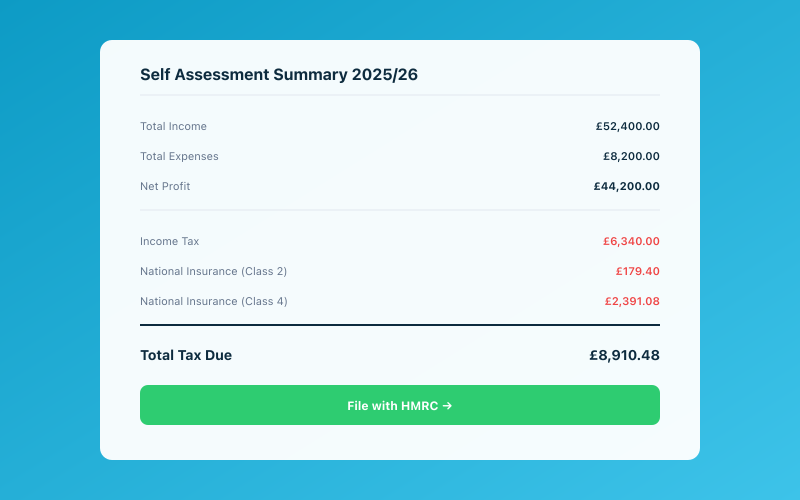 Your Accounted dashboard shows your real-time tax position
If your total gross property income in a tax year is £1,000 or less, you don't need to:
- Pay any tax on it
- Report it to HMRC
- File a Self Assessment tax return (unless you have other reasons to do so)
This is a per-person allowance, not a per-property one. So if you receive property income from multiple sources, you add it all together and compare the total to the £1,000 threshold.
The allowance is automatic — you don't need to claim it or tick a special box. If your property income is within the limit, it's simply tax-free.
What Counts as Property Income?
The property allowance applies to income from land or property. This includes:
- Rent from letting a room or property. Whether it's a full house, a flat, a room, a garage, or a parking space.
- Income from renting out a driveway. If you rent your driveway to commuters, the income counts.
- Income from storage. Letting someone store their belongings in your garage or shed.
- Filming fees. If someone pays to film at your property, that's property income.
- Income from land. Renting out a field, garden, or plot of land.
It doesn't matter whether the arrangement is formal or informal. If someone is paying you for the use of your land or property, it's property income.
However, the property allowance does not apply to:
- Income from a property business carried on in partnership
- Income where the property is owned jointly with another person and you've elected to split the income in a non-standard way under the Income Tax Act
- Income from a company you control or are connected with (anti-avoidance rules)
- Income covered by Rent a Room Relief (you can choose one or the other, but not both)
That last point is particularly important. If you let a furnished room in your own home, you might be better off using Rent a Room Relief, which gives you up to £7,500 per year tax-free. You can't stack the property allowance on top of Rent a Room Relief — it's one or the other.
How Does It Work in Practice?
Let's walk through a few examples to make this concrete.
Example 1: Renting out a driveway You rent your driveway to a local commuter for £80 per month — that's £960 per year. This is below the £1,000 property allowance, so it's completely tax-free. You don't need to tell HMRC or include it on a tax return.
Example 2: Occasional Airbnb income You let your spare room on Airbnb for a few weekends throughout the year and earn £850 in total. This is under £1,000, so the property allowance covers it — no tax to pay, no need to report.
But wait — if the room is in your own home and it's furnished, you might want to consider Rent a Room Relief instead. Since you only earned £850, both the property allowance and Rent a Room Relief would cover it. The choice doesn't matter this year. But if you plan to do more letting next year, Rent a Room Relief (with its £7,500 threshold) would be the smarter option going forward.
Example 3: Small rental income above £1,000 You rent a garage for £150 per month, giving you annual income of £1,800. This exceeds the property allowance, so you can't simply ignore it. But you have a choice:
- Option A: Use the property allowance as a flat deduction. You declare £1,800 as income but deduct the £1,000 property allowance, leaving taxable profit of £800. You can't claim any actual expenses on top of this.
- Option B: Claim actual expenses. You declare £1,800 as income and deduct your actual expenses (insurance, repairs, etc.). If your expenses are more than £1,000, this option leaves you with a lower taxable profit.
In this case, you'd compare your actual expenses against the £1,000 allowance and choose whichever gives you the better result.
Example 4: Full rental property You let out a buy-to-let flat and receive £12,000 per year in rent. Your expenses (mortgage interest tax credit aside) total £4,500. In this case, the property allowance is irrelevant — your actual expenses far exceed £1,000, so you'd always claim those instead. The property allowance is not designed for this situation, and using it would cost you money.
When Should You Use the Property Allowance?
The property allowance is most useful in two scenarios:
Scenario 1: Very small amounts of property income (under £1,000). If your total property income is below the threshold, the allowance means you don't have to do anything. No tax, no reporting, no hassle.
Scenario 2: Small amounts of property income (over £1,000) with minimal expenses. If your income is a bit above £1,000 and your actual expenses are negligible, using the property allowance as a flat-rate deduction might give you a simpler life, even if it doesn't quite match claiming actual expenses.
For most landlords with conventional rental properties, the property allowance won't be beneficial. Your actual expenses — insurance, repairs, agent fees, ground rent, service charges, and so on — will almost certainly exceed £1,000, making it better to claim the real figures.
The Property Allowance and Making Tax Digital
If you're already filing Self Assessment returns for other reasons (self-employment, other property income above the threshold, etc.), you can still use the property allowance for qualifying income. You'd simply include it on your return and elect to use the allowance instead of actual expenses.
With Making Tax Digital for Income Tax coming into force, some people with very small amounts of property income are wondering whether they'll be pulled into the MTD reporting requirements. The good news is that if your total qualifying income (from self-employment and property) is below the MTD threshold, you won't need to make quarterly submissions. The property allowance can help keep your reportable property income at zero if you're under the £1,000 mark.
If you're already using Accounted for your self-employment income and you have a small amount of property income on the side, Penny can help you work out whether the property allowance or actual expenses gives you a better result. It's a quick calculation, but it's one worth getting right.
Can You Use It Alongside the Trading Allowance?
Yes. The property allowance and the trading allowance are separate. You can use both in the same tax year if you have both property income and trading income that qualify.
For example, if you rent out your driveway for £800 a year (covered by the property allowance) and also sell handmade crafts at a car boot sale for £600 a year (covered by the trading allowance), both amounts are tax-free and neither needs to be reported.
This can be particularly useful for people with multiple small income streams who don't want to get drawn into the Self Assessment system unnecessarily.
Common Questions
Can I carry forward unused property allowance? No. The £1,000 allowance is per tax year. If you don't use it, you lose it. There's no rolling it over to future years.
Does the property allowance apply to overseas property? Yes, it applies to overseas property income as well as UK property income. However, if you have both UK and overseas property income, they're combined for the purpose of the £1,000 threshold.
What if I jointly own a property? Each co-owner has their own £1,000 property allowance. So if you and your partner jointly own a property and split the income equally, you each compare your share of the income against your own £1,000 threshold. However, be aware of the exclusion for partnership income mentioned earlier.
Can I switch between the property allowance and actual expenses each year? Yes. You can choose whichever method suits you best in each tax year. There's no obligation to be consistent. In a year where your expenses are low, the property allowance might work better; in another year, actual expenses might be the way to go.
Does the allowance apply to furnished holiday lets? Yes, though as with any property income, you'll want to compare the allowance against your actual expenses to see which is more beneficial. Given the typically higher expenses involved in holiday letting, actual expenses will almost always be the better option.
Record Keeping
Even if your property income is below £1,000 and you don't need to report it, it's sensible to keep basic records. HMRC could ask you to demonstrate that your income was within the threshold, and having a simple record of the amounts received makes that straightforward.
For income above £1,000 where you elect to use the property allowance as a deduction, you'll need to declare the income on your Self Assessment return. Keep records of the gross income received in case of any queries.
And if you're in any doubt about whether the property allowance or actual expenses is better for your situation, a quick comparison is all it takes. Accounted can help you track your property expenses alongside your other business costs, giving you a clear picture of which approach saves you more tax. For a full rundown of what you can claim, have a look at our guides to landlord allowable expenses and what expenses landlords can claim.
Related reading:
Accounted helps UK sole traders stay on top of their bookkeeping and tax. Start your free 30-day trial at getaccounted.co.uk.
Related Reading
- Holiday Lets vs Long-Term Lets — Which Is More Tax-Efficient?
- Joint Property Ownership — How to Split Rental Income for Tax
Explore our property features built specifically for UK landlords.
Accounted includes built-in property management — track rental income, Section 24, and allowable expenses across multiple properties. See property features →
Tax & Compliance Specialists
Our tax specialists have decades of combined experience in UK sole trader and small business taxation, MTD compliance, and HMRC submissions. All content is reviewed against current HMRC guidance before publication and updated quarterly to reflect legislative changes.
Ready to try Accounted?
Join UK sole traders who are simplifying their bookkeeping and tax.
Start your 14-day free trial