What is the Personal Allowance for 2025/26? Tax-Free Income Explained
What is the Personal Allowance?
The Personal Allowance is the amount of income you can earn each tax year before you start paying income tax. For the 2025/26 tax year (6 April 2025 to 5 April 2026), the Personal Allowance remains at £12,570.
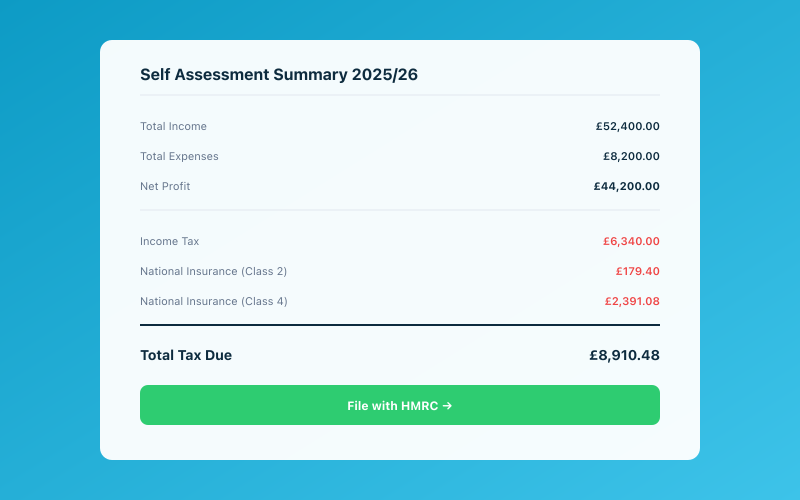 Your Accounted dashboard shows your real-time tax position
This means the first £12,570 you earn from all sources — employment, self-employment, pensions, rental income, and most other taxable income — is completely tax-free.
The Personal Allowance has been frozen at £12,570 since 2021/22 and is expected to stay at this level until at least April 2028. Because of inflation, this freeze means more people are paying more tax in real terms each year, a process often called "fiscal drag."
How Income Tax Works Above the Personal Allowance
Once your income exceeds £12,570, you start paying income tax at the following rates for 2025/26:
Basic Rate (20%)
You pay 20% on taxable income between £12,571 and £50,270. This means the basic rate band covers £37,700 of income above your Personal Allowance.
Higher Rate (40%)
Income between £50,271 and £125,140 is taxed at 40%.
Additional Rate (45%)
Any income above £125,140 is taxed at 45%.
It is worth noting that these rates apply to most types of income. Dividends and savings income have their own rates and allowances, which we cover in separate guides.
What Happens to the Personal Allowance Above £100,000?
This is where things get painful. If your total adjusted net income exceeds £100,000 in the 2025/26 tax year, your Personal Allowance starts to reduce. It goes down by £1 for every £2 of income above £100,000.
Here is a quick breakdown:
- Income of £100,000 — Full Personal Allowance of £12,570
- Income of £110,000 — Personal Allowance reduced to £7,570 (lost £5,000 because income is £10,000 over the threshold, and £10,000 divided by 2 = £5,000)
- Income of £120,000 — Personal Allowance reduced to £2,570
- Income of £125,140 or above — Personal Allowance is zero
This creates an effective marginal tax rate of 60% on income between £100,000 and £125,140. For every additional £1 you earn in this range, you lose 50p of Personal Allowance (which would have been tax-free), plus you pay 40% tax on the £1 itself. The combined effect is a 60% marginal rate.
How to Reduce the Impact
If your income is near the £100,000 threshold, there are legitimate ways to keep your adjusted net income below it:
- Pension contributions — Personal pension contributions made under relief at source reduce your adjusted net income. A contribution of £25,140 gross (£20,112 net if you are a higher rate taxpayer) could restore your full Personal Allowance.
- Gift Aid donations — Charitable donations under Gift Aid also reduce your adjusted net income for Personal Allowance purposes.
- Salary sacrifice — If your employer offers salary sacrifice arrangements for pensions, childcare, or cycle-to-work schemes, these reduce your gross income directly.
If you use Accounted to track your income throughout the year, our AI bookkeeper Penny can alert you when you are approaching the £100,000 threshold, giving you time to plan ahead rather than facing a surprise tax bill.
Blind Person's Allowance
If you are registered as blind or severely sight impaired with your local council (or, in Scotland, with a health board), you are entitled to the Blind Person's Allowance. For 2025/26, this is an extra £3,070 on top of the standard Personal Allowance, giving you a total tax-free amount of £15,640.
If you cannot use the full Blind Person's Allowance yourself (for example, if your income is too low), you can transfer the surplus to your spouse or civil partner.
To claim, you need to include it on your Self Assessment tax return or contact HMRC directly if you are taxed through PAYE.
Marriage Allowance
The Marriage Allowance lets you transfer £1,260 of your Personal Allowance to your spouse or civil partner, provided:
- You earn less than £12,570 (so you are not using your full Personal Allowance)
- Your partner pays tax at the basic rate only (income no higher than £50,270)
This can save the higher-earning partner up to £252 per year in income tax (£1,260 at 20%).
How to Claim Marriage Allowance
You can apply online through the GOV.UK website. Once set up, it automatically applies each year until you cancel it. You can also backdate claims for up to four previous tax years, which could mean a refund of up to £1,008.
A common mistake is claiming Marriage Allowance when the higher earner is a higher rate taxpayer. This does not work — the receiving partner must be a basic rate taxpayer only.
How the Personal Allowance Interacts with Different Income Types
Your Personal Allowance is set against your income in a specific order. HMRC applies it against non-savings income first (such as employment or self-employment income), then against savings income, and finally against dividend income.
This ordering matters because savings and dividend income have their own tax-free allowances:
- Personal Savings Allowance — Basic rate taxpayers get £1,000 of tax-free savings interest. Higher rate taxpayers get £500. Additional rate taxpayers get nothing.
- Dividend Allowance — Everyone gets £500 of tax-free dividend income for 2025/26 (reduced from £1,000 in 2023/24 and £2,000 in 2022/23).
If your total income is low enough that your Personal Allowance covers all your non-savings income, it effectively cascades down and shelters your savings and dividend income too. This is particularly relevant for retirees and people with multiple small income streams.
Scottish Taxpayers
If you live in Scotland, you pay Scottish income tax rates on your non-savings, non-dividend income. However, your Personal Allowance is still £12,570 — that is set by the UK government, not the Scottish Parliament. Scotland has its own rate bands (starter, basic, intermediate, higher, advanced, and top rate) which are different from the rest of the UK, but the tax-free Personal Allowance applies in the same way.
Common Questions About the Personal Allowance
Do I get a Personal Allowance if I am self-employed?
Yes. The Personal Allowance applies to everyone who is a UK taxpayer, whether you are employed, self-employed, or both. If you are self-employed, it is applied against your trading profits.
Does state pension use up my Personal Allowance?
Yes. The state pension is taxable income, even though tax is not deducted at source. For 2025/26, the full new state pension is approximately £11,975 per year, which uses up most of your Personal Allowance. Any additional income on top could push you into paying tax.
Can I have more than one Personal Allowance?
No. You get one Personal Allowance regardless of how many jobs, businesses, or income sources you have. All your income is added together, and the single Personal Allowance is applied against the total.
What if I have not used my full Personal Allowance?
If your income is below £12,570, the unused portion of your Personal Allowance is generally lost — you cannot carry it forward to the next year. The only exception is the Marriage Allowance transfer mentioned above.
Keep Track of Your Tax-Free Allowance
Understanding your Personal Allowance is the foundation of managing your tax efficiently. If you are self-employed or have multiple income streams, keeping track of where you stand can be tricky.
Accounted makes this straightforward. Connect your bank accounts and let Penny, our AI bookkeeper, categorise your income and expenses automatically. You will always know where you stand against your Personal Allowance, and you can plan ahead to make the most of every tax-free pound. Start your free trial today and take the guesswork out of your tax position.
Related Reading
Start your free trial and let Penny handle your bookkeeping automatically.
Penny, your AI bookkeeper, tracks your tax position in real time and flags opportunities to reduce your bill. Meet Penny →
Tax & Compliance Specialists
Our tax specialists have decades of combined experience in UK sole trader and small business taxation, MTD compliance, and HMRC submissions. All content is reviewed against current HMRC guidance before publication and updated quarterly to reflect legislative changes.
Ready to try Accounted?
Join UK sole traders who are simplifying their bookkeeping and tax.
Start your 14-day free trial