What is Payment on Account? A Simple Guide to HMRC's Advance Tax
Few things in the self-employed world cause as much confusion and frustration as payments on account. You file your first Self Assessment, expecting a tax bill based on what you earned, and instead you are hit with a bill that is 50% larger than you anticipated. It feels like HMRC is overcharging you, but they are not. They are asking you to pay some of next year's tax in advance.
This guide explains how payments on account work, why they exist, and how to manage them so they do not catch you off guard.
What Are Payments on Account?
Payments on account are advance payments towards your next year's tax bill. They are based on the assumption that you will earn roughly the same amount next year as you did this year.
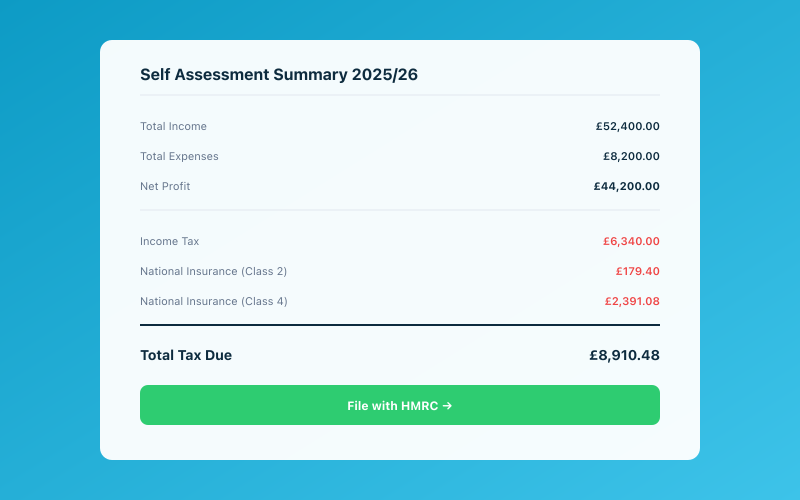 Your Accounted dashboard shows your real-time tax position
Each payment on account is equal to half of your previous year's tax bill (the total Self Assessment liability, including Class 4 National Insurance but excluding certain items like student loan repayments and capital gains tax).
There are two payments on account per year, plus a possible balancing payment.
Why Do They Exist?
Employees pay tax in real time through PAYE — their employer deducts tax from each payslip and sends it to HMRC throughout the year. By the time the tax year ends, most of their tax is already paid.
Self-employed people, on the other hand, traditionally paid all their tax in a lump sum after the year ended. This meant HMRC was always a year behind in collecting tax from the self-employed.
Payments on account exist to bring self-employed taxpayers closer to the real-time payment model. Instead of paying everything 10 months after the tax year ends, you pay in instalments throughout the following year.
It is not extra tax. It is the same tax, just paid earlier.
When Are They Due?
There are three possible payment dates each year:
31 January
The first payment on account for the current tax year is due on 31 January. This is the same deadline as the Self Assessment filing and payment deadline for the previous year.
This means that on 31 January, you may be paying three things at once:
- Any remaining tax for the previous year (the balancing payment)
- The first payment on account for the current year
- Any student loan or other amounts due
This is why the January tax bill can be shockingly large, especially in your first year of self-employment.
31 July
The second payment on account for the current tax year is due on 31 July. There is no Self Assessment filing associated with this date — it is purely a payment deadline.
The Following 31 January
When you file your Self Assessment for the year, the actual tax due is calculated. The two payments on account you have already made are deducted, and if there is a remaining balance, it becomes the balancing payment, due on 31 January along with the next year's first payment on account.
If you overpaid through your payments on account (because your income was lower than the previous year), you receive a refund.
A Worked Example
Let us walk through a typical scenario.
Year 1: 2024/25
Tom starts freelancing. His tax bill for 2024/25 is £6,000 (income tax and Class 4 NIC combined).
On 31 January 2026, he must pay:
- £6,000 — the full tax for 2024/25
- £3,000 — first payment on account for 2025/26 (50% of £6,000)
- Total due: £9,000
On 31 July 2026, he must pay:
- £3,000 — second payment on account for 2025/26
Tom has now paid £6,000 in advance towards 2025/26, without yet knowing what his actual 2025/26 tax bill will be.
Year 2: 2025/26
Tom's actual tax bill for 2025/26 turns out to be £7,200. He has already paid £6,000 through payments on account.
On 31 January 2027, he must pay:
- £1,200 — balancing payment for 2025/26 (£7,200 minus £6,000 already paid)
- £3,600 — first payment on account for 2026/27 (50% of £7,200)
- Total due: £4,800
On 31 July 2027:
- £3,600 — second payment on account for 2026/27
And so it continues each year.
What If Income Falls?
Suppose Tom's 2025/26 tax bill was only £4,000 instead of £7,200. He has already paid £6,000 through payments on account — that is £2,000 more than he owed.
On 31 January 2027:
- £2,000 refund (or credit against other amounts due)
- £2,000 — first payment on account for 2026/27 (50% of £4,000)
The system is self-correcting. Overpayments come back to you; underpayments are caught by the balancing payment.
The First Year Problem
The first year of self-employment is when payments on account cause the most pain. You go from paying nothing (or having tax deducted via PAYE from employment) to suddenly owing a full year's tax plus half of next year's tax on the same date.
Using Tom's example, his first January bill was £9,000 — 150% of his actual tax liability for the year. He owed the full £6,000 for the year just gone, plus £3,000 as an advance on the year ahead.
If you are newly self-employed, plan for this. Set aside money throughout the year so the January bill does not come as a shock.
How to Reduce Payments on Account
If you know that your income this year will be lower than last year, you can ask HMRC to reduce your payments on account. This is called making a claim to reduce.
Common reasons for reducing:
- You had an unusually good year last year and expect to return to normal
- You are reducing your hours or winding down your business
- You have taken on employment and will earn less from self-employment
- A major client has been lost
You can reduce payments on account through your HMRC online account or by contacting HMRC directly. In Accounted, Penny tracks your year-to-date income and can flag when your current trajectory suggests your payments on account may be too high.
A Warning About Reducing
If you reduce your payments on account and your actual tax bill turns out to be higher than you estimated, HMRC charges interest on the underpayment. Only reduce if you are genuinely confident that your income will be lower. If in doubt, pay the full amount — you will get any overpayment back.
When Payments on Account Do Not Apply
You do not have to make payments on account if:
- Your Self Assessment tax bill is less than £1,000, or
- More than 80% of your tax is collected at source (through PAYE, for example)
This means that if you have a small side business alongside full-time employment and your Self Assessment liability is under £1,000, you pay it in one go without any advance payments.
How Accounted Helps You Plan
One of the most useful things bookkeeping software can do is remove the surprise from your tax bill. Accounted tracks your income and expenses in real time, and Penny calculates your estimated tax liability as the year progresses.
This means you can see at any point:
- Your estimated tax for the current year
- What your payments on account for next year are likely to be
- How much you should be setting aside each month
No more guessing. No more nasty surprises in January.
Accounted also shows your payment on account amounts from the previous year, so you can see exactly how much has already been paid towards the current year's bill and what is likely left to pay.
Budget Monthly, Pay Confidently
The simplest way to manage payments on account is to save for tax every month. Take your estimated annual tax bill (including payments on account), divide by 12, and move that amount into a savings account each month.
Penny can help with this. Based on your current income and expenses, she estimates how much you should be setting aside. Some Accounted users set up a standing order to a savings account based on Penny's recommendation.
When 31 January and 31 July arrive, the money is already there. No stress, no scramble, no overdraft.
Stay Ahead of Your Tax Bill
Payments on account do not need to be a source of anxiety. Once you understand the system — and once you have software tracking your position throughout the year — they become just another part of running a business. Start your free trial of Accounted and let Penny keep you informed about what you owe, what you have paid, and what is coming next. Being prepared is the best tax strategy there is.
Related Reading
Start your free trial and let Penny handle your bookkeeping automatically.
Penny, your AI bookkeeper, tracks your tax position in real time and flags opportunities to reduce your bill. Meet Penny →
Tax & Compliance Specialists
Our tax specialists have decades of combined experience in UK sole trader and small business taxation, MTD compliance, and HMRC submissions. All content is reviewed against current HMRC guidance before publication and updated quarterly to reflect legislative changes.
Ready to try Accounted?
Join UK sole traders who are simplifying their bookkeeping and tax.
Start your 14-day free trial