What is National Insurance for Self-Employed People?
National Insurance: The Basics
National Insurance (NI) is a tax you pay on your earnings that funds state benefits, including the state pension, Maternity Allowance, and certain other entitlements. If you are employed, your employer deducts NI from your wages automatically through PAYE. But if you are self-employed, you are responsible for paying it yourself through Self Assessment.
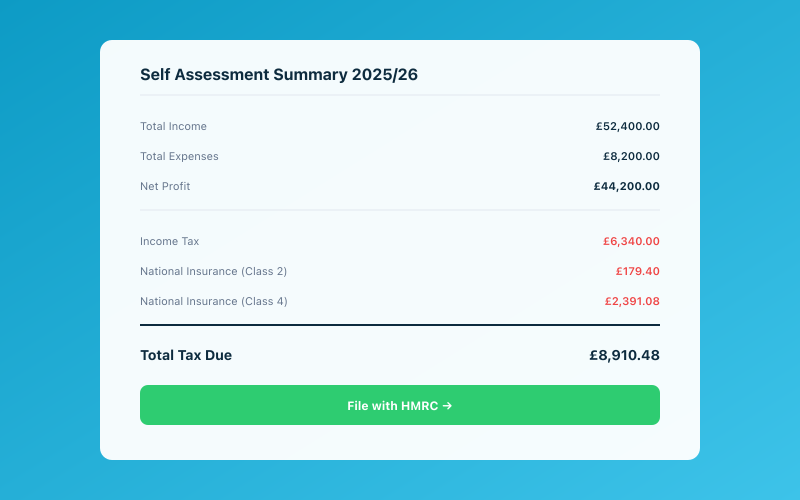 Your Accounted dashboard shows your real-time tax position
Self-employed people pay two types of National Insurance:
- Class 2 — A flat-rate weekly contribution
- Class 4 — A percentage-based contribution calculated on your profits
Both are calculated and collected through your annual Self Assessment tax return. You do not need to make separate monthly or weekly payments — it all gets added to your January (and potentially July) tax bill.
Class 2 National Insurance
Class 2 NI is a flat-rate contribution that helps you build up your entitlement to the state pension and certain benefits.
The 2025/26 Rates
For the 2025/26 tax year:
- Rate: £3.45 per week (£179.40 per year)
- Small Profits Threshold: £6,845 per year
If your self-employed profits are at or above the Small Profits Threshold of £6,845, you are liable to pay Class 2 NI. At £3.45 per week, that is £179.40 for the full year. It is not a large amount, but it is important because it protects your state pension record.
If your profits are below £6,845, you are not required to pay Class 2 NI. However, you may choose to pay it voluntarily (more on that below).
What Class 2 Gets You
Paying Class 2 NI counts towards:
- State pension — You need 35 qualifying years of NI contributions to get the full new state pension. Each year you pay Class 2 counts as a qualifying year.
- Maternity Allowance — Self-employed women can claim Maternity Allowance if they have paid Class 2 NI for at least 13 of the 66 weeks before the baby is due.
- Employment and Support Allowance (contributory) — If you become too ill to work, NI contributions may entitle you to this benefit.
- Bereavement benefits — NI credits can affect your family's entitlement to bereavement benefits.
Recent Changes to Class 2
The government announced in 2023 that Class 2 NI would be abolished, but this decision was reversed. Class 2 continues to exist for the 2025/26 tax year. There have been some administrative changes — for many self-employed people, Class 2 is now treated as a zero-rate liability (meaning you get the NI credit without actually having to pay), but this depends on your specific circumstances and profit level.
The key takeaway is that Class 2 still exists, still protects your state pension, and the rate remains modest.
Class 4 National Insurance
Class 4 NI is the bigger contributor to your NI bill. It is calculated as a percentage of your self-employed profits and is paid alongside your income tax through Self Assessment.
The 2025/26 Rates
For the 2025/26 tax year:
- 6% on profits between £12,570 and £50,270
- 2% on profits above £50,270
The Lower Profits Limit is £12,570 (aligned with the Personal Allowance), and the Upper Profits Limit is £50,270 (aligned with the higher rate tax threshold).
How Class 4 Is Calculated
Class 4 NI is calculated on your net self-employed profits — that is, your total self-employed income minus your allowable business expenses. It uses the same profit figure as your income tax calculation.
A Worked Example
Suppose your self-employed profits for 2025/26 are £40,000.
Class 4 NI:
- Profits between £12,570 and £40,000 = £27,430
- £27,430 x 6% = £1,645.80
Class 2 NI:
- Profits are above £6,845, so Class 2 is due
- 52 weeks x £3.45 = £179.40
Total NI for the year: £1,825.20
This is on top of your income tax bill.
Another Example: Higher Profits
Now suppose your profits are £65,000.
Class 4 NI:
- Profits between £12,570 and £50,270 = £37,700 x 6% = £2,262.00
- Profits between £50,270 and £65,000 = £14,730 x 2% = £294.60
- Total Class 4: £2,556.60
Class 2 NI: £179.40
Total NI: £2,736.00
Notice how the rate drops from 6% to 2% once you pass the Upper Profits Limit. This is similar to how income tax rates increase in bands, except NI effectively decreases at higher levels.
What About Class 1?
Class 1 NI is what employees and their employers pay. If you are both employed and self-employed (which is increasingly common), you pay Class 1 on your employment earnings and Class 2/Class 4 on your self-employed profits.
However, there are annual maximum thresholds to prevent you from overpaying NI. If your combined Class 1 and Class 4 contributions exceed a certain amount, you can apply for a refund or deferment. HMRC usually handles this automatically through your Self Assessment return, but if you have high earnings from both sources, it is worth checking.
Voluntary Class 2 Contributions
If your self-employed profits are below the Small Profits Threshold of £6,845, you are not required to pay Class 2 NI. However, this means you will not get a qualifying year towards your state pension for that year.
You can choose to pay voluntary Class 2 contributions at the same rate of £3.45 per week to fill in that gap. This is usually excellent value — £179.40 per year is a small price to pay for a year of state pension entitlement, which is worth thousands of pounds over a retirement.
When Voluntary Contributions Make Sense
- You are building towards 35 qualifying years — Check your NI record on the GOV.UK website. If you have gaps, voluntary Class 2 is one of the cheapest ways to fill them.
- You are starting out and profits are low — In your first year or two of self-employment, profits might be below the threshold. Paying voluntary Class 2 keeps your pension record intact.
- You are semi-retired or winding down — If you are still doing some self-employed work but profits have dropped, voluntary contributions maintain your record.
When They May Not Make Sense
- You already have 35 qualifying years — Additional years do not increase your state pension further.
- You get NI credits from other sources — If you receive certain benefits (like Universal Credit or Child Benefit for a child under 12), you may already receive NI credits that count towards your state pension.
You can check your National Insurance record online at GOV.UK to see how many qualifying years you have and whether you have any gaps.
How NI Differs from Income Tax
It is worth understanding a few key differences between NI and income tax:
No Personal Allowance "Cascade"
While income tax has a Personal Allowance that can be set against any type of income, Class 4 NI only applies to self-employed profits. You cannot offset employment losses against self-employed profits for NI purposes, or vice versa.
Married Couple and Other Allowances
There is no marriage allowance or blind person's allowance equivalent for National Insurance. These only reduce income tax.
No NI on Savings or Dividends
You do not pay National Insurance on savings interest, dividends, or rental income. NI only applies to earnings — whether from employment (Class 1) or self-employment (Class 2 and Class 4).
NI Is Per Person
Unlike income tax, where couples can sometimes transfer allowances, NI is always calculated individually. There is no way to share NI liability with a spouse.
When Do You Pay?
Class 2 and Class 4 NI are both collected through Self Assessment. They are added to your tax bill and are due on the same dates:
- 31 January following the end of the tax year (the main payment)
- 31 July (if payments on account apply)
They are included in your payments on account calculation, so if your total bill (including NI) exceeds £1,000, you will be making advance payments.
How Accounted Helps You Track NI
Your National Insurance liability is calculated alongside your income tax, so having accurate profit figures throughout the year is essential. Accounted tracks your income and expenses in real time, so Penny can estimate not only your income tax but also your Class 2 and Class 4 NI contributions as you go.
This means no surprises when you file your return. You will know what you owe for NI well before the deadline, and you can set aside the right amount throughout the year.
Start your free trial of Accounted today and let Penny keep track of your full tax position — income tax and National Insurance included — so you are always prepared when payment day arrives.
Related Reading
-
National Insurance for Sole Traders: Class 2 and Class 4 Explained
-
Class 2 and Class 4 National Insurance: What Sole Traders Pay
-
What is Payment on Account? A Simple Guide to HMRC's Advance Tax
Start your free trial and let Penny handle your bookkeeping automatically.
Penny, your AI bookkeeper, tracks your tax position in real time and flags opportunities to reduce your bill. Meet Penny →
Tax & Compliance Specialists
Our tax specialists have decades of combined experience in UK sole trader and small business taxation, MTD compliance, and HMRC submissions. All content is reviewed against current HMRC guidance before publication and updated quarterly to reflect legislative changes.
Ready to try Accounted?
Join UK sole traders who are simplifying their bookkeeping and tax.
Start your 14-day free trial