Class 2 and Class 4 National Insurance: What Sole Traders Pay
If you are self-employed in the UK, you pay two types of National Insurance: Class 2 and Class 4. They are calculated differently, serve different purposes, and appear in different places on your Self Assessment return. Yet most sole traders have only a vague understanding of what they are actually paying and why.
This guide breaks down both classes for the 2025/26 tax year, explains when each applies, and covers the important link between Class 2 contributions and your State Pension.
What Is National Insurance?
National Insurance (NI) is a tax on earnings that funds the State Pension, certain benefits such as Maternity Allowance and Employment and Support Allowance, and the NHS. Employees pay Class 1 NI, which is deducted from their wages by their employer. Self-employed people pay Class 2 and Class 4 instead.
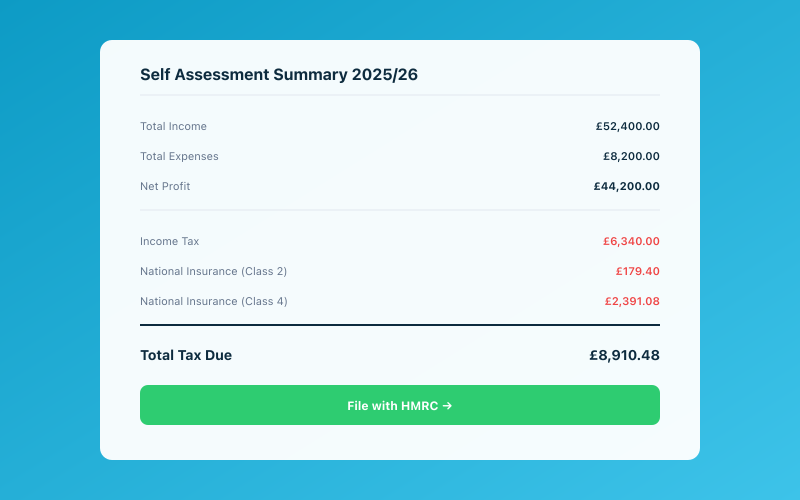 Your Accounted dashboard shows your real-time tax position
Both classes are collected through your Self Assessment tax return. You do not pay them separately — they are included in the tax bill HMRC sends you after you file.
Class 2 National Insurance
What It Is
Class 2 NI is a flat-rate weekly contribution. Unlike Class 4, which is based on a percentage of your profits, Class 2 is the same amount regardless of how much you earn.
2025/26 Rates
| Detail | Amount | |--------|--------| | Weekly rate | £3.45 | | Annual cost (52 weeks) | £179.40 | | Small Profits Threshold | £6,725 per year |
When You Pay
If your self-employed profits for the year are £6,725 or above, you are liable for Class 2 NI. The charge is calculated automatically when you file your Self Assessment return and is included in your overall tax bill.
If your profits are below £6,725, you are not required to pay Class 2 NI. However, you may want to pay voluntarily — and this is where things get important.
Why Class 2 Matters for Your State Pension
Class 2 contributions count as qualifying years for the State Pension. You need 35 qualifying years to receive the full new State Pension (currently £221.20 per week for 2025/26) and a minimum of 10 qualifying years to receive anything at all.
At just £3.45 per week, Class 2 NI is one of the cheapest ways to build up your State Pension entitlement. If your profits are below the Small Profits Threshold and you choose not to pay, you will have a gap in your NI record for that year. Over time, these gaps can reduce your State Pension significantly.
Voluntary Class 2 Contributions
If your profits are below £6,725, you can opt to pay Class 2 voluntarily by ticking the relevant box on your Self Assessment return. This is almost always worthwhile. The annual cost of £179.40 is trivial compared to the value of a qualifying year towards your State Pension.
You can also fill gaps from previous years, though the rules on how far back you can go have changed. Currently, you can fill gaps going back to April 2006, but this window is expected to close soon. Check the GOV.UK website for the latest deadline.
How It Appears on Your Tax Return
On the self-employment pages of your Self Assessment return (SA103), there is a section for Class 2 NI. If your profits exceed the Small Profits Threshold, the amount is calculated automatically. If your profits are below the threshold, you will see an option to pay voluntarily.
Class 4 National Insurance
What It Is
Class 4 NI is a percentage-based charge on your self-employed profits. It is the larger of the two NI charges and works similarly to Income Tax in that it applies to profits above a certain threshold, with different rates at different levels.
2025/26 Rates
| Profit band | Rate | |-------------|------| | Below £12,570 | 0% | | £12,570 to £50,270 | 6% | | Above £50,270 | 2% |
How the Calculation Works
Class 4 NI is calculated on your net self-employed profit — that is, your income minus allowable expenses, the same figure you use for Income Tax purposes.
The Lower Profits Limit of £12,570 matches the Income Tax Personal Allowance. This means you start paying Class 4 NI at the same point you start paying Income Tax.
Example: Profit of £40,000
- Profits between £12,570 and £40,000 = £27,430
- Class 4 NI = £27,430 x 6% = £1,645.80
Example: Profit of £60,000
- Profits between £12,570 and £50,270 = £37,700 at 6% = £2,262.00
- Profits between £50,270 and £60,000 = £9,730 at 2% = £194.60
- Total Class 4 NI = £2,456.60
Does Class 4 Count Towards the State Pension?
No. Class 4 NI does not count towards your State Pension or any contributory benefits. It is effectively a pure tax on self-employed earnings. Only Class 2 contributions build your pension entitlement.
This is an important distinction. Even though Class 4 is the larger charge, it gives you nothing in return beyond the general funding of public services. Class 2, despite being a much smaller amount, is what actually protects your pension.
How It Appears on Your Tax Return
Class 4 NI is calculated automatically based on the profit figure you enter on your self-employment pages. You will see it broken down on your SA302 tax calculation, which is the document HMRC produces summarising your total tax bill.
Class 2 and Class 4 Together: A Complete Example
Let us put both classes together for a sole trader with a profit of £35,000 in 2025/26.
Class 2 NI:
- Profit exceeds the Small Profits Threshold of £6,725, so Class 2 is due.
- £3.45 x 52 = £179.40
Class 4 NI:
- Profits between £12,570 and £35,000 = £22,430
- £22,430 x 6% = £1,345.80
Total National Insurance: £1,525.20
For comparison, the Income Tax on the same profit would be:
- Taxable income after Personal Allowance: £35,000 minus £12,570 = £22,430
- £22,430 x 20% = £4,486.00
So the combined tax and NI bill would be £6,011.20, an effective rate of about 17.2% on the full profit.
Recent Changes to Be Aware Of
The 2024/25 Class 4 Rate Cut
In the Autumn Statement 2023, the government cut the main Class 4 rate from 9% to 8%, effective from April 2024. A further cut to 6% took effect from April 2024 (combining the two cuts). This represents a meaningful saving for self-employed workers. On a profit of £40,000, the saving compared to the old 9% rate is approximately £823 per year.
The Abolition of the Class 2 Requirement (Reversed)
The government previously announced plans to abolish Class 2 NI entirely. This was later reversed. Class 2 remains in place for 2025/26, and self-employed people continue to pay it as before. If you see old articles stating Class 2 has been abolished, they are out of date.
How to Check Your NI Record
You can check your National Insurance record online at GOV.UK to see how many qualifying years you have and whether there are any gaps. Go to the "Check your National Insurance record" service and sign in with your Government Gateway credentials. The record shows each tax year, whether it is a full year, and how many more years you need for the full State Pension.
If you spot gaps, paying voluntary Class 2 contributions to fill them is usually the most cost-effective option.
How Accounted Handles National Insurance
When you use Accounted, Penny — the AI bookkeeper — tracks your income and expenses in real time and estimates not just your Income Tax but also your Class 2 and Class 4 NI liabilities. Your dashboard shows a running total of your expected tax bill, broken down by component, so you always know what to set aside.
There is no need to remember thresholds or rates. Penny applies the current year's figures automatically and updates your estimate every time a new transaction comes in.
Start your free trial of Accounted today and let Penny calculate your National Insurance alongside your tax — so you can see your true take-home profit at a glance.
Related Reading
Start your free trial and let Penny handle your bookkeeping automatically.
Penny, your AI bookkeeper, tracks your tax position in real time and flags opportunities to reduce your bill. Meet Penny →
Tax & Compliance Specialists
Our tax specialists have decades of combined experience in UK sole trader and small business taxation, MTD compliance, and HMRC submissions. All content is reviewed against current HMRC guidance before publication and updated quarterly to reflect legislative changes.
Ready to try Accounted?
Join UK sole traders who are simplifying their bookkeeping and tax.
Start your 14-day free trial