National Insurance for Sole Traders: Class 2 and Class 4 Explained
National Insurance for Sole Traders: Class 2 and Class 4 Explained
If you're self-employed in the UK, you don't just pay income tax on your profits. You also pay National Insurance contributions (NICs). And unlike employees — who have everything neatly deducted from their payslips — sole traders need to understand what they owe and when.
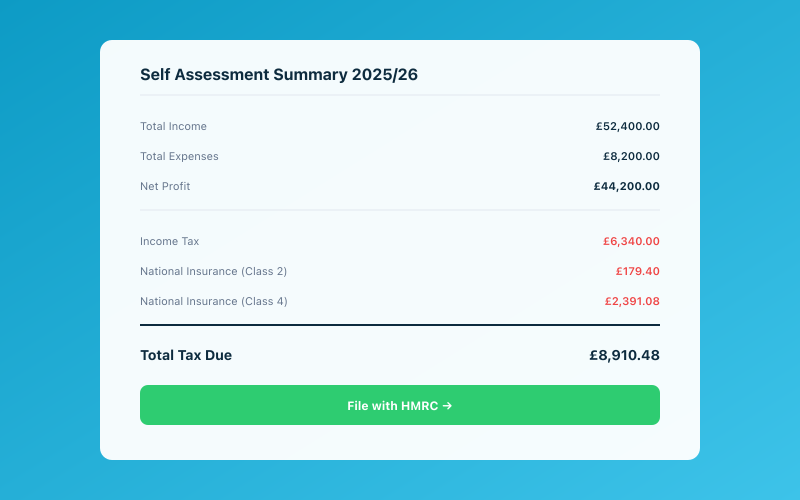 Your Accounted dashboard shows your real-time tax position
The good news? It's not as complicated as it first looks. There are really just two classes you need to worry about: Class 2 and Class 4. Let's break them both down.
Class 2 National Insurance
Class 2 NICs are a flat-rate contribution. For the 2025/26 tax year, the rate is £3.45 per week, which works out to roughly £179.40 per year.
You pay Class 2 NICs if your profits are above the Small Profits Threshold, which is currently £6,725 per year. If your profits fall below that threshold, you won't be charged Class 2 — but you can choose to pay voluntarily (more on that in a moment).
What does Class 2 actually get you?
Class 2 contributions count towards your qualifying years for the State Pension. You need 35 qualifying years for the full new State Pension, so these small weekly payments are genuinely important for your long-term financial security.
They also protect your entitlement to certain benefits, including Maternity Allowance and bereavement benefits.
Class 4 National Insurance
Class 4 is the bigger one. This is calculated as a percentage of your taxable profits, and it's where most of your NI bill comes from.
For 2025/26, the rates are:
- 6% on profits between £12,570 and £50,270
- 2% on profits above £50,270
Notice that the lower threshold (£12,570) matches the income tax Personal Allowance. That's not a coincidence — it means you start paying Class 4 NI at the same point you start paying income tax.
A quick example
Let's say your taxable profits are £35,000.
- Profits between £12,570 and £35,000 = £22,430
- Class 4 NI at 6% = £1,345.80
- Plus Class 2 NI = £179.40
- Total NI bill: £1,525.20
Not pocket change, but at least it's predictable once you know the rates.
When Do You Pay National Insurance?
Here's something that catches a lot of new sole traders off guard: you don't pay NI monthly or weekly. It's collected alongside your Self Assessment tax bill.
That means your NI is due on 31 January following the end of the tax year — the same deadline as your income tax. If you're also making payments on account, your NI is rolled into those too.
So if you're submitting your 2025/26 return, your NI (along with your income tax) is due by 31 January 2027, with a second payment on account due 31 July 2027.
Payments on Account and National Insurance
Speaking of payments on account — these apply to your National Insurance as well as your income tax. HMRC doesn't separate them out. Your payment on account is based on 50% of your total previous year's bill, which includes both income tax and Class 4 NI.
This is why your first year's tax bill can feel like a punch in the stomach. You're paying the full year's tax and the first payment on account for next year. We've written a detailed guide to payments on account if you want to understand exactly how this works.
The Small Profits Threshold: Can You Opt Out?
If your self-employed profits are below the Small Profits Threshold of £6,725, you won't be required to pay Class 2 NICs. HMRC won't charge you automatically.
But should you opt out? Usually, no.
At £3.45 per week, Class 2 is incredibly cheap for what it gives you. Each year of Class 2 contributions counts as a qualifying year for your State Pension. Missing years can mean a reduced pension later on, and filling gaps retrospectively is possible but more expensive.
Unless you're already building up qualifying years through employment (perhaps you're self-employed on the side), it's almost always worth paying Class 2 voluntarily, even when you're below the threshold.
How to pay voluntarily
You can contact HMRC to arrange voluntary Class 2 payments, or simply note it on your Self Assessment return. It's straightforward and costs less than a coffee per week.
How NI Interacts With Your Income Tax
One common question: does National Insurance reduce your income tax bill? Unfortunately, no. NI and income tax are calculated independently on your profits. You can't deduct one from the other.
However, they do share the same profit figure as their starting point. Your allowable business expenses reduce both your income tax and your NI liability, which is why claiming every legitimate expense matters even more than you might think.
Here's how the full calculation works for a sole trader:
- Calculate your taxable profit (income minus allowable expenses)
- Income tax: Apply the Personal Allowance (£12,570), then basic rate (20%), higher rate (40%), etc.
- Class 4 NI: Apply the lower profits limit (£12,570), then 6% up to £50,270, then 2% above
- Class 2 NI: Flat rate of £3.45/week if profits exceed £6,725
- Total bill = income tax + Class 4 + Class 2
If you're earning enough to be a higher-rate taxpayer, the combined marginal rate of income tax (40%) plus Class 4 NI (2%) means you're handing over 42p of every pound above £50,270. Below that threshold, it's 20% income tax plus 6% NI — a combined 26%.
How Accounted Calculates Your NI Automatically
Working out your National Insurance by hand is doable, but it's one more thing to keep track of — and getting it wrong means either overpaying or facing an unexpected bill.
Accounted calculates your Class 2 and Class 4 NI liability in real time as part of your tax position dashboard. As you log income and expenses throughout the year, your estimated NI updates automatically alongside your income tax forecast.
That means no surprises come January. You can see exactly what you'll owe — broken down by income tax, Class 2, and Class 4 — and plan your cash flow accordingly. When it's time to file, your Self Assessment submission through Accounted includes your NI calculations automatically.
The Bottom Line
National Insurance is an unavoidable cost of being self-employed, but it's not mysterious. Class 2 is cheap and protects your State Pension. Class 4 is percentage-based and scales with your profits. Both are paid alongside your income tax through Self Assessment.
The key takeaway? Factor NI into your tax planning from day one. It's easy to focus on income tax and forget that NI adds another 6% (or 2%) on top. Build it into your cash flow planning and you'll never be caught short.
Ready to simplify your bookkeeping? Try Accounted free for 14 days →
Related Reading
Start your free trial and let Penny handle your bookkeeping automatically.
Penny, your AI bookkeeper, tracks your tax position in real time and flags opportunities to reduce your bill. Meet Penny →
Tax & Compliance Specialists
Our tax specialists have decades of combined experience in UK sole trader and small business taxation, MTD compliance, and HMRC submissions. All content is reviewed against current HMRC guidance before publication and updated quarterly to reflect legislative changes.
Ready to try Accounted?
Join UK sole traders who are simplifying their bookkeeping and tax.
Start your 14-day free trial