Company Dormancy — Putting Your Company to Sleep
Sometimes, the right move isn't to close your limited company — it's to put it to sleep. Company dormancy is a legitimate option for directors who want to pause trading without going through the hassle and cost of dissolving the company entirely. Perhaps you're taking a career break, moving into employment for a while, or simply waiting for the right time to pick things up again.
Whatever the reason, making your company dormant is relatively straightforward — but there are still obligations you need to meet while it's sleeping. In this guide, we'll cover exactly what dormancy means, how to do it properly, and what you need to keep on top of while your company is inactive.
What Does "Dormant" Actually Mean?
The word "dormant" means different things depending on whether you're talking to Companies House or HMRC, which is one of the things that catches people out.
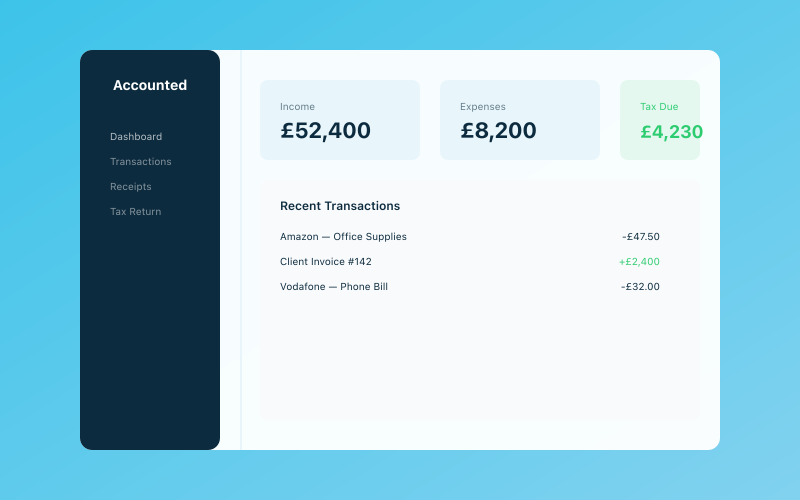 Your Accounted dashboard — income, expenses, and tax at a glance
Companies House definition: A company is dormant if it has had no "significant accounting transactions" during the accounting period. The only transactions that don't count are fees paid to Companies House itself (for filing the annual confirmation statement, for example) and shares paid for when the company was first set up. Everything else — including bank interest, a single invoice, or even a small direct debit — counts as a significant transaction and means the company is not dormant in Companies House's eyes.
HMRC definition: HMRC considers a company dormant for Corporation Tax purposes if it's not active — meaning it's not carrying on business, not receiving any income, and not making any payments. HMRC's definition is a bit broader, but the practical effect is similar: the company can't be doing anything commercial.
For most purposes, if your company genuinely isn't trading and has no money flowing in or out (apart from Companies House fees), it will qualify as dormant under both definitions. But it's worth understanding the distinction, because the obligations differ slightly.
Why Make a Company Dormant Instead of Closing It?
There are several good reasons why you might choose dormancy over dissolution:
You plan to trade again in the future. Setting up a new limited company isn't difficult, but it does mean a new company number, potentially a new company name (if someone else registers yours in the meantime), and the hassle of updating clients, suppliers, and banks. Keeping the company dormant preserves everything.
You want to protect the company name. If you've built up a trading name and reputation, making the company dormant keeps that name reserved on the Companies House register. Nobody else can register a company with the same name while yours exists.
There are ongoing contractual obligations. Some contracts, leases, or licences are held in the company's name. Dissolving the company could complicate these arrangements.
It's simpler and cheaper than liquidation. Formal liquidation involves appointing a liquidator and can cost several thousand pounds. Dormancy costs nothing beyond the minimal ongoing filing requirements.
On the other hand, if you're certain you won't trade through the company again and there's nothing worth preserving, striking off or liquidation might be a cleaner option. We'll link to our guide on that below.
How to Make Your Company Dormant — Step by Step
Making a company dormant is less about a single formal action and more about a series of practical steps to wind down activity and notify the relevant bodies.
Step 1: Stop Trading and Settle Outstanding Obligations
Before you can declare dormancy, you need to wrap up any active business. This means:
- Completing or cancelling any ongoing contracts
- Invoicing for any work already done and collecting payment
- Paying all outstanding supplier invoices
- Filing and paying any outstanding VAT returns
- Running final payroll and filing final RTI submissions if you have employees (including yourself)
- Paying any outstanding PAYE, National Insurance, or corporation tax
Essentially, you want a clean slate — no loose ends.
Step 2: Close Your Business Bank Account (Optional but Recommended)
You don't strictly have to close the bank account, but leaving it open creates a risk of accidental transactions (bank charges, interest, direct debits) that would mean the company isn't actually dormant. Many directors choose to close the business bank account to avoid this, or at the very least, cancel all standing orders and direct debits and ensure no interest is being credited.
Step 3: Notify HMRC
You need to tell HMRC that the company is now dormant. You can do this by:
- Writing to HMRC's Corporation Tax office (the address will be on your last correspondence from them) to say the company is dormant and will not be trading
- If you're registered for VAT, you'll need to deregister — you can't be dormant and VAT-registered at the same time
- If you're registered as an employer, you'll need to close your PAYE scheme once final submissions have been made
Once HMRC marks the company as dormant for Corporation Tax purposes, they'll stop expecting you to file Company Tax Returns — though they may still send you a notice to deliver one for the final active period.
Step 4: Notify Companies House
You don't need to formally tell Companies House that the company is dormant, but you do still need to file certain documents. What you can do is file dormant company accounts (see below), which signals to Companies House that the company is inactive.
Step 5: Cancel Any Business Insurance and Subscriptions
Don't forget to cancel professional indemnity insurance, public liability insurance, software subscriptions, domain renewals you don't need, and anything else that might generate transactions or costs.
What Are Your Ongoing Obligations?
This is the important bit. A dormant company still exists as a legal entity, and that means certain obligations continue:
Annual accounts. You must still file annual accounts at Companies House, even if the company is dormant. The good news is that dormant company accounts are extremely simple — usually just a basic balance sheet showing any share capital and perhaps a small balance. You can file these online through Companies House, and the process takes only a few minutes.
Confirmation statement. Every year, you must file a confirmation statement (formerly the annual return) with Companies House, confirming that the company's details — registered office, directors, shareholders, and so on — are still correct. There's a £13 filing fee for online submissions.
Maintain the registered office. The company must continue to have a registered office address that's capable of receiving post. If your registered office was your business premises and you've given those up, you'll need to update it — perhaps to your home address or a registered office service.
Keep company records. You're still required to maintain statutory registers (register of members, register of directors, etc.) even while dormant.
Corporation Tax Return (possibly). If HMRC has accepted that the company is dormant, they won't expect CT600s. But if they do issue a notice to deliver a return, you must file one — even if it's a nil return.
The key point is that dormancy reduces your obligations, but it doesn't eliminate them. If you fail to file your confirmation statement or dormant accounts, Companies House can and will take action — potentially including striking the company off the register.
Common Pitfalls with Dormant Companies
Forgetting to file the confirmation statement. This is the most common mistake. Companies House will send reminders, but if your registered office address has changed and you haven't updated it, you might miss them. Set a reminder in your calendar.
Accidental transactions making the company non-dormant. Even a small bank charge or a penny of interest can technically mean the company is no longer dormant. This is why closing or carefully managing the bank account matters.
Not deregistering for VAT. If you're VAT-registered and the company goes dormant, you must deregister. Failing to do so means HMRC will keep expecting VAT returns.
Assuming dormancy means no tax filing. Until HMRC confirms they've marked the company as dormant, you should keep filing. If you receive a notice to deliver a CT600, you must respond — even if it's a nil return.
Leaving it dormant indefinitely without checking. Companies House may propose to strike off companies that appear to be defunct. If you receive a letter about this and you want to keep the company, you need to respond promptly.
Waking Up a Dormant Company
When you're ready to start trading again, you essentially reverse the process:
- Notify HMRC that the company is now active again
- Re-register for Corporation Tax (HMRC will send you a new notice to deliver a CT600)
- Register for VAT if your turnover will exceed the threshold (or voluntarily)
- Set up a PAYE scheme if you'll be taking a salary
- Open a business bank account if you closed the old one
- Take out appropriate business insurance
There's no formal "wake up" process with Companies House — you simply start trading and file the next set of accounts as an active company rather than dormant ones.
If you're reviving the company and getting your finances organised from scratch, Penny in Accounted can help you hit the ground running — categorising transactions, tracking income and expenses, and keeping everything tidy from day one.
Is Dormancy Right for You?
Dormancy is ideal if you want to press pause without losing your company. It's cheap, it's simple, and it keeps your options open. But it does require ongoing attention — those annual filings won't do themselves, and the consequences of forgetting them can be surprisingly harsh.
If you're fairly sure you won't trade again through the company, it may be cleaner and simpler to close it down properly. Our guide on striking off vs liquidation covers the options available.
And if you're debating whether to keep your limited company or switch to a different structure entirely, our sole trader vs limited company comparison might help you think through the pros and cons.
Related Reading
Start your free trial and see how Accounted simplifies your bookkeeping.
Accounted helps UK sole traders stay on top of their bookkeeping and tax. Start your free 30-day trial at getaccounted.co.uk.
Accounted keeps your books sorted automatically so you can focus on running your business. See Accounted →
Business & Operations Advisors
Our business advisors cover the practical side of running a UK sole trader business — from HMRC registration to managing growth. Content is written for real business owners in plain English, not accountants.
Ready to try Accounted?
Join UK sole traders who are simplifying their bookkeeping and tax.
Start your 14-day free trial