Striking Off a Company vs Liquidation — Which to Choose
Every business has a lifecycle, and sometimes that lifecycle comes to an end. Whether you're retiring, moving to employment, switching to a sole trader structure, or simply closing up shop, you'll need to formally close your limited company. In the UK, there are two main routes: striking off (voluntary dissolution) and liquidation. They sound similar, but they're quite different in practice, cost, and suitability.
Choosing the wrong route can cost you money — sometimes thousands of pounds. So let's break down both options properly so you can make the right decision for your circumstances.
What Is Striking Off?
Striking off, also known as voluntary dissolution, is the simpler and cheaper way to close a limited company. You apply to Companies House to have the company removed from the register, and after a waiting period, the company ceases to exist.
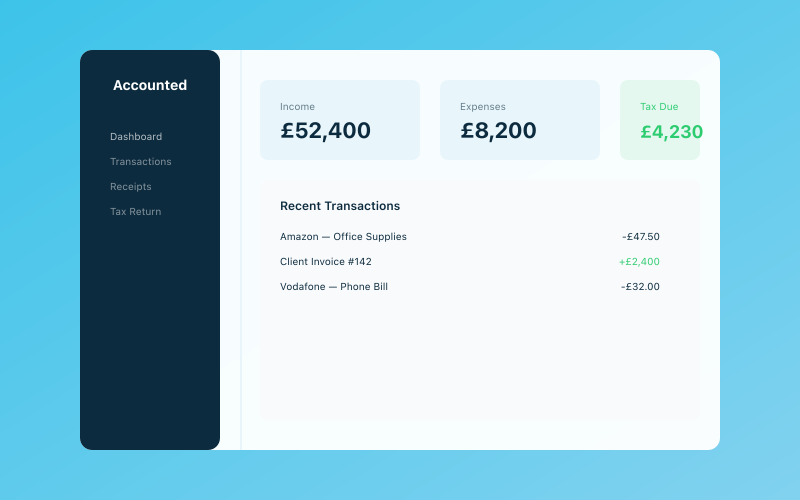 Your Accounted dashboard — income, expenses, and tax at a glance
The formal process involves filing a DS01 form (Application to Strike Off) at Companies House. You can do this online, and there's no fee for the application itself.
Before you apply, you must:
- Have stopped trading at least three months ago (or never traded at all)
- Not have changed the company name in the last three months
- Not be subject to any insolvency proceedings
- Not have any outstanding agreements with creditors (such as a Company Voluntary Arrangement)
When you submit the DS01, you must also notify:
- All members (shareholders) of the company
- All creditors
- Any employees or their representatives
- Any managers or trustees of any employee pension fund
- Any directors who didn't sign the DS01
Once Companies House receives the application, they publish a notice in the Gazette giving two months for any objections. If no one objects and all looks well, the company is struck off the register. The whole process typically takes around three months from start to finish.
What Is Liquidation?
Liquidation (specifically Members' Voluntary Liquidation, or MVL, for solvent companies) is a formal insolvency procedure overseen by a licensed insolvency practitioner. It's used when a company has assets to distribute to shareholders and the directors want to do so in a tax-efficient way.
In an MVL, the directors make a statutory declaration of solvency — essentially swearing that the company can pay all its debts within 12 months. A licensed insolvency practitioner (IP) is then appointed as liquidator. The liquidator takes control of the company, realises its assets, pays off any debts, and distributes the remaining funds to the shareholders.
The key advantage of an MVL is that distributions to shareholders are treated as capital (not income), which means they're subject to Capital Gains Tax rather than Income Tax. If the shareholders qualify for Business Asset Disposal Relief (formerly Entrepreneurs' Relief), the CGT rate on the first £1 million of qualifying gains is just 10% — significantly less than the dividend tax rates that would otherwise apply.
Liquidation is more expensive and more involved than striking off, but for companies with significant retained profits, the tax savings can far outweigh the costs.
Striking Off vs Liquidation — Key Differences
Let's lay out the main differences side by side:
Cost. Striking off is essentially free (just the cost of your time). An MVL typically costs between £2,000 and £5,000 plus VAT for the insolvency practitioner's fees, depending on the complexity of the company's affairs.
Time. Striking off takes around 3 months. An MVL can take 6 to 12 months or occasionally longer, depending on how quickly assets can be realised and distributed.
Tax treatment of distributions. This is the big one. With striking off, any final distributions to shareholders up to £25,000 are treated as capital distributions (subject to CGT). Distributions above £25,000 are treated as income (subject to Income Tax at dividend rates). With an MVL, all distributions are treated as capital, regardless of the amount — meaning CGT rates apply, and Business Asset Disposal Relief may be available.
Suitability. Striking off is ideal for companies with minimal assets — say, less than £25,000 in total to distribute. Liquidation makes sense when there's more than £25,000 to distribute, particularly when Business Asset Disposal Relief is available.
Formality. Striking off is a simple administrative process you can handle yourself. An MVL requires professional involvement — you can't do it without a licensed insolvency practitioner.
The £25,000 Threshold — Why It Matters
The £25,000 figure is crucial in deciding between the two routes. Here's why.
When a company is struck off and its remaining assets are distributed to shareholders, HMRC's "moneybox" anti-avoidance rule (under the Transactions in Securities rules, specifically S396B ITTOIA 2005) means that distributions exceeding £25,000 in total are treated as income rather than capital.
So if your company has, say, £40,000 sitting in the bank after all debts are paid and you strike it off, the entire distribution could be treated as a dividend — taxed at your marginal dividend tax rate (which could be as high as 39.35% for additional rate taxpayers).
If you went down the MVL route instead, that £40,000 would be treated as a capital distribution. With Business Asset Disposal Relief, you'd pay CGT at 10% on the gain (after deducting your base cost in the shares). Even without the relief, the CGT rates (18% or 24%) are often lower than dividend tax rates.
For a company with £100,000 or more in retained profits, the tax difference between the two routes can easily run into tens of thousands of pounds. That's why it's worth doing the sums carefully.
When to Choose Striking Off
Striking off is the right choice when:
- The company has less than £25,000 in assets to distribute to shareholders
- The company has little or no assets at all (perhaps everything has already been drawn down as salary and dividends)
- You want a quick, low-cost closure
- The company was never traded or has been dormant
- There are no complicated creditor situations or outstanding liabilities
It's also the right choice for dormant companies that you've decided to close permanently rather than keep on the register.
The process is simple enough to handle yourself. File the DS01, wait for the Gazette notice period to pass, and the company is dissolved. Just make sure you've dealt with any outstanding tax obligations (final Corporation Tax Return, final VAT return if applicable, final payroll submissions) before applying.
When to Choose Liquidation (MVL)
An MVL is worth considering when:
- The company has more than £25,000 in assets to distribute
- The directors/shareholders qualify for Business Asset Disposal Relief
- You want the most tax-efficient way to extract retained profits
- The company is solvent (can pay all its debts within 12 months)
The larger the retained profits, the stronger the case for an MVL. At £50,000 or above, the tax savings often significantly exceed the insolvency practitioner's fees. At £100,000 and above, it's almost always the better option from a pure tax perspective.
It's worth noting that HMRC introduced targeted anti-avoidance rules (TAAR) in 2016 that can treat MVL distributions as income rather than capital in certain circumstances — particularly where the individual receiving the distribution continues to be involved in a similar trade within two years. This is designed to prevent people from repeatedly "phoenixing" — closing one company, extracting the cash tax-efficiently, and immediately setting up a new one doing the same thing.
If you're planning to continue in a similar business (perhaps as a sole trader or through a new company), take professional advice on whether the TAAR might apply to your situation.
What About Creditors' Voluntary Liquidation?
We should mention that everything above assumes the company is solvent — meaning it can pay its debts. If the company is insolvent (it can't pay what it owes), the options are different. An insolvent company would typically go through a Creditors' Voluntary Liquidation (CVL) or potentially a compulsory liquidation if a creditor petitions the court.
If your company is struggling with debt, that's a different situation entirely, and you should seek professional insolvency advice as soon as possible. Directors of insolvent companies have specific legal duties, and getting these wrong can lead to personal liability.
Practical Checklist Before Closing Your Company
Whichever route you choose, there are several things to take care of before the company closes:
Tax affairs. File all outstanding Corporation Tax Returns and pay any tax due. If HMRC is owed money when the company is dissolved, they can object to the striking off — and they frequently do.
VAT. If the company is VAT-registered, file the final VAT return and apply to deregister. Remember to account for VAT on any assets retained by the directors.
PAYE. Run the final payroll, file the final Full Payment Submission, and submit the Employer Payment Summary to tell HMRC no further submissions are due.
Bank accounts. Empty and close business bank accounts. Any money left in a dissolved company's bank account passes to the Crown (the legal term is "bona vacantia"), and getting it back is not straightforward.
Insurance and contracts. Cancel any ongoing insurance policies, service contracts, and subscriptions.
Records. Keep all company records for at least 6 years after the company is dissolved. HMRC can still investigate closed companies.
Using a tool like Accounted throughout the life of your company means you'll have clean, well-organised records when the time comes to close — making the whole process smoother and reducing the risk of any nasty surprises from HMRC. Penny keeps everything categorised and trackable, so your final accounts and tax returns are based on solid data.
Making the Decision
Here's a quick framework:
-
How much is in the company? If there's less than £25,000 to distribute, striking off is probably the way to go. If there's more, get a tax calculation done for both routes.
-
Do you qualify for Business Asset Disposal Relief? If yes, and there's a decent sum to distribute, an MVL could save you a significant amount of tax.
-
Are you planning to continue in a similar trade? If yes, be aware of the TAAR rules and take advice before proceeding with an MVL.
-
Is the company solvent? If not, you need professional insolvency advice, not a DIY striking off.
-
How quickly do you want this done? Striking off is faster and simpler. An MVL takes longer but can be worth the wait.
In most cases, the decision comes down to a simple tax calculation. Run the numbers for both scenarios, factor in the cost of an insolvency practitioner for the MVL, and the right answer usually becomes clear.
Related Reading
Start your free trial and see how Accounted simplifies your bookkeeping.
Accounted helps UK sole traders stay on top of their bookkeeping and tax. Start your free 30-day trial at getaccounted.co.uk.
Accounted keeps your books sorted automatically so you can focus on running your business. See Accounted →
Business & Operations Advisors
Our business advisors cover the practical side of running a UK sole trader business — from HMRC registration to managing growth. Content is written for real business owners in plain English, not accountants.
Ready to try Accounted?
Join UK sole traders who are simplifying their bookkeeping and tax.
Start your 14-day free trial