Mobile Businesses — Licensing, Insurance, and Tax for Traders on the Move
Mobile businesses are everywhere — food vans at festivals, mobile hairdressers visiting clients' homes, dog groomers in converted vans, mobile mechanics, pop-up retailers, and tradespeople who carry their workshop with them. The appeal is obvious: lower overheads than a fixed premises, the ability to go where the customers are, and a flexibility that's hard to match.
But "mobile" doesn't mean "regulation-free." There are licences to obtain, insurance to arrange, vehicle rules to follow, and the same tax obligations that apply to any self-employed person. Here's what you need to know to run a mobile business properly.
Types of Mobile Businesses and Their Licensing
The licensing requirements depend on what you're doing and where you're doing it.
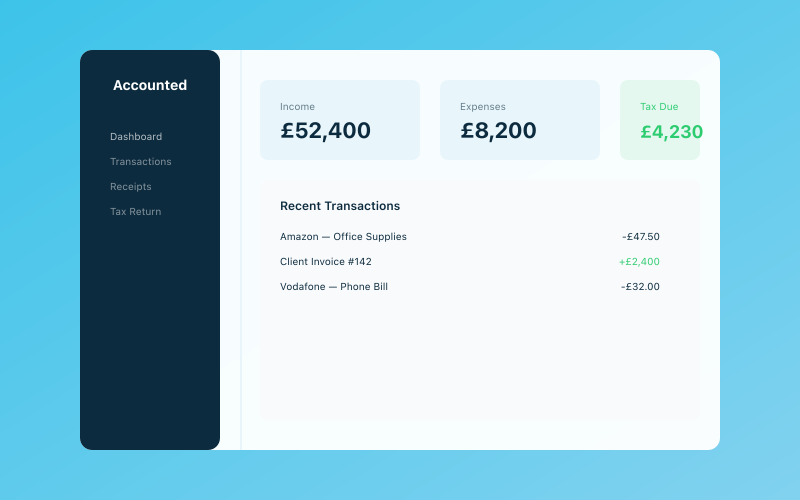 Your Accounted dashboard — income, expenses, and tax at a glance
Mobile food businesses (food vans, burger vans, ice cream vans, coffee carts) need:
- Food business registration with your local council's environmental health department — at least 28 days before trading. This is free.
- Street trading licence or consent from each local authority area where you want to trade. Every council sets its own rules, fees, and conditions. If you trade in multiple boroughs, you may need separate licences for each one.
- Food Hygiene Rating — you'll be inspected and scored. In Wales and Northern Ireland, displaying your rating is mandatory.
- Level 2 Food Hygiene Certificate — not legally required but widely expected by councils and event organisers.
If you want to trade on private land (a car park, private estate, or business premises) with the landowner's permission, you generally don't need a street trading licence — but you still need food business registration.
Mobile hairdressers, beauticians, and therapists don't typically need specific licences beyond registering as self-employed, but there are some exceptions:
- Special treatments licences may be required in some council areas for tattooing, piercing, acupuncture, or electrolysis — even if done at clients' homes
- Professional qualifications are expected by insurance companies and may be required by some councils
- DBS checks might be needed if you work with vulnerable people
Mobile tradespeople (plumbers, electricians, gardeners, cleaners) generally need:
- Self-employment registration with HMRC
- Relevant professional qualifications and registration (Gas Safe for gas engineers, Part P certification for electricians, etc.)
- Appropriate insurance
Market traders, car boot sellers, and pop-up retailers follow the rules we've covered in our market stall guide — street trading licences, market pitch agreements, and product-specific regulations.
Vehicle Requirements
If your vehicle is central to your business, there are several things to get right.
Vehicle classification. A standard car or van doesn't need special licensing, but if you've converted a vehicle for commercial use — especially food preparation — it may be reclassified. A vehicle primarily used for selling hot food, for example, might be treated differently for insurance and licensing purposes.
MOT and roadworthiness. Your vehicle must be roadworthy, taxed, and have a valid MOT (if over three years old). If HMRC or the police find you trading from an unroadworthy vehicle, you'll face penalties.
ULEZ and Clean Air Zones. If you operate in or drive through a Clean Air Zone (London's ULEZ covers all of Greater London), non-compliant vehicles face daily charges. London's ULEZ charge is £12.50 per day for vans and cars that don't meet emission standards. Birmingham, Bristol, and other cities have their own zones. These charges are claimable as business expenses if the journey is for business purposes.
Signage and livery. If your vehicle has business signage, some councils require this to be included on your street trading licence application. Vehicle wraps and signage costs are claimable as advertising expenses.
Weight limits. If your vehicle (including its contents) exceeds 3.5 tonnes, you may need additional licensing. This mainly affects larger food trucks or mobile workshops.
Insurance for Mobile Businesses
Getting the right insurance is critical for mobile businesses. The standard policies to consider are:
Motor insurance. Your personal car insurance almost certainly doesn't cover commercial use. You need a commercial vehicle policy or business use added to your existing policy. Using your vehicle for business without proper cover could invalidate your insurance entirely. Class 1 business use (driving to a single place of work) is sometimes included on standard policies, but Class 2 or 3 use (visiting multiple locations, carrying tools or stock) usually requires a specific business policy.
Public liability insurance. This covers claims from members of the public who are injured or suffer property damage as a result of your business activities. Most event organisers and many councils require a minimum of £5 million cover. Premiums for mobile businesses typically start from £50-150 per year.
Product liability insurance. If you sell food or physical products, this covers claims if a product causes harm. Essential for food businesses.
Employers' liability insurance. Required by law if you employ anyone, even part-time. Minimum cover of £5 million.
Equipment and stock cover. Tools, equipment, and stock in your vehicle may not be covered by your motor insurance. A separate commercial contents policy or an "all risks" extension can cover theft, damage, and loss.
Professional indemnity insurance. Relevant if you provide advice or specialist services — beauty treatments, consultancy, training.
For a full overview of what you need and what it costs, check our business insurance guide.
Tax Obligations for Mobile Businesses
Your tax obligations as a mobile business owner are the same as for any sole trader. You need to:
- Register as self-employed with HMRC
- Keep records of all income and expenses
- File a Self Assessment tax return each year
- Pay income tax and National Insurance on your profits
For 2025/26, the key rates are:
Income tax:
- Personal Allowance: £12,570 (tax-free)
- Basic rate: 20% on profits between £12,570 and £50,270
- Higher rate: 40% on profits between £50,270 and £125,140
- Additional rate: 45% above £125,140
National Insurance:
- Class 2: £3.45 per week if profits exceed £12,570
- Class 4: 6% on profits between £12,570 and £50,270, plus 2% above
VAT: Register if your taxable turnover exceeds £90,000 in any rolling 12-month period.
Making Tax Digital for Income Tax applies from April 2026 for those earning over £50,000. You'll need to keep digital records and submit quarterly updates. Getting your bookkeeping digitised now — using a tool like Accounted — means you'll be ready when the time comes.
Expenses Mobile Businesses Can Claim
Mobile businesses often have higher travel and vehicle expenses than static ones, which means more deductions from your taxable profits. Here are the main categories:
Vehicle expenses. You have two options:
- Simplified mileage rate: 45p per mile for the first 10,000 business miles, 25p per mile after that. This covers fuel, insurance, road tax, servicing, and depreciation — you can't claim these separately if you use this method.
- Actual costs: Claim the business proportion of all vehicle-related costs — fuel, insurance, road tax, MOT, servicing, repairs, depreciation, and finance charges. You'll need to keep a mileage log to establish the business/personal split.
For vehicles that are predominantly used for business, actual costs often give a higher deduction. For vehicles with mixed use, the simplified rate is easier to calculate. Once you've chosen a method for a particular vehicle, you generally need to stick with it.
Fuel and parking. If you're not using the simplified mileage rate, fuel costs for business journeys are claimable. Parking fees for business purposes are always claimable regardless of which method you use. Parking fines, however, are never deductible.
Congestion charges and tolls. Business-related congestion charges (£15 per day in London), ULEZ charges, and road tolls are fully claimable.
Equipment and tools. Everything you need for your trade — cooking equipment, hairdressing tools, cleaning supplies, trade tools. These are either deducted in full in the year of purchase (for most items under the Annual Investment Allowance) or spread over their useful life.
Stock and materials. The cost of goods you sell or materials you use in providing your service.
Pitch fees and event charges. If you pay for a pitch at a market, festival, or other event, it's fully deductible.
Marketing costs. Vehicle wraps, signage, flyers, social media advertising, website costs, and business cards.
Phone and communications. The business proportion of your mobile phone bill and any other communication costs.
Licensing fees. Street trading licences, food hygiene certificates, professional registrations.
Insurance premiums. All business-related insurance is fully deductible.
Uniform and protective clothing. Branded workwear, safety equipment, and specialist clothing (but not ordinary clothes you happen to wear for work).
For the full list, see our sole trader expenses guide.
Tracking all these expenses as they happen is crucial. It's easy to lose track when you're on the road every day. Accounted lets you record expenses on the go, and Penny can help categorise them correctly — so a receipt photographed at a petrol station at 7am doesn't get lost in a glovebox pile by the end of the week.
Practical Tips for Mobile Business Success
Plan your routes and territories. Fuel costs and time are your biggest overheads. Grouping appointments or pitches geographically saves both.
Build a regular schedule. Customers like predictability. If you're a mobile hairdresser, regular weekly or monthly slots build loyalty. If you're a food van, turning up at the same location on the same days builds a following.
Have a wet weather plan. If your business is affected by bad weather — food vans, outdoor markets, gardening — have contingency plans. Diversify your income streams where possible, so one rained-off Saturday doesn't ruin the month.
Keep your vehicle maintained. A breakdown doesn't just cost you the repair — it costs you a day's income. Regular servicing and proactive maintenance pay for themselves. And yes, maintenance costs are deductible expenses.
Get paid promptly. Carry a card reader if you're selling directly to the public. If you invoice clients, set clear payment terms and follow up on late payments. Cash flow management is particularly important for mobile businesses where income can fluctuate day to day.
Know your numbers. Track your income and expenses closely so you know your actual profit per day, per market, per route. Some pitches might be busy but unprofitable once you factor in pitch fees, fuel, and stock costs. Knowing your numbers lets you make smart decisions about where to invest your time.
Running a mobile business offers freedom and flexibility that a fixed premises can't match. The key is getting the administrative foundations right — licences, insurance, tax — so you can focus on what you do best: serving customers, wherever they are.
Related Reading
Start your free trial and see how Accounted simplifies your bookkeeping.
Accounted helps UK sole traders stay on top of their bookkeeping and tax. Start your free 30-day trial at getaccounted.co.uk.
Accounted keeps your books sorted automatically so you can focus on running your business. See Accounted →
Business & Operations Advisors
Our business advisors cover the practical side of running a UK sole trader business — from HMRC registration to managing growth. Content is written for real business owners in plain English, not accountants.
Ready to try Accounted?
Join UK sole traders who are simplifying their bookkeeping and tax.
Start your 14-day free trial