Direct Debit vs Bank Transfer — Which Is Better for Collecting Payment?
When you're running a business, few things matter as much as getting paid. You can be brilliant at what you do, but if the money doesn't arrive on time — or at all — everything else falls apart. And one of the biggest factors in how quickly and reliably you get paid is the payment method you offer your clients.
For most UK sole traders, the two main options for collecting payment are direct debit and bank transfer. Both work. Both are widely used. But they behave very differently in practice, and choosing the right one (or the right combination) can make a real difference to your cash flow. Let's break down how each works, what the pros and cons are, and which might be best for your situation.
How Bank Transfers Work
Bank transfers — also known as Faster Payments or BACS transfers — are the most common way sole traders get paid. The process is simple: you send an invoice with your bank details (sort code and account number), and the client logs into their bank and sends the money.
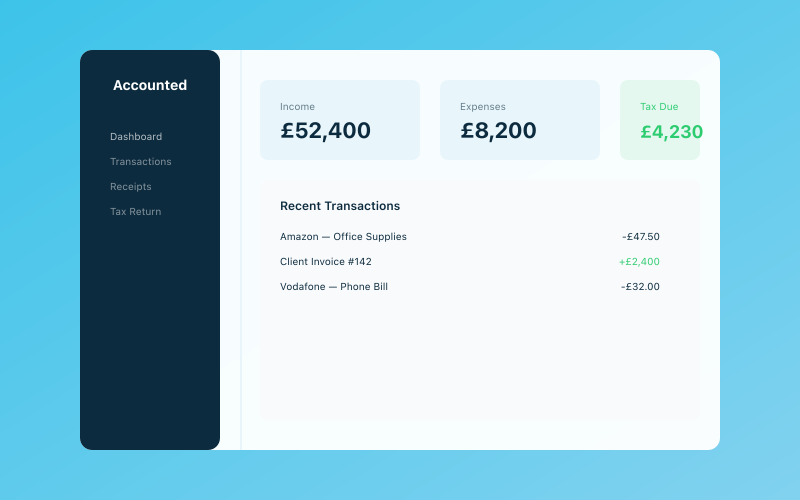 Your Accounted dashboard — income, expenses, and tax at a glance
Most bank transfers in the UK are processed through the Faster Payments system, which means the money typically arrives the same day, often within a couple of hours. Some larger payments or those initiated through older BACS systems can take up to three working days.
The biggest advantage of bank transfers is that they're completely free for you to receive. There are no transaction fees, no percentage charges, no monthly subscriptions. The money goes straight into your account, and you keep every penny.
Bank transfers are also universally understood. Every business in the UK has a bank account, and every client knows how to make a transfer. There's no setup required on either side.
The downside? The client has to actively do something. They need to see your invoice, log into their bank, enter your details, and authorise the payment. That means there are multiple points where things can stall — they might not see the invoice, they might put it off, they might make a mistake with the account details, or they might simply forget. This is why so many sole traders end up spending time chasing payments, which is neither fun nor productive. For tips on reducing that friction, have a look at our guide on getting paid faster as a small business.
How Direct Debits Work
Direct debit is a pull-based payment system. Instead of waiting for the client to push money to you, you pull the agreed amount from their account on a set date. The client authorises this upfront by signing a Direct Debit mandate, and from then on, payments happen automatically.
For businesses, direct debit is typically set up through a provider like GoCardless, which handles the mandate process and the actual collection. You set up the payment schedule, and the provider collects the money and deposits it into your account — minus a small fee.
The biggest advantage is automation. Once the mandate is in place, you don't need to chase payments. The money comes in on schedule, every time. This is particularly valuable if you have recurring clients or offer subscription-based services.
There are a few things to be aware of, though. First, there are fees. GoCardless, for example, charges around 1-2% per transaction on their standard plan, with a cap. Other providers have different pricing structures, but you'll always pay something for the service.
Second, direct debit isn't instant. Collections typically take three to five working days to process, which is slower than a bank transfer. And clients have the right to request a refund through the Direct Debit Guarantee for up to 13 months after a payment is taken, although this is rarely an issue in practice for legitimate transactions.
Third, some clients simply don't like giving direct debit authority. They prefer to control when money leaves their account. This is more common with smaller businesses and individual clients than with larger companies.
Comparing the Two: A Practical Breakdown
Let's put these two options side by side across the factors that matter most to a typical sole trader.
Speed of payment. Bank transfers win here. Faster Payments means money can arrive within hours, while direct debit collections take three to five days. If you need money quickly, bank transfer is the faster option.
Reliability of payment. Direct debit wins comfortably. Because it's automated, there's no reliance on the client remembering or choosing to pay. Once the mandate is set up, the money comes in on schedule. With bank transfers, you're always dependent on the client taking action, which introduces the risk of late or missed payments.
Cost. Bank transfers are free to receive. Direct debits cost money — either a per-transaction fee or a monthly subscription to a provider. For a sole trader processing a handful of invoices a month, the difference might be modest. But if your average invoice is small, the percentage fees can eat into your margins.
Client experience. This depends on the client. Some prefer the simplicity of a bank transfer — they see the invoice, they pay it, done. Others appreciate the convenience of direct debit, especially for regular payments, because they don't need to do anything after the initial setup.
Administrative effort. Direct debit wins significantly for recurring payments. If you're billing the same client every month, setting up a direct debit once is far easier than sending an invoice and chasing payment twelve times a year. For one-off projects, though, bank transfer is simpler since there's no mandate to set up.
Record keeping. Both methods create clear records. Bank transfers show in your bank statements, and direct debit providers give you detailed transaction reports. If you're using software like Accounted, payments can be matched to invoices automatically regardless of the method, so your bookkeeping stays tidy.
When Bank Transfer Makes More Sense
Bank transfer is the natural choice in several common scenarios.
One-off or irregular projects. If you're doing a single piece of work for a client, setting up a direct debit mandate doesn't make sense. Send an invoice, get paid, move on.
High-value invoices. For larger invoices, the percentage fee on a direct debit can be significant. A 1% fee on a £5,000 invoice is £50 — money you'd keep in your pocket with a bank transfer.
Clients who prefer to control payments. Some clients, particularly smaller businesses and individuals, feel more comfortable initiating payments themselves. Respecting that preference can strengthen the relationship.
When you need fast payment. If cash flow is tight and you need money as quickly as possible, bank transfer through Faster Payments is the quickest option.
When Direct Debit Makes More Sense
Direct debit really shines in specific situations.
Recurring monthly billing. If you provide ongoing services — retainer work, maintenance contracts, subscription services — direct debit is brilliant. Set it up once and the money arrives every month without you lifting a finger.
Clients with a history of late payment. If you've got a client who consistently pays late but you still want to work with them, moving them to direct debit removes the friction. They authorise it once, and the payment happens automatically. No more chasing. Our guide on handling late-paying clients covers other strategies for this situation too.
When you want predictable cash flow. Knowing exactly when money will arrive makes financial planning much easier. If all your regular clients are on direct debit, you can forecast your income with far more confidence.
Scaling up. If you're growing your business and taking on more clients, chasing individual bank transfers becomes increasingly time-consuming. Direct debit scales much better — adding another client is just adding another mandate.
Can You Use Both?
Absolutely, and many sole traders do. A common approach is to use direct debit for regular, recurring clients and bank transfer for one-off projects or new clients where you haven't yet established an ongoing relationship.
This hybrid approach gives you the reliability of automated payments for your core income while keeping things simple and cost-free for occasional work. Penny within Accounted can help you keep track of which clients are on which payment method and flag any overdue invoices, regardless of how payment was supposed to arrive.
You might also consider offering clients a choice. Some people respond well to being given options — "You can set up a direct debit for automatic monthly payments, or I can invoice you for bank transfer." Letting them choose removes a potential objection and makes them more likely to agree to your terms.
The Bottom Line
There's no single right answer here. The best payment method depends on your business model, your clients, and your priorities.
If you bill irregularly for varying amounts, bank transfer keeps things simple and free. If you have regular clients paying consistent amounts, direct debit gives you predictability and saves you hours of chasing. And if you're somewhere in between — as most sole traders are — using both is a perfectly sensible approach.
Whatever method you choose, the key is making it as easy as possible for clients to pay you. Clear invoices, clear payment details, and clear terms. If you're looking for more ways to tighten up your invoicing and get paid on time, our guide on how to create a professional invoice is a good next step.
Related reading:
- Getting Paid Faster as a Small Business
- How to Handle Late-Paying Clients
- How to Create a Professional Invoice
Accounted helps UK sole traders stay on top of their bookkeeping and tax. Start your free 30-day trial at getaccounted.co.uk.
Related Reading
- Running a Business in Rural Areas — Challenges and Tax Benefits
- Subscription Business Models — Accounting and Tax
Start your free trial and see how Accounted simplifies your bookkeeping.
Accounted keeps your books sorted automatically so you can focus on running your business. See Accounted →
Business & Operations Advisors
Our business advisors cover the practical side of running a UK sole trader business — from HMRC registration to managing growth. Content is written for real business owners in plain English, not accountants.
Ready to try Accounted?
Join UK sole traders who are simplifying their bookkeeping and tax.
Start your 14-day free trial