Subscription Business Models — Accounting and Tax
Subscription businesses are everywhere — from software platforms and membership communities to monthly snack boxes and premium newsletters. The appeal is obvious: predictable, recurring revenue that smooths out the feast-and-famine cycle of one-off sales. But from an accounting and tax perspective, subscriptions introduce a few wrinkles that traditional businesses do not have to worry about.
If you are running (or planning to start) a subscription-based business in the UK, this guide covers the key accounting and tax considerations you need to get right from the beginning.
How subscription income works for tax purposes
The fundamental question with subscription income is: when do you recognise the revenue? If a customer pays you £120 upfront for a 12-month subscription, have you earned £120 in that moment, or £10 per month over the next year?
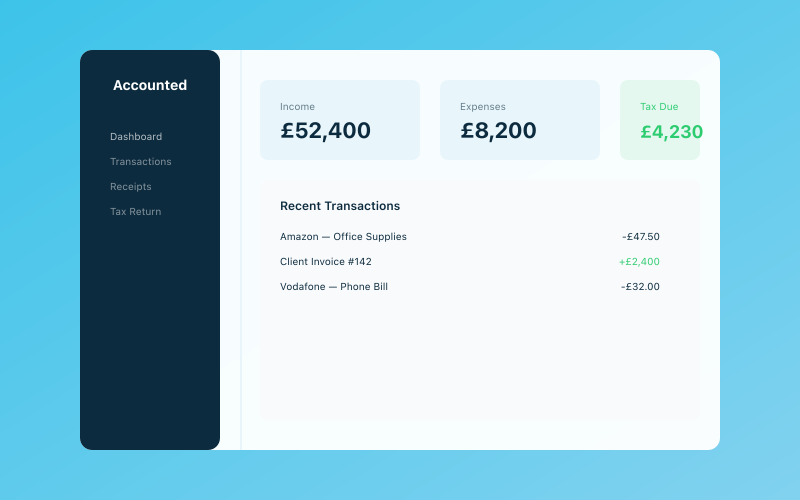 Your Accounted dashboard — income, expenses, and tax at a glance
The answer depends on your accounting method.
Cash basis accounting: Most sole traders and small businesses use the cash basis, which is the simpler of the two approaches. Under the cash basis, you recognise income when the cash hits your bank account. So if a customer pays £120 in June, you report £120 of income in June. Simple.
Accrual (traditional) accounting: Under accrual accounting, you recognise income when it is earned, not when the cash arrives. That £120 annual payment would be spread across 12 months — £10 per month — with the unearned portion sitting on your balance sheet as "deferred revenue" or "unearned income."
For sole traders with straightforward subscription businesses, the cash basis is usually the easiest option. But if your business is growing quickly, if you are seeking investment, or if you want a more accurate picture of your monthly performance, accrual accounting gives you better data. It is worth discussing with an accountant if you are unsure which method suits your situation.
VAT on subscriptions
VAT adds another layer of complexity to subscription businesses, particularly if you sell digital services to customers outside the UK.
UK customers: If your taxable turnover exceeds the VAT registration threshold of £90,000, you must register for VAT and charge 20% on your subscription fees. Below that threshold, registration is optional (though voluntary registration can be beneficial if you have significant business-to-business customers who can reclaim the VAT you charge).
Continuous supplies of services: HMRC treats subscriptions as "continuous supplies of services." The tax point (the date when VAT becomes due) is the earlier of the date you issue an invoice or the date you receive payment. For most subscription businesses billing monthly, this is straightforward — the tax point is when the customer pays.
Annual prepayments: If a customer pays for a full year upfront, the VAT is due on the full amount at the point of payment, even if you are spreading the income recognition across 12 months under accrual accounting. This catches some business owners out — you owe HMRC the VAT immediately, even though you have not "earned" all the income yet.
International digital subscriptions: If you sell digital services (SaaS, online memberships, streaming content) to consumers in the EU or other countries with digital services tax rules, you may need to charge local VAT. Our guide on VAT for digital services covers the detail.
Deferred revenue and your balance sheet
If you use accrual accounting, deferred revenue is a concept you will need to get comfortable with. It represents money you have received but not yet earned — a liability on your balance sheet.
Here is how it works in practice:
- A customer pays £240 for a 12-month subscription on 1 April.
- On that date, you record £240 as deferred revenue (a liability).
- Each month, you move £20 from deferred revenue to earned revenue on your profit and loss statement.
- By 31 March the following year, the full £240 has been recognised as income.
This might seem like unnecessary complexity, but it gives you an honest picture of your business performance. Without deferred revenue accounting, a month where you land several annual subscribers looks like a bumper month, and the following months look artificially quiet — even though the underlying business performance has not changed.
Accounted can handle this kind of revenue tracking for you, so you do not need to manage spreadsheet gymnastics every month.
Key metrics every subscription business should track
Beyond the standard profit-and-loss figures, subscription businesses benefit from tracking a few specific metrics:
Monthly Recurring Revenue (MRR). The total predictable revenue you expect each month from active subscriptions. This is your north star metric — it tells you whether your business is growing, flat, or shrinking.
Churn rate. The percentage of subscribers who cancel each month. Even a small churn rate compounds quickly. A 5% monthly churn means you lose roughly half your subscribers every year if you are not replacing them.
Customer Lifetime Value (CLV). How much revenue a typical customer generates before they cancel. This helps you work out how much you can afford to spend acquiring new customers.
Customer Acquisition Cost (CAC). How much it costs to acquire a new subscriber, including marketing, advertising, and sales costs. Comparing CAC to CLV tells you whether your growth strategy is sustainable.
These metrics are not just useful for your own decision-making — they are also what investors, lenders, and potential acquirers look at when evaluating subscription businesses.
Allowable expenses for subscription businesses
Subscription businesses tend to have specific cost structures. Here are the most common deductible expenses:
- Platform and hosting costs — Stripe, Chargebee, Recurly, or whatever billing platform you use, plus web hosting, CDN, and infrastructure costs
- Payment processing fees — typically 1.4–2.9% plus a fixed fee per transaction
- Software tools — CRM systems, email marketing, customer support platforms, analytics tools
- Content creation — if your subscription is content-based, the costs of producing that content (writers, designers, videographers)
- Physical product costs — for subscription boxes, the cost of goods, packaging, and postage
- Marketing and advertising — a significant expense for most subscription businesses trying to grow
- Staff and freelancer costs — if you have team members, their wages or fees are deductible
- Home office expenses — if you run your business from home
Tracking recurring expenses alongside recurring revenue gives you a clear picture of your unit economics — how much each subscriber actually contributes to your bottom line after costs. Penny in Accounted can spot recurring charges in your bank feed and categorise them automatically, which keeps your bookkeeping current without manual effort.
Handling refunds, cancellations, and chargebacks
Refunds and cancellations are an inevitable part of running a subscription business. The accounting treatment depends on your method:
Cash basis: If you refund a customer, you deduct the refund from your income in the period it is paid. Straightforward.
Accrual basis: If a customer cancels mid-subscription after paying upfront, you reverse the unearned portion of the deferred revenue. The amount you had already recognised as earned revenue stays recognised, but the remaining deferred revenue is removed from your balance sheet and recorded as a refund.
Chargebacks (where a customer's bank reverses a payment) are treated similarly to refunds for accounting purposes, but they also typically incur a fee from your payment processor — which is an additional deductible expense.
Keep a log of all refunds and chargebacks with dates and amounts. This is important for your VAT return too — if you charged VAT on the original sale, you can reclaim the VAT on the refunded amount.
Tax planning for subscription businesses
The predictability of subscription revenue is actually a significant advantage for tax planning. Because you can forecast your income with reasonable accuracy, you can also forecast your tax liability and set aside the right amount each month.
A sensible approach is to transfer a fixed percentage of your MRR into a separate savings account earmarked for tax. For most sole traders, setting aside 25–30% covers income tax, National Insurance, and any VAT liability. If you are a higher-rate taxpayer, bump that up to 40%.
Also be aware of how much you can earn before needing to tell HMRC. If your subscription business is a side project alongside employment, the £1,000 trading allowance might cover your initial months, but growing subscription revenue will quickly exceed this.
Getting your subscription accounting right from day one
The biggest mistake subscription business owners make is treating their bookkeeping as an afterthought. When you have dozens or hundreds of small recurring transactions each month, reconciliation backlogs build up fast.
Set up your systems early. Connect your payment processor and bank accounts to Accounted, establish your chart of accounts, and decide on your accounting method before your subscriber count makes it painful to switch. The time you invest now will save you hours of frustration later — and give you the financial clarity you need to grow confidently.
Related reading:
- VAT for digital services in the UK
- How to register as self-employed with HMRC
- VAT registration threshold guide
Accounted helps UK sole traders stay on top of their bookkeeping and tax. Start your free 30-day trial at getaccounted.co.uk.
Related Reading
- Mobile Businesses — Licensing, Insurance, and Tax for Traders on the Move
- How to Open a Business Bank Account — Comparison and Guide
Start your free trial and see how Accounted simplifies your bookkeeping.
Accounted keeps your books sorted automatically so you can focus on running your business. See Accounted →
Business & Operations Advisors
Our business advisors cover the practical side of running a UK sole trader business — from HMRC registration to managing growth. Content is written for real business owners in plain English, not accountants.
Ready to try Accounted?
Join UK sole traders who are simplifying their bookkeeping and tax.
Start your 14-day free trial