Inheritance Tax and Business Property Relief — Protecting Your Business
If you own a business, you have probably spent years building it up. The thought that a large chunk of its value could be lost to Inheritance Tax when you die is not a comfortable one. But there is good news — Business Property Relief (BPR) can reduce or even eliminate the IHT charge on qualifying business assets.
BPR is one of the most valuable reliefs in the UK tax system, potentially sheltering your entire business from the 40% IHT rate. But the rules are specific, and getting them wrong could leave your family or business partners with an unexpected tax bill at the worst possible time.
In this guide, we will explain how BPR works, what qualifies, what does not, and how to make sure your business is protected.
What Is Inheritance Tax?
Inheritance Tax (IHT) is charged on your estate when you die. Your estate includes everything you own — property, savings, investments, personal possessions, and business assets — minus any debts and liabilities.
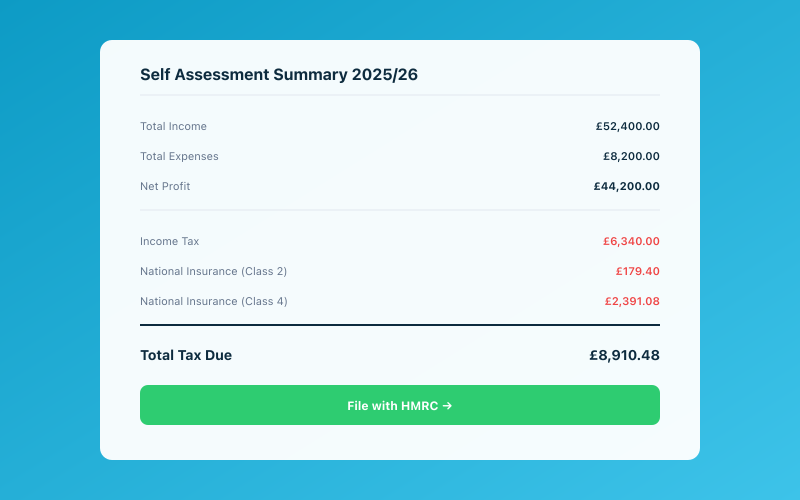 Your Accounted dashboard shows your real-time tax position
Everyone gets a nil-rate band (NRB) of £325,000, which is the amount that can pass tax-free. There is also a residence nil-rate band (RNRB) of £175,000, available when a main residence is passed to direct descendants. Anything above these thresholds is taxed at 40%.
For a business owner with a successful enterprise, the value of the business can easily push the estate well above these thresholds. Without BPR, the IHT bill could be devastating — potentially forcing the sale of the business to pay the tax.
How Business Property Relief Works
BPR reduces the value of qualifying business property for IHT purposes. The relief is available at two rates:
100% Relief
The full 100% relief applies to:
- A business or an interest in a business (for example, a sole trader's business or a partner's share in a partnership)
- Shares in an unlisted company (including shares traded on the Alternative Investment Market, AIM)
With 100% relief, the qualifying business property is effectively removed from the estate entirely for IHT purposes.
50% Relief
The reduced 50% relief applies to:
- Shares in a listed company where the deceased had a controlling interest
- Land, buildings, or machinery owned personally but used in a business in which the deceased was a partner or controlling shareholder
With 50% relief, half the value of the qualifying asset is removed from the estate.
Important Changes From April 2026
The government announced significant changes to BPR in the Autumn Budget 2024. From April 2026:
- The first £1 million of combined BPR and Agricultural Property Relief (APR) qualifying assets will continue to attract 100% relief
- Assets above £1 million will only qualify for 50% relief (effectively taxed at 20% rather than the full 40%)
- For AIM-listed shares, relief will be restricted to 50% from April 2026 (effectively a 20% IHT rate)
These changes represent a significant tightening of BPR for larger business estates. Business owners with qualifying assets worth more than £1 million need to review their estate planning.
Qualifying Conditions
To qualify for BPR, several conditions must be met:
Two-Year Ownership
The business property must have been owned by the deceased for at least two years immediately before death. There are limited exceptions — for example, if the property replaced other qualifying business property, the combined ownership period may count.
Trading Requirement
The business must be a trading business, not one that consists wholly or mainly of dealing in securities, stocks or shares, land or buildings, or making or holding investments.
This is the most common area of dispute with HMRC. A business that has accumulated substantial cash reserves or investment assets may fail this test. The question is whether the business is "wholly or mainly" one of holding investments — HMRC generally applies an 80/20 test, looking at factors such as:
- The proportion of assets used in trading vs held as investments
- The proportion of income from trading vs investment activities
- The proportion of time and effort spent on trading vs investment
- The overall context and history of the business
Binding Contract for Sale
BPR is not available if the business property is subject to a binding contract for sale at the date of death. This can catch people out if they are in the process of selling the business when they die.
What Does Not Qualify for BPR
Some assets are specifically excluded:
- Buy-to-let property portfolios — Holding residential property as investments does not qualify, even if managed actively.
- Businesses consisting mainly of investments — If the company primarily holds investments rather than trading, BPR will not apply.
- Excepted assets — Assets that are neither used for the business nor required for future use are excluded from the relief. For example, if a trading company holds £500,000 of surplus cash that is not needed for the business, that cash may not qualify for BPR.
The "excepted assets" rule is particularly important. HMRC will look at whether assets were used in the business in the two years before death or were required at the time of death for future use in the business. Surplus cash sitting in a bank account is a common target.
Planning for BPR
Effective BPR planning involves several considerations:
Keep the Business Trading
The most fundamental requirement is that the business continues to trade. If you are winding down operations, reducing trading activity, or accumulating investments, you risk losing BPR qualification. Regular review of the trading vs investment balance is essential.
Manage Surplus Cash
Excess cash in the business is one of the biggest risks to BPR. If HMRC determines that the cash is not needed for the business, it can be excluded as an excepted asset. Strategies to manage this include:
- Investing surplus cash back into the business
- Making pension contributions (for employed directors)
- Distributing surplus cash as dividends (which removes it from the company but adds it to your personal estate — so consider the overall IHT position)
- Using surplus cash for genuine business expansion
Consider the Two-Year Rule
If you are restructuring your business — perhaps incorporating a sole trade, or transferring assets between entities — be aware that the two-year clock restarts on the new structure. Plan restructuring well in advance to ensure the two-year period is satisfied.
Lifetime Gifts
Business property qualifying for BPR can be given away during your lifetime. If the gift qualifies for BPR at the time of transfer, it may be immediately free of IHT (rather than having to survive seven years, as with other potentially exempt transfers). However, the recipient must still hold qualifying business property at the date of the donor's death (or at the date of the recipient's earlier death) for the relief to be maintained.
Write a Suitable Will
Your will should be drafted with BPR in mind. Consider leaving business assets to beneficiaries who will benefit most from BPR (for example, those who will continue the business) and non-business assets to others (who can use the nil-rate band and RNRB).
For broader inheritance tax guidance, see our guide on inheritance tax and business relief.
BPR and AIM Shares
One of the most popular IHT planning strategies has been investing in AIM-listed shares that qualify for BPR. Many AIM companies are trading businesses, and their shares — being unlisted for IHT purposes — can qualify for 100% BPR after two years of ownership.
This has been widely used as an alternative to traditional IHT planning (such as trusts or insurance). However, the changes from April 2026, which restrict AIM share relief to 50%, will significantly reduce the attractiveness of this strategy. The effective IHT rate on AIM shares will be 20% rather than 0%.
Investors using AIM shares for BPR planning should review their portfolios in light of these changes.
BPR and Agricultural Property Relief
Agricultural Property Relief (APR) is a separate but related relief that applies to agricultural land and buildings. Where both BPR and APR apply to the same property, APR takes priority.
The April 2026 changes to the combined £1 million cap apply to both BPR and APR together, meaning that farmers with large holdings will be affected alongside business owners.
Record-Keeping for BPR
Demonstrating BPR qualification after death can be challenging, particularly if records are incomplete. Trustees, executors, and personal representatives need to show:
- The ownership period of the business assets
- The trading nature of the business
- That assets were used in the business (not excepted assets)
- The valuation of the business at the date of death
Keeping thorough, up-to-date records of your business activities and finances is one of the best things you can do for your estate planning. Accounted makes it easy to maintain clear financial records for your sole trade, and Penny can help ensure your bookkeeping is always current — which will make life much easier for your executors when the time comes.
Common Mistakes
- Assuming BPR will apply without checking — The rules are specific, and a business that was once qualifying can become non-qualifying if its activities change.
- Ignoring excepted assets — Surplus cash and non-business assets within the company are common reasons for BPR claims being reduced or denied.
- Failing to meet the two-year rule — Business restructuring, incorporation, or asset transfers can restart the clock.
- Not updating the will — As the business and personal circumstances evolve, the will should be reviewed to ensure it still works efficiently with BPR.
Related Reading
Protect What You Have Built
Business Property Relief is a powerful tool for protecting your business from IHT, but it requires proactive planning and good record-keeping. Do not leave it to chance — review your position regularly and keep your financial records in order.
Accounted helps UK sole traders stay on top of their bookkeeping and tax. Start your free 30-day trial at getaccounted.co.uk.
Further Reading
- Check the current income tax rates and allowances on GOV.UK.
- Tax planning strategies should be considered when filing your Self Assessment return.
- Check the Capital Gains Tax rules on GOV.UK.
Start your free trial and let Penny handle your bookkeeping automatically.
Penny, your AI bookkeeper, tracks your tax position in real time and flags opportunities to reduce your bill. Meet Penny →
Tax & Compliance Specialists
Our tax specialists have decades of combined experience in UK sole trader and small business taxation, MTD compliance, and HMRC submissions. All content is reviewed against current HMRC guidance before publication and updated quarterly to reflect legislative changes.
Ready to try Accounted?
Join UK sole traders who are simplifying their bookkeeping and tax.
Start your 14-day free trial